The quality of a GEO engagement is decided in the first week, before any measurement runs or any content is written. It is decided by how well you capture what the client actually is: what they sell, who they sell to, who they compete with, and what they can and cannot say. Get that right and everything downstream is sharp. Get it thin and everything downstream is vague.
All of that information lives in one place: the knowledge base. A knowledge base is a single, structured record of everything the AI engines need to know about the brand, so the work is grounded in the client's real facts rather than whatever the engines guessed about them. Building it well is the real work of onboarding, and it starts with collecting the right information from the client.
This article is a checklist of exactly what to gather from a new client before you start GEO, organized by the sections a good knowledge base needs. Collect these, and you begin from a position of strength. Skip them, and you spend the engagement correcting a foundation you should have set on day one.
Contents
- Why this matters more than it looks
- Red flags to watch for during onboarding
- How to actually collect it
- Where SixWings fits
- Frequently asked questions
Why this matters more than it looks
It is tempting to treat onboarding as a formality, a quick form to clear before the real work. It is the opposite. The information you collect now sets the ceiling for the quality of everything that follows.
Here is why. In GEO, the questions you test, the content you analyze, and the fixes you recommend are all grounded in the client's context. If that context is accurate and complete, the measurement is accurate, the analysis is sharp, and the recommendations are on-brand.
If it is thin or wrong, every step inherits the gap: you test the wrong questions, you miss the real competitors, and you risk producing content that makes claims the client would never approve.
There is also a trust dimension. A client who is asked thoughtful, specific questions at the start sees an agency that understands their business. A client handed a generic form sees a vendor. The onboarding conversation is your first delivery, and it sets the tone for the relationship.
So treat this checklist as the foundation of the engagement, not a box to tick. The hour you spend getting it right saves you from correcting the foundation for months.
1. Company identity
Start with the basics of who the company is, stated the way the company states it.
Collect the legal and trading name, the website, a clear one-line description of what the business does, and the markets and languages it operates in. This sounds obvious, but the point is precision: you want the exact way the company describes itself, because inconsistency between how they describe themselves and how they appear elsewhere is one of the things that weakens AI visibility.
Ask how they want to be referred to, the exact brand name, any sub-brands or product names, and whether there are old names still floating around that should be retired. Engines build their understanding of a brand from many sources, and a clear, consistent identity is what lets them connect everything as one brand rather than several.
What to ask the client: "How do you describe the company in one sentence? What are your main markets and languages? Are there any old names or spellings of the brand still out there?"
2. Products and services
Next, what the company actually sells, in enough detail to be useful.
Collect the full list of products or services, what each one does, who it is for, and what makes it distinct. You also want the current, accurate details that buyers care about and that AI answers often get wrong: pricing shape, key features, and what is and is not included. Outdated product information is a common source of inaccurate AI answers, so getting the current picture from the client directly is valuable.
Pay attention to anything that has recently changed, a renamed plan, a dropped feature, a new capability, because those are exactly the facts that old pages and third-party listings get wrong, and that the engines may still be repeating.
What to ask the client: "Walk me through your products or services. What does each one do, who is it for, and what makes it different? Has anything changed recently, pricing, features, names, that the market might not have caught up with?"
3. Audiences and ideal customers
Now who the company sells to, because this shapes the questions you will test.
Collect the ideal customer profiles: the roles, the company types and sizes, and the industries the client sells into. For each one, capture the problems that buyer is trying to solve and the language they use to describe those problems, in their words, not the company's internal jargon.
This matters because AI answers change depending on who is asking. A brand can be well represented for one kind of buyer and invisible for another. Knowing the real ICPs is what lets you later test how the brand appears to each of the buyers it actually cares about, rather than to a generic, nobody-in-particular audience.
What to ask the client: "Who are your main types of buyer? For each, what is their role, what kind of company are they at, and what problem are they trying to solve when they come to you? What words do they use for it?"
4. Competitors
You cannot measure a brand's position without knowing who it is measured against.
Collect the direct competitors, the ones a buyer would genuinely weigh the client against, and the indirect ones, the alternative approaches a buyer might consider instead. Get the real names, not an aspirational list. The point is accuracy: these are the brands you will look for in AI answers alongside the client, so a wrong or wishful competitor set produces misleading results.
Ask specifically which competitors the client loses deals to, and which ones they are most often compared with. Those are the ones whose presence in AI answers matters most, because they are the ones a buyer is choosing between.
What to ask the client: "Who do you actually compete with? Who do you lose deals to? When a buyer is comparing options, who else is on their list?"
5. Positioning and approved claims
This is where you capture how the company wants to be understood, and what it is allowed to say.
Collect the positioning: what the company wants to be known for, its main differentiators, and the specific, provable claims it stands behind. The emphasis is on specific and provable, because concrete, evidenced claims are what AI engines are willing to repeat, while vague boasts are not. "Cuts onboarding from weeks to days" is more useful than "the leading solution."
Gather the proof points too: numbers, named integrations, case studies, and any statistics the company can stand behind. These are the raw material for content that gets cited, and collecting them now saves hunting for them later.
What to ask the client: "What do you want to be known for? What are the specific, provable things you can say about yourselves, the numbers, the results, the facts, rather than the adjectives?"
6. The claims they must never make
As important as what the company can say is what it must not, and this is the section that protects both of you.
Collect the off-limits claims: anything the company is legally, contractually, or for compliance reasons not allowed to say, any superlatives it avoids, and any topics that need careful handling. For regulated clients especially, this is critical, because AI-assisted content that makes a forbidden claim creates real exposure, in the client's name.
Also capture any sensitivities specific to the brand: comparisons they will not make, competitors they will not name, or framing they want to avoid. These guardrails are what keep the content you produce later safe and on-brand.
What to ask the client: "What can you absolutely not say, for legal, compliance, or brand reasons? Are there claims, comparisons, or topics we should steer clear of entirely?"
7. Tone and guardrails
Finally, how the company sounds, so anything produced later matches its voice.
Collect the tone of voice: formal or conversational, technical or plain, and any words or phrases the brand favors or avoids. If the client has a brand or style guide, this is the moment to get it. Content that will represent the brand in AI answers has to sound like the brand, and capturing the voice now means you are not guessing later.
This section plus the previous two, the approved claims, the forbidden claims, and the tone, together form the guardrails that govern every piece of content you create in the engagement. They are what let you move fast later without going off-brand.
What to ask the client: "How should the brand sound? Are there words or phrases you always use, or ones you never use? Do you have a style or brand guide we can work from?"
8. Brand and competitor mention keywords
One more practical item that makes your measurement accurate: the exact words that count as a mention.
Collect the precise terms that should count as a mention of the client's brand, including sub-brands, product names, and common variations or misspellings, and do the same for the key competitors. This is what lets the measurement later correctly detect when the brand or a rival is named in an AI answer, rather than missing a mention because it used a variant spelling.
It is a small step, but it is the difference between measurement that catches every mention and measurement that quietly misses some.
What to ask the client: "What are all the ways your brand name appears, including product names and common misspellings? And the same for your main competitors?"
Red flags to watch for during onboarding
A few things tend to surface during onboarding that are worth catching early, because they shape the engagement.
Vague answers to "what makes you different." If the client can only answer in adjectives, leading, trusted, best in class, that is a sign their positioning is thin, which will show up later as weak AI visibility. It is also an early content opportunity: part of your job will be turning those adjectives into specific, provable claims.
An aspirational competitor list. Clients sometimes name the market leaders they want to be compared with rather than the rivals they actually lose deals to. Gently separate the two. The real competitors are the ones whose presence in AI answers matters.
Out-of-date information presented as current. When a client describes a plan or feature that changed a while ago, note it, because old versions are probably still circulating on third-party pages and in the engines' answers. These are often the first inaccuracies worth fixing.
No clear sense of off-limits claims. If the client has not thought about what they cannot say, especially in a regulated space, raise it now. It is far cheaper to establish the guardrails at onboarding than to discover them after content has gone out.
Catching these during onboarding does two things: it makes the knowledge base more accurate, and it surfaces early talking points that show the client you understand their business.
How to actually collect it
Knowing what to collect is half the job. Collecting it efficiently is the other half, and a little structure helps.
Pull what you can yourself first. A lot of the identity, product, and positioning information is already on the client's website and in their existing materials. Gather that before the call, so you are confirming and filling gaps rather than making the client recite things they have already written down.
Then run a focused onboarding conversation for the rest. The highest-value items, the real competitors, the off-limits claims, the recent changes, the proof points, are the ones that live in people's heads rather than on the website. A single well-run conversation, guided by the sections above, gets most of them.
Treat the client's review as part of the process. Once you have assembled the picture, a short review with the client to confirm the facts, claims, and guardrails are right is what turns a draft into an authoritative record. It also catches the things they forgot to mention and the things you misunderstood.
Do not wait for perfection to start. The record can be a working draft while you complete it, and it should be as complete and accurate as possible before it becomes the foundation the engagement runs on. Completeness is the goal, but a strong draft that gets refined beats an empty one that waits.
Where SixWings fits
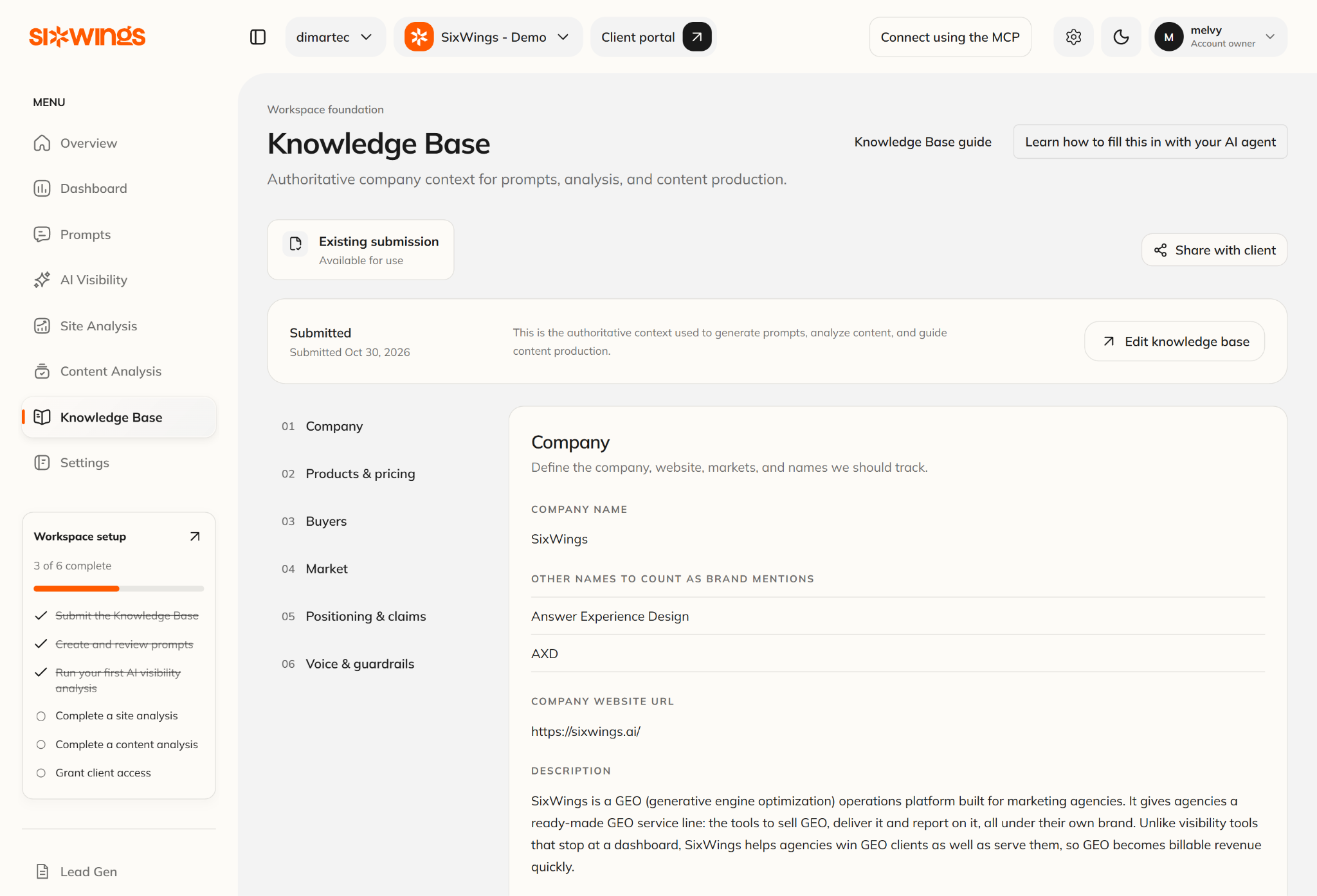
Everything in this checklist feeds the knowledge base, and in SixWings the knowledge base is the foundation the whole engagement is built on. Collecting this information well is what makes the platform's output sharp.
SixWings pioneered the Answer Experience Design model and built the platform that runs it. In plain terms, it is a fully white-labelled GEO operating system.
It measures how a brand shows up in AI answers, turns that raw data into prioritized recommendations and simple implementation briefs, and hands those to whoever executes, so the work is easy to act on. Think of it as an SEO toolkit, but for the AI-answer layer instead of Google rankings.
For onboarding specifically, the knowledge base is a guided build. It has a section for each part of this checklist, company identity, products, audiences, competitors, positioning and claims, guardrails, and mention keywords, with prompts for each, so collecting the client's context is structured rather than a blank page.
Once it is reviewed and submitted, it becomes the authoritative record that grounds everything downstream: the buyer questions you test across supported providers (currently OpenAI, Anthropic, Gemini, Perplexity, Grok, and Google's AI Overviews), the content analysis, and the content you produce, all of it held to the facts, claims, and guardrails you captured here.
This is also why the depth of the knowledge base is a deliberate difference in how SixWings works. Many tools scrape a client's website and let the AI guess the rest, which is quicker but thin, because the AI does not know the client's real competitors, their off-limits claims, or what makes them different. Capturing the detail properly up front is what makes everything the platform produces afterward accurate and on-brand.
The point is not that a tool collects the information for you. It is that a strong GEO engagement is built on a complete, accurate record of the client, and SixWings is built to hold that record and ground every later step in it.
Frequently asked questions
What is the single most important thing to collect from a new GEO client? There is no single item, but the highest-value ones are the real competitors, the off-limits claims, and any recent changes to products or pricing. These are the things that live in people's heads rather than on the website, and getting them wrong undermines the measurement and risks producing content the client cannot approve.
Why does onboarding matter so much for GEO specifically? Because everything downstream is grounded in the client's context. The questions tested, the content analyzed, and the fixes recommended all inherit the quality of the information collected at the start. A thin or inaccurate start produces thin or inaccurate results at every later step.
How long should client onboarding take? Most of the time goes into gathering and confirming the information rather than entering it. Pull what you can from the client's website first, run one focused conversation for what is not written down, and finish with a short client review. Treat it as the real work of the first week, not a quick form.
What if the client does not have clear answers to everything? Capture what they have and leave the gaps explicit rather than guessing. The record can be a working draft that you refine, but never invent facts, competitors, or claims to fill it, because the whole point is that the work is grounded in what is true about the client.
Which AI engines will the collected information be used against? The major generative answer surfaces buyers use today, including ChatGPT, Google's AI Overviews and Gemini, Perplexity, and Claude. The same client context grounds the work across all of them, which is why collecting it accurately once pays off across every platform.