It is now easy to see what an AI engine says about a brand. Ask ChatGPT, Perplexity, Gemini, Google's AI Overviews, or Claude a category question, read the answer, note whether the brand shows up and how it is described. A dozen tools will do this at scale and hand back a score.
Seeing the answer is not the valuable part. Deciding what to do about it is. The real work, the part that actually moves a brand's position inside AI answers, is choosing which single thing to address next: which prompt to target, which query beneath it, which source shaping it, which issue on the site, or which gap in the content. An answer is an observation. A decision is a piece of work with an owner and an outcome.
This article is about that translation, from answer to prioritised work. It walks through the five kinds of decision an AI answer can lead to, what each one looks like, and how to tell which one a given finding actually calls for. The premise throughout is simple: the value is not merely seeing an answer, it is deciding which prompt, query, source, site issue, or content gap should be addressed next.
Contents
- Why "seeing" is the easy 20% of the work
- Decision 1: Which prompt to target
- Decision 2: Which query beneath the prompt
- Decision 3: Which source to influence
- Decision 4: Which site issue to fix
- Decision 5: Which content gap to close
- How the five decisions connect
- Where SixWings fits
- Frequently asked questions
Why "seeing" is the easy 20% of the work
There is a reason so many teams get stuck at the answer. Seeing is genuinely easy now, and easy things feel like progress. But an answer on its own does not tell you what to change, and a pile of answers is not a plan.
The gap shows up the moment someone asks the obvious question: we can see we are weak here, so what do we actually do? A raw answer does not carry its own instruction. "We appear in 20% of answers" could lead to a content project, a technical fix, a source to influence, or nothing at all, depending on details the score alone does not surface. Without a way to turn the observation into a specific, owned action, the work stalls exactly where it should start.
There is also a discipline point that matters before any of the five decisions. Not every weak AI answer deserves work. Multi-brand teams cannot chase every prompt, mention, or citation gap, and trying to is how programs drown. The skill is not reacting to every finding. It is deciding which findings are worth a piece of work, and which kind of work each one calls for.
That is what the rest of this article is: the five kinds of work an answer can become, and how to tell them apart. Think of them as a progression, from the broad question a buyer asks down to the specific fix that changes the answer.
Decision 1: Which prompt to target
The first and broadest decision is which buyer questions to care about at all. In this discipline, a "prompt" is a real question a buyer asks an AI engine, and they are not equal in value.
The distinction that matters most is commercial intent. Discovery prompts ("best tool for X"), comparison prompts ("X versus Y"), and category-defining questions are where AI recommendations actually move a buying decision.
A brand can be perfectly visible on low-stakes informational questions and absent from the handful of high-intent prompts where a shortlist is formed. Presence is not uniform, and the value is concentrated.
So the first decision is a filter, not a dragnet. Out of everything a buyer might ask, which prompts sit closest to a purchase, and of those, where is the brand weak? A finding that the brand is missing from a top comparison prompt is worth more than being missing from ten peripheral ones. The evidence to make this call is specific: for each prompt, is the brand mentioned, is it cited, and is a competitor taking the slot instead.
An illustrative case: a brand appears in most "what is X" educational answers but vanishes from "best X for mid-market teams," the exact question its buyers ask before choosing. That single prompt, not the twenty easy ones, is the target. Naming it is the first piece of prioritised work, and everything downstream hangs off it.
The output of this decision is a short list of target prompts: the questions worth working on, chosen by commercial value and current weakness rather than by whichever ones were easy to check.
Decision 2: Which query beneath the prompt
A prompt is the buyer's question. Underneath it, an AI engine often runs its own web searches to build the answer, and those searches are a second, more precise decision layer.
These provider-issued queries are where a lot of the real influence sits, because they determine which pages the model even considers. Two brands can be targeting the same buyer prompt while the model is running completely different searches beneath it, pulling from different corners of the web. If you only look at the top-level prompt, this layer is invisible, and you end up guessing at what actually shapes the answer.
The decision here is which of those underlying queries are worth targeting. Beneath a valuable prompt, some searches repeat often, span multiple providers, and consistently surface the sources that decide who gets recommended. Those are the ones that matter. A query that appears once, for one provider, is noise. A query that recurs across providers and feeds the answer every time is a lever.
An illustrative case: beneath "best X for mid-market," the models repeatedly search for something like "X pricing for teams" and "X versus [competitor]." Those recurring queries, not the buyer prompt itself, are where the answer is really being decided, so they become the next unit of prioritised work.
The output is a focused set of target queries beneath the prompts that matter: the specific searches worth influencing, chosen by how often they recur and how directly they feed the answer.
Decision 3: Which source to influence
Queries lead to sources. When a model answers, it draws on specific pages, and those pages are usually not the brand's own. A large share of what shapes an AI answer comes from third-party domains: directories, review sites, publishers, and competitor pages. This is the decision layer closest to the actual cause of an answer.
The decision is which sources are worth acting on, and the first cut is by relationship. A cited page is either the brand's own, a competitor's, or a neutral third party, and each implies a different move. The brand's own page can be strengthened directly. A neutral third party might be worth earning a presence on. A competitor's page winning the citation is a signal about what the model currently trusts, and a map of what to counter.
The second cut is influence. A source that shows up across many queries, is cited frequently, and spans multiple providers is shaping the answer far more than one that appears once. Prioritising sources by how much they actually influence the answer, rather than treating every cited URL equally, is what keeps this from becoming an endless list.
An illustrative case: a single third-party "best tools" listicle turns out to be cited across several of the queries feeding a key prompt, and the brand is either absent from it or thinly described. Influencing that one page, by earning an accurate inclusion, changes the input to many answers at once. That is a high-leverage piece of work precisely because the source is doing so much of the shaping.
The output is a ranked set of target sources: the specific pages and domains worth influencing, chosen by their relationship to the brand and how much they actually move the answers.
Decision 4: Which site issue to fix
The first three decisions look outward, at prompts, queries, and sources. The fourth looks inward, at the brand's own website, because sometimes the reason a brand is not cited is that its own pages are hard for an AI engine to read, trust, or extract.
This is a different kind of finding. It is not "we are missing from this answer," it is "here is a technical reason we are hard to cite anywhere."
The relevant issues are specific and diagnosable: whether AI crawlers can access the site at all, whether machine-readable signals exist, whether structured data and metadata are clean, whether entities and claims are consistent across pages, and whether the content is laid out so an answer engine can lift a clear passage from it.
The decision is which of these issues to fix first, and the useful ordering principle is reach. A technical barrier that makes the whole site hard to crawl affects every answer and outranks a cosmetic issue on one page.
A guiding operating principle for the whole discipline applies especially here: make the brand's most important claims easy to retrieve, easy to verify, and hard to misstate. Site issues that block retrieval or verification of important claims are the ones to fix first.
An illustrative case: an audit finds the brand's key comparison page has no clear, extractable summary and inconsistent naming of its own product across the site. Until that is fixed, even a well-targeted source and content effort has a weaker page to point back to. The technical fix is the unglamorous but high-leverage next step.
The output is a prioritised list of site issues, ordered by how much each one limits the brand's ability to be read and cited, rather than by how easy it is to tick off.
Decision 5: Which content gap to close
The fifth decision is the one most people jump to first, and it is strongest when it comes last, informed by the other four. A content gap is a question buyers ask, and answers care about, that the brand has not addressed well enough to be cited for.
Content gaps come in two forms, and the distinction changes the work. The first is a missing-topic gap: there is no page that addresses the question at all. The second is subtler and often missed: the content exists but is not structured for citation. A page can cover the right topic and still be passed over because it lacks a clear definition near the top, a direct answer, a comparison table, or extractable structure. The topic is present; the citable form is not.
The decision is which gap to close next, and this is where the earlier decisions pay off. A content gap tied to a high-intent target prompt, where a competitor is currently cited and an influential source is shaping the answer, is worth far more than a gap on a peripheral topic.
Mapping each gap back to the specific prompts and queries it would affect is what turns a generic list of content ideas into a prioritised plan. Without that mapping, content work is just guessing at what to publish.
An illustrative case: the target prompt is "best X for mid-market," the models keep searching "X versus [competitor]," and the brand has no clear comparison content of its own, so the model uses the competitor's framing. The gap is not "write more blog posts." It is one specific, well-structured comparison page that answers the exact question the models are asking. That precision is only possible because the first four decisions pointed at it.
The output is a short, ranked content plan where each item is tied to a real prompt, a real query, and a real gap, rather than a content calendar built on hunches.
How the five decisions connect
The five decisions are not a menu to pick from at random. They are a progression, and their power is in the sequence.
A target prompt tells you which buyer question matters. The queries beneath it tell you what the model actually searches to answer it. The sources tell you which pages are shaping that answer today. The site issues tell you whether the brand's own pages can even compete. And the content gap tells you what to build or fix so the answer changes next time.
Each decision narrows the last: from a broad question, down to the searches, down to the pages, down to the specific fix.
This is why "just make more content" so often fails. It jumps straight to the fifth decision without the four that tell you which content, structured how, aimed at which question, to counter which source. The content might be good and still change nothing, because it was not pointed at anything specific.
It is also why the raw answer, on its own, is not enough. The answer is the input to this chain, not the output. The output is a single, defensible decision: this prompt, this query, this source, this issue, or this gap, next, and here is why. That decision is the thing a client is actually paying for, and it is the thing a pile of AI answers cannot produce by itself.
One caution keeps the whole chain honest. Confidence should scale with evidence. A finding that shows up once, for one provider, is directional and worth watching. A finding that repeats across prompts and providers is confirmed and worth acting on. A finding that involves a reputation, accuracy, or compliance problem is urgent regardless of frequency. Treating a one-off blip as if it were a confirmed pattern is how teams waste effort on work that was never a priority.
Where SixWings fits
Everything above is a method for turning answers into decisions. SixWings pioneered the Answer Experience Design model and built the platform that runs that method.
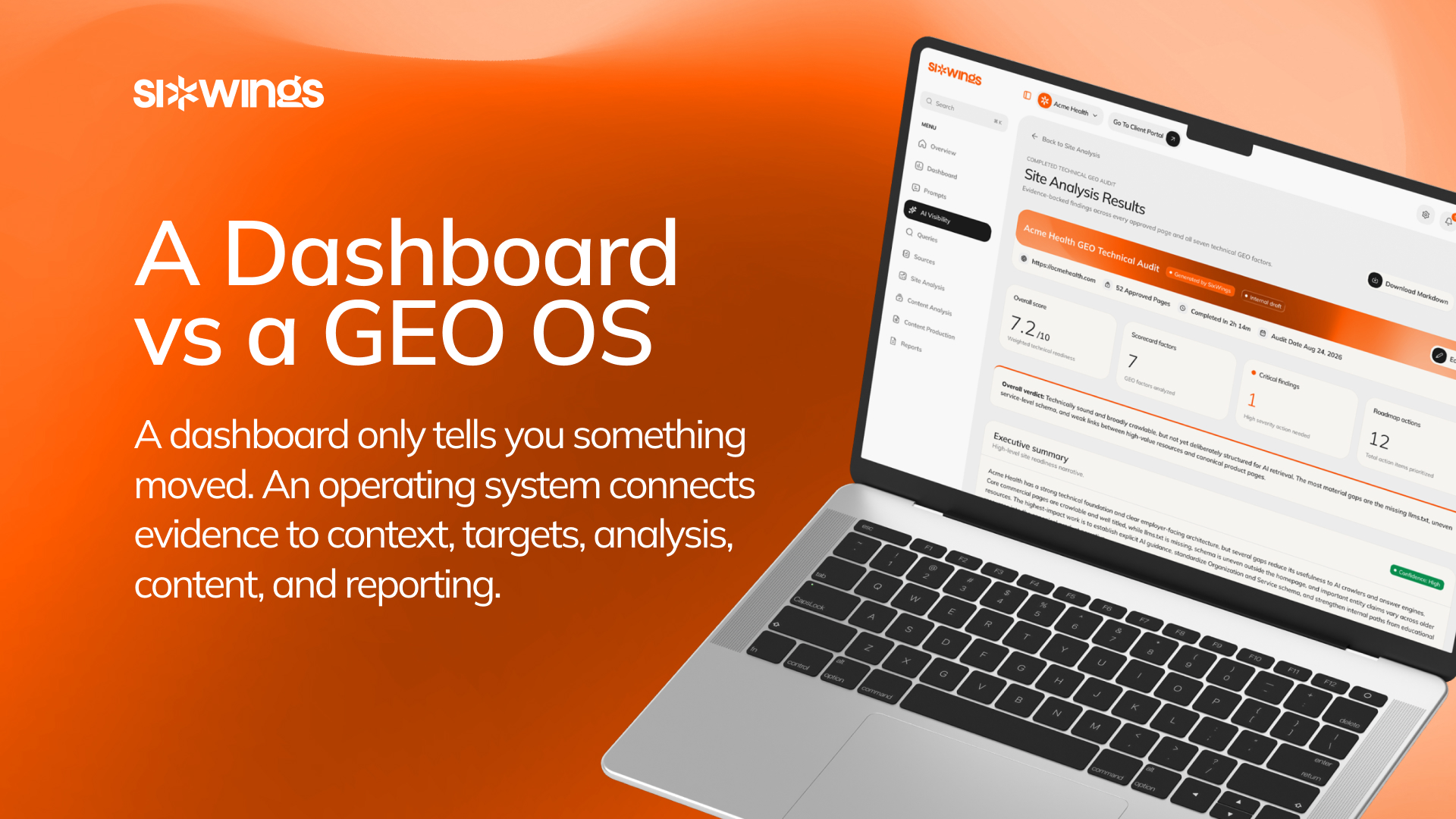
In plain terms, SixWings is a fully white-labelled GEO operating system. It measures how a brand shows up in AI answers, turns that raw data into prioritized recommendations and simple implementation briefs, and hands those to whoever executes, an in-house team or an external one, so the work is easy to act on. Think of it as an SEO toolkit, but for the AI-answer layer instead of Google rankings, and built to produce decisions rather than just observations.
The five decisions in this article map directly onto how SixWings works:
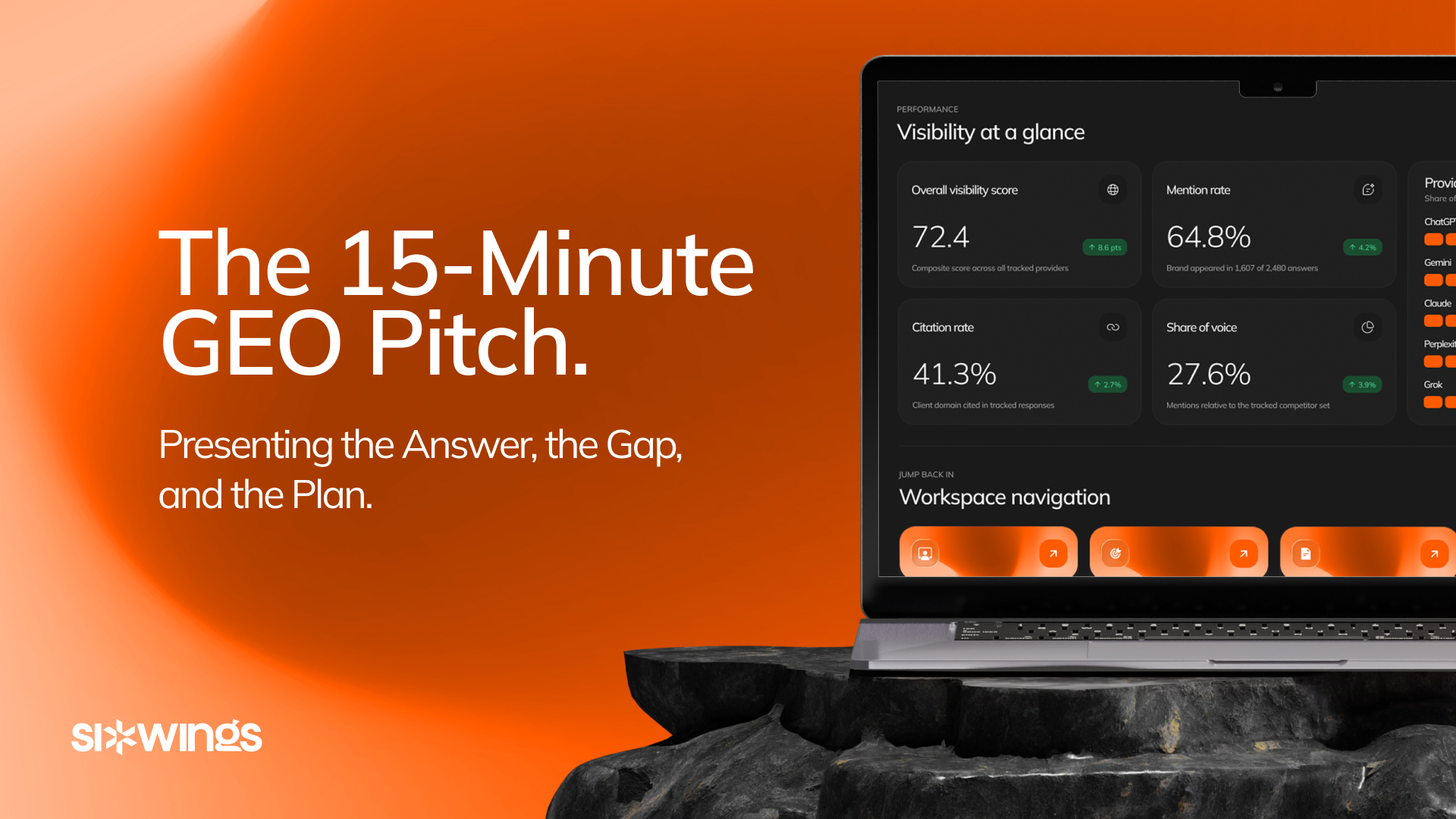
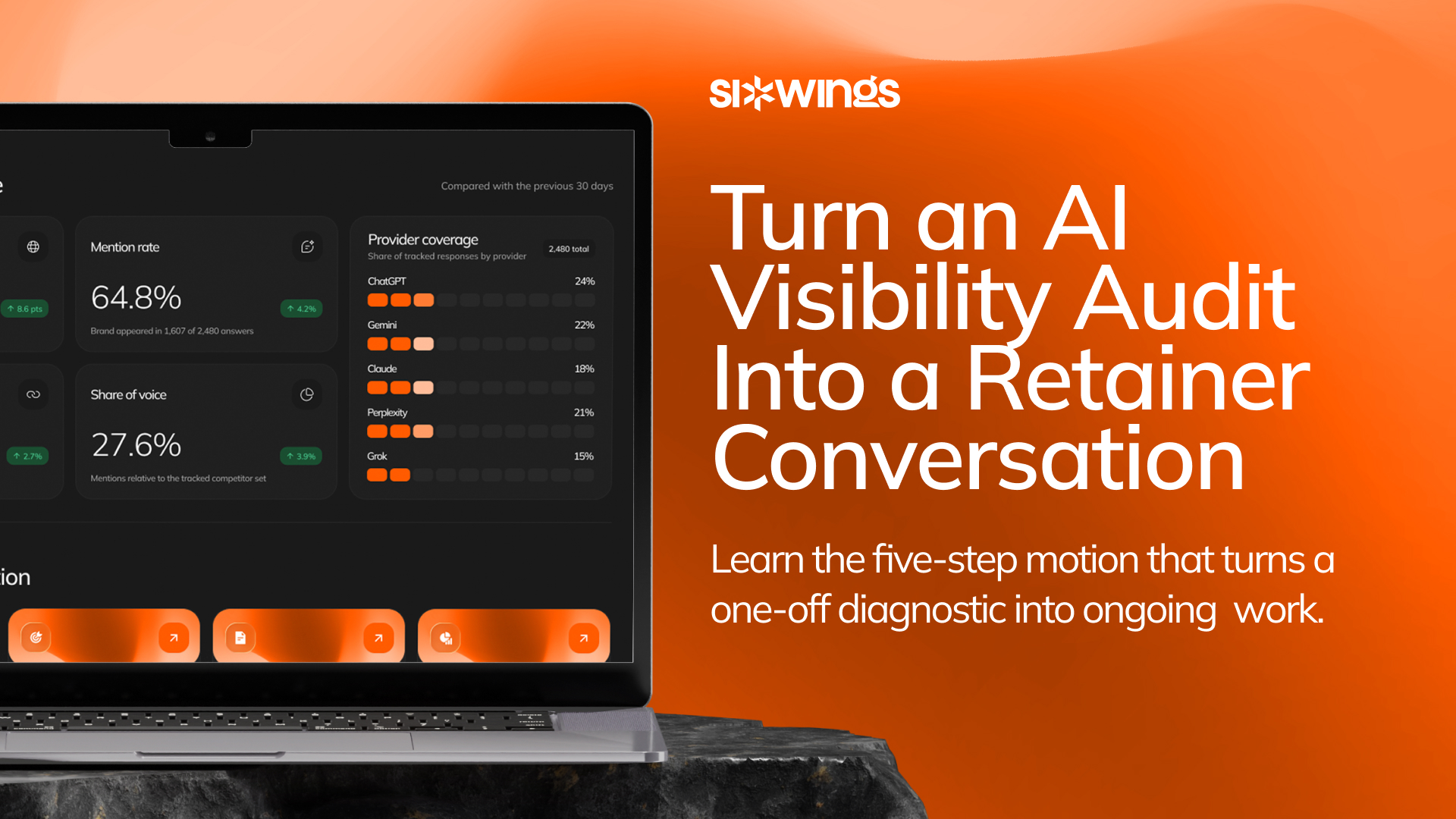
- Target prompts. It generates buyer-relevant prompts grounded in the brand's own context, runs them across supported providers (currently OpenAI, Anthropic, Gemini, Perplexity, and Grok), and lets you shortlist the prompts that matter by commercial intent and by whether the brand or a competitor was mentioned or cited.
- Target queries. It captures the provider-issued searches beneath those prompts, so the recurring, high-coverage queries feeding the answers become their own target list.
- Target sources. It keeps the sources behind each answer and lets you prioritise them by relationship to the brand and by how often they shape the result.
- Site issues. It produces a bounded technical audit of the site against the specific factors that make a brand hard to read and cite.
- Content gaps. It analyses existing pages and the wider content set against the brand's context, so gaps are identified in a form ready to become governed content work, with human approval before anything ships.
The connective tissue is the part that matters most. Rather than leaving a team to interpret a pile of data, SixWings does the prioritizing, distilling the evidence into the short list of prompts, queries, sources, issues, and gaps that deserve work next. That removes the decision fatigue and the hours normally lost to figuring it out, and the result can be shared through a custom-branded portal so the decision, not just the data, reaches the client.
The point is not that a tool sees more answers. It is that the value was never in seeing the answer. It is in deciding what to do next, and SixWings was built to produce that decision.
Frequently asked questions
Isn't seeing what AI says about a brand the main thing? It is the starting point, not the value. Seeing an answer is easy and widely available now. The work that actually changes a brand's position is deciding which specific thing to address next, a prompt, a query, a source, a site issue, or a content gap, and that decision is what a raw answer cannot produce on its own.
Why five decisions instead of just "make better content"? Because content is only the last of five, and it fails when it skips the other four. Good content aimed at the wrong question, structured in a way answer engines cannot extract, or ignoring the source actually shaping the answer, changes nothing. The first four decisions are what make the fifth precise.
How do you decide which findings are worth acting on? By commercial value and by evidence strength. A weakness on a high-intent buyer prompt matters more than one on a peripheral question, and a pattern that repeats across prompts and providers is more actionable than a one-off blip. Not every weak answer deserves work, and confidence should scale with how consistently a finding appears.
What is the difference between a prompt and a query here? A prompt is the question a buyer asks the AI engine. A query is a search the engine itself runs to build its answer. A single buyer prompt can sit on top of several provider queries, and those queries are often where the answer is really decided, which is why they are a separate decision layer.
Which AI engines does this apply to? The major generative answer surfaces buyers use today, including ChatGPT, Google's AI Overviews and Gemini, Perplexity, and Claude. Because each behaves differently and can search and cite different sources, the evidence is kept per provider rather than blended into one universal number.