When you check how a client shows up in AI answers, two different things can happen, and they are easy to confuse. The engine can name the brand in its answer. Or it can use one of the brand's pages as a source and link to it. These are not the same event, and treating them as one number hides the thing your client actually needs to know.
A mention is being talked about. A citation is being trusted as a source. A brand can get one without the other, and each tells you something different about where it stands and what to do next.
This article is for agencies reporting GEO to clients. It explains what a mention is and what a citation is, the four combinations the two can produce, and why keeping them separate makes your reporting sharper and your recommendations clearer. If your report shows a single blended "visibility" number, you are hiding exactly the distinction a client needs to act on.
Contents
- What a mention is
- What a citation is
- Why they are not the same thing
- The four combinations, and what each one means
- A worked example
- Why both matter for your clients
- Why both matter for your reporting
- The reporting mistakes to avoid
- Where SixWings fits
- Frequently asked questions
What a mention is
A mention is when an AI answer names the brand in the text it shows the user. Someone asks an engine a question in the brand's category, and the brand's name appears in the response. That is a mention.
Mentions are about presence in the conversation. If a buyer asks "what are the best tools for X" and your client is named in the list, your client is in the room. The engine considered them worth talking about, which is the first thing any brand needs.
A useful way to measure this across a set of questions is the mention rate: out of all the questions you test, in how many does the brand get named. If a brand is mentioned in 30 out of 100 buyer questions, that is a 30% mention rate. It is a simple, honest measure of how often the brand shows up at all.
One thing to hold onto: a mention says the brand was named. It does not say the engine pointed to the brand's own website as the reason. That is what a citation covers.
What a citation is
A citation is when the answer uses a specific page as a source and shows it, usually as a link or a reference next to a claim. The engine is not just talking about something; it is saying "this is where that came from."
Citations are about being a trusted source. When an engine cites a page, it is leaning on that page to support what it just said. For a brand, a citation of its own page means the engine treated that page as evidence worth standing behind, not just background it half-remembered.
This matters for a reason that is easy to miss: the page an engine cites is often not the brand's own. Engines pull from across the web, so a citation behind an answer about your client might point to a directory, a review site, a publisher, or a competitor's page. A citation tells you which source shaped the answer, and that source has an owner.
So a mention is the brand being named. A citation is a page being used as a source. Keep those two sentences apart and most of the confusion disappears.
Why they are not the same thing
The reason mentions and citations split apart is in how an AI answer gets built. The engine writes its answer from a mix of things: what it already knows, and the live pages it pulled in for this specific question. The name it drops and the source it links are chosen by different parts of that process.
A brand can be named from the engine's general knowledge, without any page being cited, because the engine simply knows the brand exists in this category. And a brand's page can be cited as a source behind a claim, even in a sentence where the brand itself is not the one being named.
Because the two come from different places, they move independently. A brand can climb in mentions while flat on citations, or the reverse. Collapsing them into one score averages away the signal, and the signal is what tells you what to fix.
This is why the single blended "visibility score" you see in some tools can mislead. It is usually a mention measure wearing a broader name. It tells you the brand gets talked about, but it says nothing about whether the brand is being used as a source, which is a different and often more valuable position.
There is a timing difference too. Mentions can lag reality, because a brand named from the engine's general knowledge is being recalled from what the model learned during training, which may be months old.
Citations tend to reflect the live web, because they come from pages the engine pulled in for this question. So a brand can be mentioned for what it used to be and cited for what it is now, which is one more reason the two are worth reading separately.
The four combinations, and what each one means
Because a brand can have a mention, a citation, both, or neither, there are four situations to recognize. Each one means something different for your client, and each points to a different next move.
Mentioned and cited. The strongest position. The engine names the brand and points to the brand's own page as a source. The brand is both in the conversation and trusted as evidence. The job here is to protect and extend it: keep the cited pages accurate and current, and win the same position on more questions.
Mentioned but not cited. The brand is named, but the source behind the answer is someone else's page, or no page at all. This is common and important.
The brand has presence but is not yet the evidence the engine leans on, which means a competitor's page or a third-party site may be doing the work. The move is to make the brand's own content strong and clear enough to become the cited source, not just the named one.
Cited but not mentioned. The brand's page is used as a source, but the brand is not named in the visible answer. The brand is quietly influencing what the engine says without getting the on-screen credit. This is a real position: the content is trusted enough to be used, so the work is to make the brand's role in that content clearer, so being the source also earns being named.
Neither mentioned nor cited. The brand is absent on this question. Not in the conversation, not in the sources. This is the clearest gap, and it is where the biggest opportunities often sit, because there is room to move from a standing start. The move is to understand which sources are being used instead, and to build the presence and the content to break in.
Naming the combination is what turns "we are not doing well here" into a specific instruction. Each of the four has a different fix, and you cannot choose the fix without first seeing which of the two things, the mention or the citation, is missing.
A worked example
It helps to make this concrete. Picture a client that sells project management software, and the buyer question "best project management tool for agencies."
On that question, the engine names your client in its list of options. That is a mention. But when you look at the source behind the recommendation, the engine has cited a third-party "best tools" article, not your client's own page. That is mentioned-but-not-cited, and it tells you something specific: your client is in the conversation, but a publisher's page is the evidence, not theirs.
Now look at a second question, "project management software with time tracking." Here the engine does not name your client at all, but it cites your client's feature page as a source for a claim about time tracking. That is cited-but-not-mentioned. The content is trusted, but the brand is not getting the on-screen credit.
Two questions, two very different situations, two different fixes. On the first, the work is to make your client's own comparison content strong enough to become the cited source. On the second, it is to make the brand's role in that feature page clearer, so being the source also earns a mention. A blended visibility score would have flattened both into one number and told you none of this.
Why both matter for your clients
For a client, the two metrics answer two different business questions, and both matter.
Mentions answer "are we in the consideration set?" When a buyer asks an engine for options and your client is named, the client has entered the shortlist that forms inside the answer, often before any website is visited. Being named is how a brand gets considered at all, so mentions map to awareness and presence.
The simplest way to put it to a client is this. A mention means the AI is willing to talk about you. A citation means the AI is willing to rely on you. Those are different levels of trust, and most brands have plenty of the first and far too little of the second.
Citations answer "are we shaping what the engine says, and can we influence it?" A cited page is a lever. If your client's own page is the source, the client has direct control over the evidence behind the answer, because improving that page can improve the answer. If a competitor's page is the cited source instead, that is where the influence currently sits, and that is what the client is up against.
There is also a durability difference worth explaining to clients. A mention that rests on the engine's general knowledge can be vague or slow to update.
A position built on cited, well-maintained pages is more within the client's control, because the client owns the source. Helping a client move from "mentioned" to "mentioned and cited" is helping them move from being talked about to shaping the conversation.
Why both matter for your reporting
For an agency, keeping mentions and citations separate is what makes a GEO report a decision document rather than a vanity chart.
A single blended number cannot be acted on. If the report says "visibility is 34," and a client asks what to do about it, there is no answer in the number. If the report shows mentions and citations separately, broken down by question, the answer is right there: the brand is well mentioned but rarely cited on comparison questions, so the work is to make its comparison pages citable.
Separating the two also lets you show honest, specific progress. "We moved you from mentioned-but-not-cited to mentioned-and-cited on your top ten buyer questions" is a sentence a client understands and values. It is concrete, it ties to work you did, and it is far stronger than a score that drifts up and down for reasons nobody can explain.
It protects your credibility too. Clients are getting more sophisticated about AI visibility, and a report that blurs mention and citation into one figure invites the question you do not want: "what does this number actually measure?" A report that distinguishes them answers that question before it is asked, and signals that you understand the surface you are being paid to manage.
The practical rule is simple. Report the mention rate and the citation evidence as two things, segmented by the questions that matter, and end with what the combination tells you to do next. That is a report a client can act on, and renew for.
The reporting mistakes to avoid
A few predictable mistakes undo the value of separating the two metrics.
The first is reporting one blended number and calling it visibility. It usually measures mentions and buries citations, so the client learns they are talked about but not whether they are shaping answers. Report the two as distinct figures.
The second is reporting the metrics without segmenting them. A brand can be well cited on early, educational questions and absent on comparison questions, which is a completely different commercial position than the reverse. Mentions and citations only become actionable when they are broken down by the type of question a buyer asks.
The third is treating a single run as a trend. AI answers rebuild constantly, so a mention or citation count from one moment is a snapshot, not a direction. Comparisons hold only when the same questions are run the same way and each period is a fixed point in time.
The fourth is ending the report at the numbers. Mentions and citations are the evidence, not the conclusion. A report a client renews for ends with what the combination means and what to do next, in priority order.
Where SixWings fits
Seeing mentions and citations as separate signals, across every engine and every question, by hand, is not realistic at any scale. This is the kind of evidence SixWings is built to capture and keep.
SixWings pioneered the Answer Experience Design model and built the platform that runs it. In plain terms, it is a fully white-labelled GEO operating system.
It measures how a brand shows up in AI answers, turns that raw data into prioritized recommendations and simple implementation briefs, and hands those to whoever executes, so the work is easy to act on. Think of it as an SEO toolkit, but for the AI-answer layer instead of Google rankings.
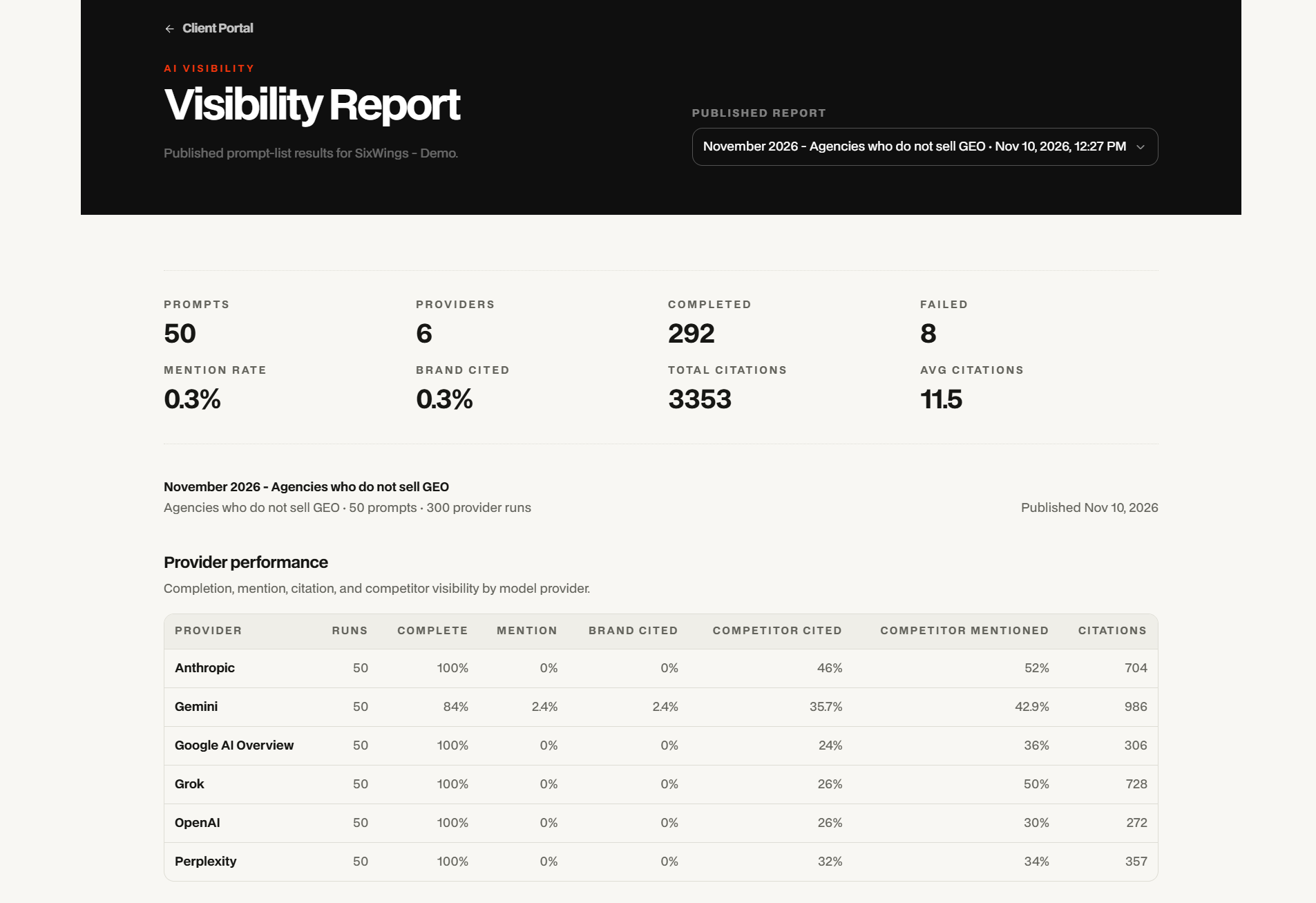
For the mention-versus-citation distinction specifically, it keeps both as distinct signals. It runs real buyer questions across supported providers (currently OpenAI, Anthropic, Gemini, Perplexity, and Grok, with Google's AI Overviews covered through the Gemini provider that powers them).
For each answer, it records whether the brand was mentioned, whether it was cited, which competitors were mentioned or cited instead, and which pages the engine drew on.
That evidence is what lets you report the two separately and act on the gap between them. Rather than leaving you to interpret it, SixWings does the prioritizing, distilling the evidence into the questions, pages, and sources that matter most and turning them into a ranked plan.
Results reach the client through a custom-branded portal, with reporting periods frozen into fixed snapshots, so your agency shows mentions and citations as the distinct, defensible metrics they are, under your own brand.
The point is not the score. It is that a mention and a citation mean different things for your client, and a report worth paying for keeps them apart.
Frequently asked questions
What is the difference between a mention and a citation in an AI answer? A mention is when the engine names the brand in the text of its answer. A citation is when the engine uses a specific page as a source and shows it, usually as a link. One is being talked about; the other is being trusted as evidence. A brand can have either without the other.
Can a brand be cited without being mentioned? Yes. The engine can use a brand's page as a source behind a claim without naming the brand in the visible answer. The brand is influencing what the engine says without getting on-screen credit, which is a real position worth improving so the source also earns a mention.
Isn't a high visibility score enough to report to a client? No, because a single blended score usually measures mentions and hides citations. It tells a client they are talked about but not whether they are shaping the answer. Reporting the two separately, by question, is what makes the report something a client can act on.
Which matters more, mentions or citations? Both, because they answer different questions. Mentions tell you whether the brand is in the consideration set. Citations tell you whether the brand, or a competitor, is shaping the evidence behind the answer. The strongest position is being both mentioned and cited on the questions that matter most to buyers.
Which AI engines do you track mentions and citations on? The major generative answer surfaces buyers use today, including ChatGPT, Google's AI Overviews and Gemini, Perplexity, and Claude. Because each names and cites differently, mentions and citations should be tracked per provider rather than blended into one universal number.