An AI visibility audit is one of the most persuasive things you can put in front of a prospect right now. It answers a question they are already asking themselves: when someone asks ChatGPT, Perplexity, Gemini, or Google's AI Overviews about our category, do we show up, and what does the AI say about us? Most brands genuinely do not know the answer, and the moment they see it, the conversation changes.
But an audit on its own does not create a retainer. It creates a reaction. The single most common waste in this kind of work is a client who buys or receives an audit, nods at the findings, and then never acts on them. The audit told them what was wrong. It did not get anything fixed.
The difference between an audit that impresses and an audit that converts is the sequence around it. This article walks through that sequence step by step: audit, findings, gap, plan, retainer. It also shows how SixWings, the platform behind the Answer Experience Design model, makes each step faster to run and easier to turn into ongoing work. The goal is not a better slide. It is a natural path from "here is what we found" to "here is the work, let's begin."
Contents
- Why the audit is the right wedge
- Step 1: Run an audit that produces evidence, not opinions
- Step 2: Present findings the prospect can feel
- Step 3: Name the gap in the prospect's own terms
- Step 4: Turn the gap into a prioritized plan
- Step 5: Make the retainer the obvious next step
- Where SixWings fits
- Frequently asked questions
Why the audit is the right wedge
Before the sequence, it helps to understand why the audit works as an opening move at all.
A category pitch asks a prospect to believe a general claim: AI search matters, you should invest. An audit does something stronger. It shows the prospect their own situation, with their own brand name in it.
A 60-minute look at how a specific company appears in AI answers is more persuasive than any deck, because it is about them, not about the trend.
The demand is already there. Web traffic referred from AI engines has grown sharply, and clients are noticing it in their analytics and raising it in their follow-up meetings. The problem is that the tools most teams already use for SEO do not measure AI visibility natively, so the prospect has a live question and no way to answer it. The audit fills that exact gap.
There is one discipline to hold onto from the start. An audit only becomes a retainer if it is built to lead somewhere. An audit run as a standalone favor tends to end as a standalone favor. Run it as the first step of a defined path, and every part of it can point toward the work that follows.
Step 1: Run an audit that produces evidence, not opinions
The first step is the audit itself, and the quality bar is simple: it has to produce evidence a prospect cannot argue with, not opinions they can wave away.
A weak audit says "your AI visibility could be better." That is an opinion. It invites debate and commits to nothing.
A strong audit shows the actual AI answers about the brand: the specific questions asked, whether the brand was mentioned, whether it was cited as a source, which competitors appeared instead, and which pages the models drew from. That is evidence. It ends the debate before it starts, because the prospect is looking at real output about their own company.
A few things make an audit evidentiary rather than anecdotal.
It has to cover a real set of buyer questions, not three cherry-picked prompts. A handful of queries is statistically thin and easy to dismiss. A meaningful battery of the questions a buyer would actually ask is what makes the result credible.
It has to run across the major AI answer surfaces, because a brand can look fine on one and be invisible on another. Reporting per provider is what keeps the finding honest.
And it has to capture the sources behind the answers, because that is the layer that later becomes the plan. Knowing a brand is absent is a finding. Knowing which competitor page or directory is being cited instead is the beginning of a fix.
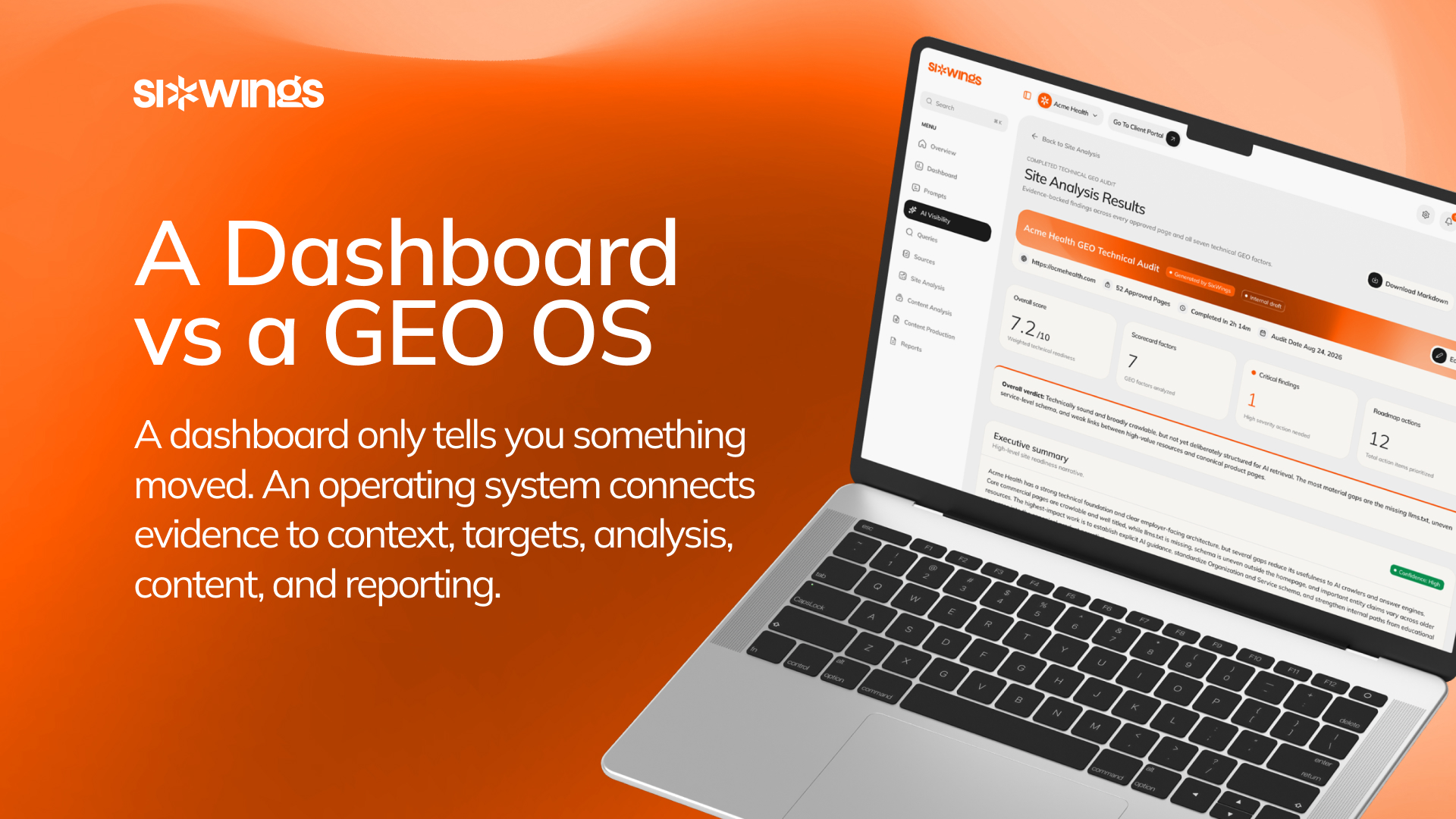
How SixWings helps. This is exactly the kind of run SixWings is built to produce. Working from a record of the brand's own facts and positioning, it generates buyer-relevant questions, runs them across supported providers (currently OpenAI, Anthropic, Gemini, Perplexity, and Grok), and preserves the full evidence behind every answer: the question, the response, brand and competitor mentions, citations, and the sources the models retrieved. It can also produce a bounded technical audit of the brand's site, checking the specific reasons AI engines find a page hard to read and cite. The output is evidence, not adjectives, which is precisely what step one needs.
Step 2: Present findings the prospect can feel
The second step is presentation, and it is where most audits quietly lose their power. The findings can be correct and still land flat if they arrive as a wall of data.
The aim is for the prospect to feel the finding, not just read it. That comes from three moves.
Lead with one headline they will remember. Usually it is a number about their absence or their standing. For context, benchmarks in 2026 suggest an average brand appears in only around 17% of relevant prompts, while the strongest brands in a category reach well over half. Placing the prospect on that scale, in a single sentence, does more than a page of charts.
Make it competitive. A brand's own visibility in isolation is abstract. The same number next to a named rival is visceral. "You appear in 12% of these buyer questions; your closest competitor appears in 48%" is a sentence a prospect cannot un-hear. Interestingly, a brand sitting at or near zero share of voice is not the hardest sell. It is often the strongest argument, because it means every action has room to show measurable movement from a standing start.
Show, do not summarize. The most persuasive moment in an audit review is often reading the prospect the actual AI answer, out loud, where a competitor is recommended and they are not, or where a fact about them is wrong. That single concrete example carries more weight than the aggregate score above it.
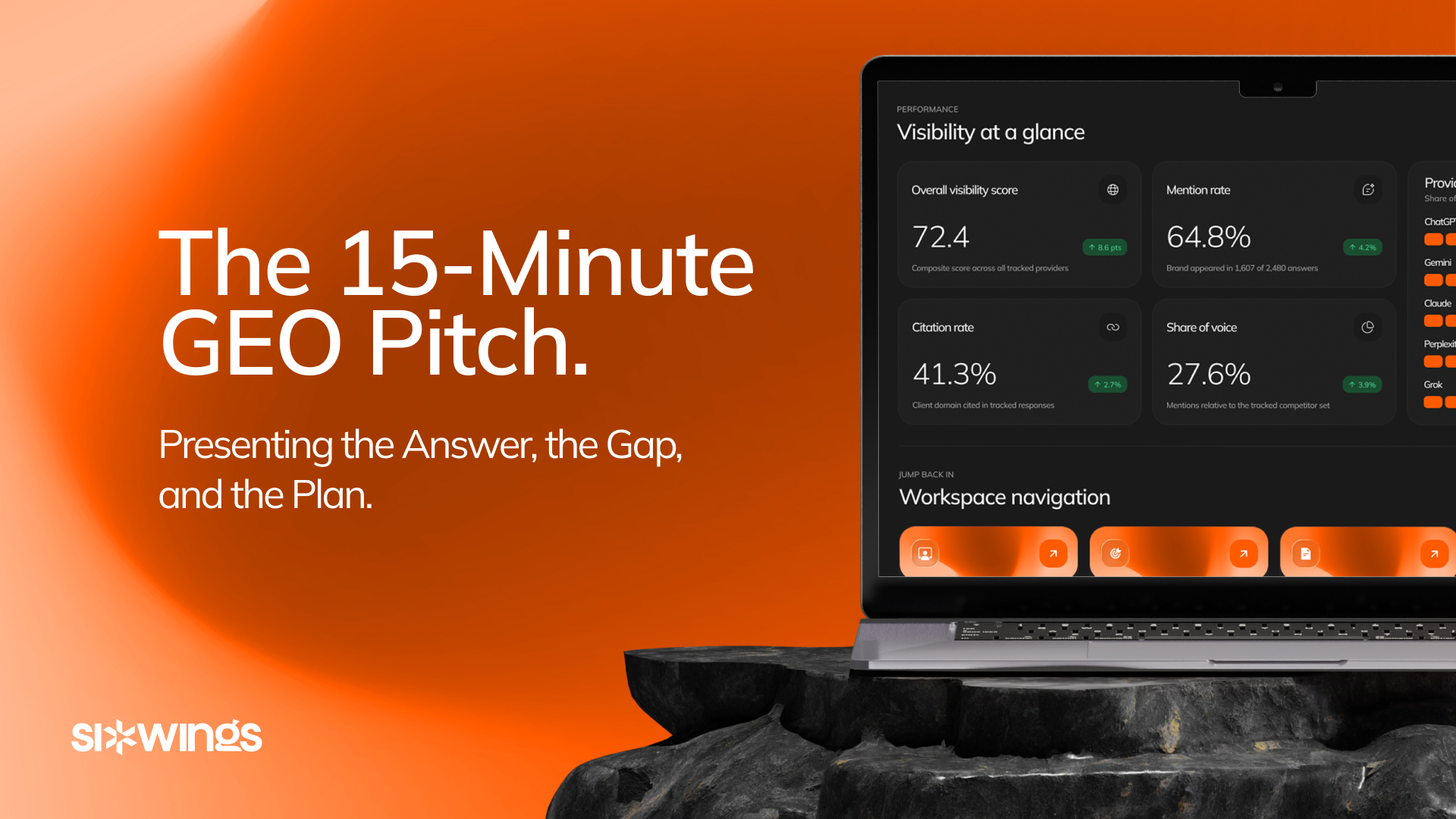
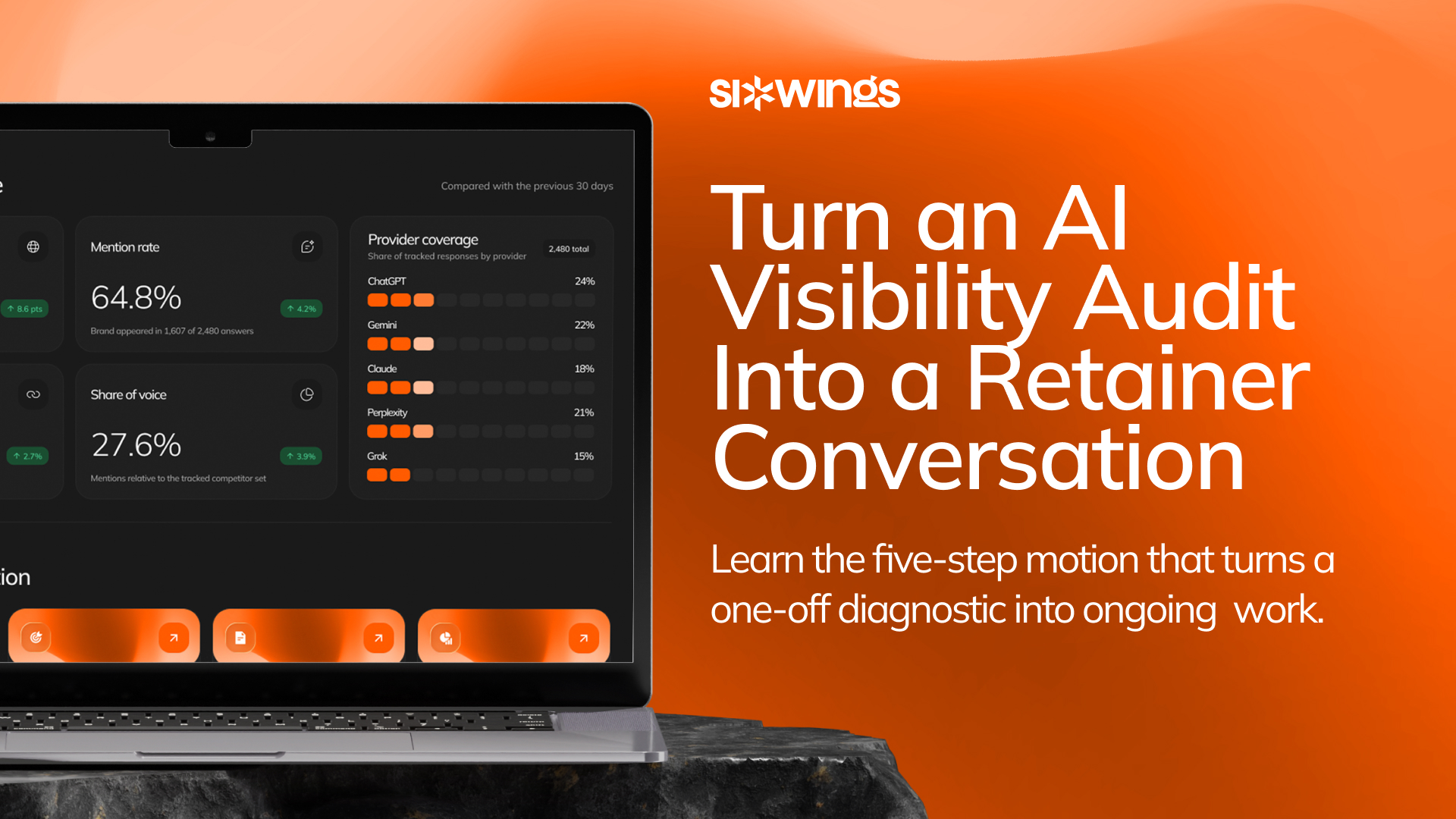
How SixWings helps. Because SixWings keeps the underlying evidence, the findings are ready to present at both altitudes: the headline mention rate per provider, the competitor comparison on the same questions, and the exact answers and citations underneath. You are not manually stitching screenshots together the night before. The material to make the prospect feel the gap is already captured and structured.
Step 3: Name the gap in the prospect's own terms
The third step is the pivot from findings to meaning. Findings describe a state. A gap describes a cost. The retainer conversation only opens once the prospect understands the gap as something happening to their business, not a score on a report.
Naming the gap well means translating the evidence into the prospect's own language and stakes.
Connect it to the buyer's journey. If the brand is absent from comparison and decision questions specifically, that is not a visibility problem in the abstract. It is a shortlist problem: buyers are forming their consideration set inside these answers, and the brand is not in it. Frame the gap where it actually bites.
Connect it to competitors concretely. The gap is not "we could do better." It is "these specific rivals are being recommended in answers where we are not, on questions our buyers are asking today." That is a gap with a name and a face.
Connect it to what standard analytics miss. Part of why the gap is dangerous is that it is invisible in the tools the prospect already trusts. Their SEO dashboard can look healthy while this is happening, because the loss forms inside an answer, off their site. Naming that blind spot is often the moment the prospect realizes they need help they do not currently have.
The tone here matters. The goal is clarity, not fear. You are not warning of doom; you are showing a prospect a real, specific gap between where they are and where a competitor already is, on a surface that is growing. That is motivating on its own without any pressure.
How SixWings helps. The evidence chain is what lets you name the gap precisely rather than vaguely. Because each answer is tied to its provider, its competitors, and its sources, you can point to the exact questions where the brand loses, the exact rivals winning them, and the exact pages shaping the result. The gap stops being "your AI visibility is low" and becomes "here, specifically, is where and why you are losing."
Step 4: Turn the gap into a prioritized plan
The fourth step is the bridge that most audits are missing, and its absence is why so many audits die on the shelf. A gap creates urgency. A plan creates a path to act on it. Without the plan, the urgency has nowhere to go and fades within a week.
A plan that converts has a few properties.
It is prioritized, not exhaustive. A list of forty things is paralyzing. A short, ranked list of what to do first, ordered by impact against effort, is a decision the prospect can actually make. Every finding should carry a sense of severity and the size of the lift, so the sequence is obvious.
It separates the quick wins from the strategic plays. Some fixes are fast: a wrong fact corrected at its source, a thin page strengthened, a technical barrier removed.
Others are longer arcs: building the authority and content that earn citations over months. Showing both tells the prospect there is something to gain immediately and something worth committing to over time. That combination is what makes ongoing work feel logical rather than open-ended.
It ties each action back to the evidence. A recommendation lands harder when it is visibly the answer to a specific finding from step two. "We fix this page because it is the source feeding the wrong answer you just saw" is far more compelling than a generic best-practice checklist.
Crucially, the plan is also where you make the implementation gap obvious without saying a word about retainers yet. As the prospect looks at a prioritized, evidence-linked plan, one question forms on its own: who is going to do all this, and keep doing it as the answers keep shifting? You have set up the retainer by making the work real, not by pitching.
How SixWings helps. This is where SixWings does the heaviest lifting. Rather than leaving you to interpret a pile of data, it does the prioritizing for you, distilling the evidence into a short list of the questions, pages, and sources that matter most. It turns findings into prioritized recommendations and simple implementation briefs, so the plan is close to ready rather than built by hand. That removes the decision fatigue and the hours normally lost to figuring out what to tackle first, and it means the plan in front of the prospect is specific enough to act on.
Step 5: Make the retainer the obvious next step
The final step is the conversation itself, and if the first four are done well, it is less of a pitch and more of a natural conclusion.
The logic to make explicit is that AI answers are not fixed. They rebuild constantly, sources shift, and competitors keep moving. A one-time audit ages out, which means the work is not "fix these ten things once" but "run this as an ongoing program that measures, acts, and re-measures on a regular cadence."
Continuous work, not a single cleanup, is what actually turns AI visibility into a channel a brand can rely on.
That reframes the retainer honestly. It is not an upsell bolted onto the audit. It is the only form the work can credibly take, because the surface itself keeps changing. The audit was the baseline. The retainer is the program that acts on it and keeps the baseline current.
A clean way to make the transition is to treat the audit as the first month of the engagement rather than a separate product. The discovery is already done, the priorities are already set, so the ongoing work starts with the scope known and the first actions ready. The prospect is not deciding whether to start something new; they are deciding whether to continue something that has already begun and already produced insight.
Two things keep this conversation credible. First, be honest about outcomes. The engines are volatile and results depend on real implementation work, so promising guaranteed rankings or guaranteed citations is both untrue and unnecessary.
What you can promise is a disciplined program: measure, prioritize, act, report, repeat. Second, be clear about what ongoing reporting will look like, because that is what justifies a recurring fee. A retainer is worth paying for when it delivers research, a prioritized roadmap, the work itself, and honest reporting on a predictable rhythm.
How SixWings helps. SixWings is built for the recurring shape of this work, not just the one-time audit. It freezes each reporting period into a fixed, point-in-time snapshot, so month-over-month comparison is real rather than a moving number. Each client sits in its own workspace with defined roles, so the same program runs across many clients without being rebuilt each time. And results are shared through a custom-branded portal, so what the client sees looks like your own service. The retainer becomes easy to sustain because the platform supplies the cadence: a fresh run, an updated set of priorities, and a clean report, period after period.
Where SixWings fits
Everything above describes a motion. SixWings is the platform that makes the motion repeatable.
SixWings pioneered the Answer Experience Design model and built the system that runs it. In plain terms, it is a fully white-labelled GEO operating system. It measures how a brand shows up in AI answers, turns that raw data into prioritized recommendations and simple implementation briefs, and hands those to whoever executes, an in-house team or an external one, so the work is easy to act on. Think of it as an SEO toolkit, but for the AI-answer layer instead of Google rankings.
Across the five steps, that means one connected flow rather than five disconnected tools:
- The audit produces real evidence across supported providers, including a bounded technical read of the site.
- The findings are ready to present at headline and detail level, with competitors and sources included.
- The gap can be named precisely, because every answer is tied to its provider, rivals, and sources.
- The plan is close to ready, because SixWings does the prioritizing and drafts the briefs.
- The retainer is easy to sustain, because fixed report snapshots, per-client workspaces, and a custom-branded portal supply the ongoing cadence.
The point is not that a tool closes the deal. It is that the audit-to-retainer motion only works when the audit produces evidence, the plan is genuinely actionable, and the reporting can repeat, and SixWings was built to supply exactly those three things.
Frequently asked questions
Why doesn't an audit convert to a retainer on its own? Because an audit describes a problem; it does not commit anyone to fixing it. The most common outcome for a standalone audit is that the client agrees with it and does nothing. Conversion comes from the sequence around the audit: turning findings into a named gap, the gap into a prioritized plan, and the plan into ongoing work.
Should the audit be free or paid? This article stays out of that choice, because the conversion logic is the same either way. What matters is that the audit is built to lead somewhere: run as a standalone favor, it tends to end as one; run as the first step of a defined path, every part of it can point toward the work that follows.
What makes an AI visibility audit credible to a skeptical prospect? Evidence over opinion. A credible audit shows the actual AI answers about the brand, across a real set of buyer questions and multiple providers, with competitors and sources included, rather than a general assessment that visibility "could be better." Real output about their own company is what ends the debate.
How do I set up the retainer without it feeling like an upsell? Make the ongoing nature of the work the honest reason. AI answers keep changing, so a one-time fix ages out and the work can only credibly take the form of a continuing program. Treating the audit as the first month of that program, rather than a separate product, makes continuing feel like the natural next step rather than a new purchase.
Which AI engines should the audit cover? The major generative answer surfaces buyers use today, including ChatGPT, Google's AI Overviews and Gemini, Perplexity, and Claude. Because each behaves differently and pulls from different sources, the audit should report per provider rather than collapsing everything into one universal number.