Most pitches for a new service spend their first ten minutes explaining the category. What is GEO, why AI search matters, how the landscape is shifting. By the time you reach anything specific to the person in the room, their attention is gone.
There is a faster way, and for AI visibility it happens to be the most persuasive one. You do not explain the category. You show the person a real AI answer about their own brand, name the gap it reveals, and hand them a ranked plan for closing it.
Three beats, roughly fifteen minutes, and a fourth thing running underneath all of them: the evidence you are showing is what makes the next step easy to agree to.
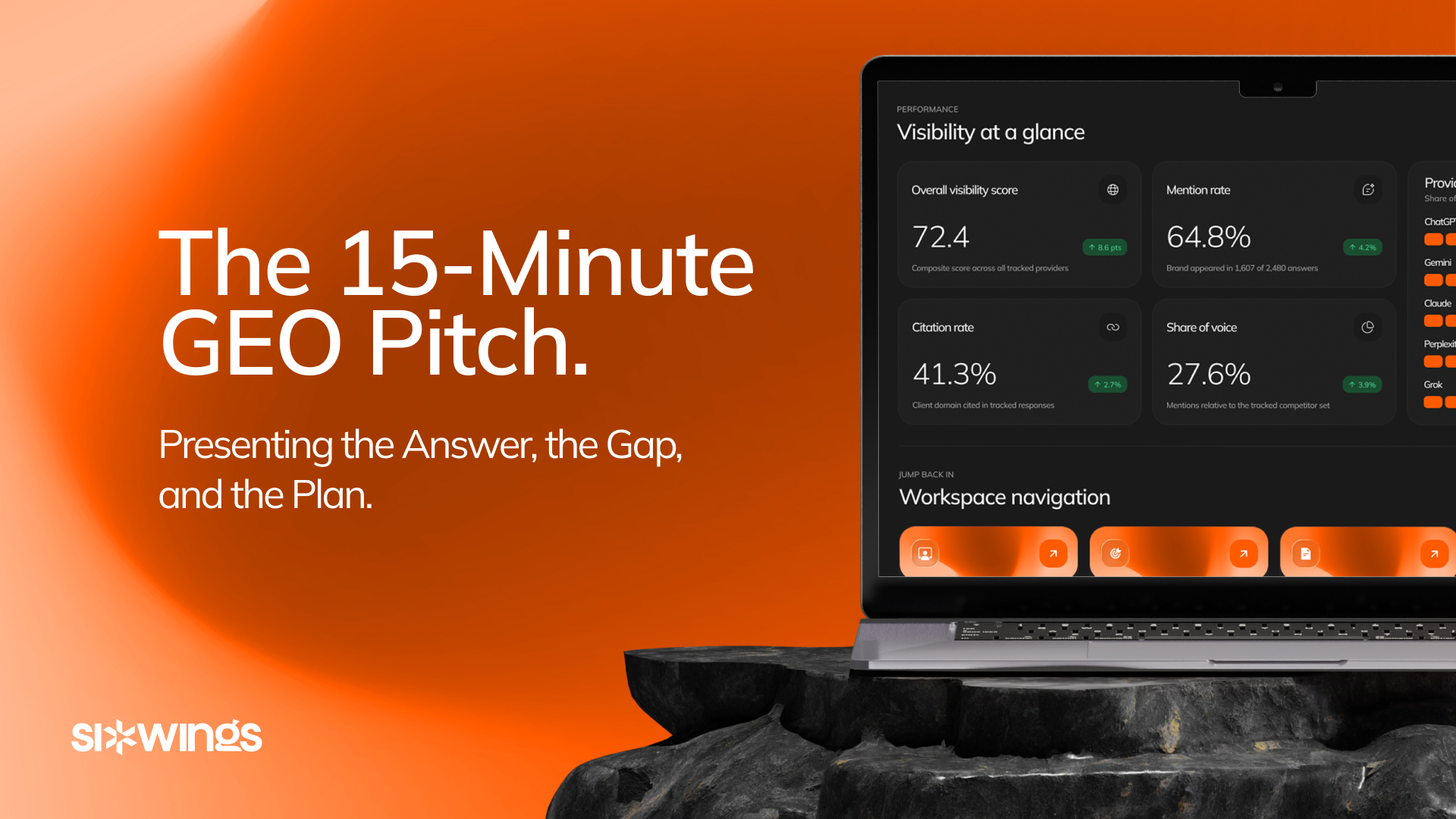
This article breaks down that pitch. It covers what goes in each beat, why the order matters, and how to build it so it works two ways: delivered live in a meeting, and left behind as a short document that keeps making the case after you leave the room. The beats are simple to remember. Show the answer. Name the competitor gap. Present the ranked plan. Let the evidence do the rest.
Contents
- Why this structure beats a category explainer
- Beat 1: Show the answer
- Beat 2: Name the competitor gap
- Beat 3: Present the ranked plan
- The fourth beat: evidence makes the next step easy
- Building it to work live and as a leave-behind
- Where SixWings fits
- Frequently asked questions
Why this structure beats a category explainer
The instinct to explain the category first is understandable and wrong. It is wrong because it front-loads the least interesting part and spends the attention you cannot get back.
Attention in a pitch is short and front-loaded. A widely used rule of thumb, the 3-3-3 rule, holds that you have about three seconds to earn attention, three minutes to engage, and three points worth remembering.
A demo principle follows from it: show the moment that lands early, do not save the best for last, because a busy person may be gone before you get there. A category explainer saves the best for last by design. It puts the abstract up front and the relevant thing at the end.
The answer-gap-plan structure inverts that. It opens with the single most engaging thing you have, which is the person's own brand inside a real AI answer, and it treats the category education as something the evidence teaches on its own. Nobody needs a definition of GEO after they have watched an AI recommend three competitors and not them. The point makes itself.
There is a deeper reason it works, drawn from how buying decisions actually get made. The biggest obstacle to a new service is rarely a competitor. It is the status quo, the quiet decision to do nothing, which accounts for a large share of stalled deals.
You do not beat the status quo by describing an opportunity. You beat it by making the cost of staying still visible and specific. A live answer about their own brand does exactly that, which is why it belongs first.
Beat 1: Show the answer
The pitch opens with proof, not preamble. You show the person an actual answer from an AI engine, ChatGPT, Perplexity, Gemini, Google's AI Overviews, or Claude, responding to a real question their buyers ask. Not a slide about visibility in the abstract. The real output, about their real brand.
The principle at work is proof over promise. Showing the product of the problem, the actual answer, lands far harder than describing it.
When a decision-maker reads, in the engine's own words, how their brand is presented or left out, it stops being a marketing claim and becomes a fact they just witnessed. That is the "aha moment," and the whole reason to lead with it is that it does more work than any explanation could.
A few things make this beat land rather than fizzle.
Use a question with real commercial weight. Not "what is [brand]," which most brands survive, but the question a buyer actually asks before choosing: "best tool for [use case]," "[brand] versus [competitor]," "alternatives to [category leader]." The high-intent questions are where the pitch has teeth.
Show it, do not summarize it. Reading the actual answer aloud, or putting it on screen verbatim, is the move. A paraphrase invites debate. The raw answer ends it, because the person is looking at the source, not your interpretation of it.
Keep it short and let it sit. One or two answers, a beat of silence, and a simple question: "Is this how you would want to be represented here?" The answer has already made the argument. Your job in this beat is mostly to get out of its way.
This opening also quietly disarms a common trust problem. Buyers frequently report a gap between what a vendor's website says and what a seller tells them in a meeting. Leading with unedited evidence about their own brand sidesteps that entirely, because you are not making a claim they have to trust. You are showing them something true.
Beat 2: Name the competitor gap
An answer on its own creates a reaction. Naming the gap turns that reaction into a reason to act, and the sharpest version of the gap is almost always competitive.
The move is to place the brand's presence directly next to a named rival's, on the same questions. "On these buyer questions, [competitor] is recommended in most answers. You appear in a handful." Absolute numbers are abstract. The same number next to a competitor is visceral, because it reframes the situation from "we could improve" to "we are losing ground we can see."
This works because of how people weigh loss. Behavioral research consistently finds that the prospect of losing something moves people roughly two to three times more strongly than the prospect of gaining something equivalent. A competitor being recommended in answers where the brand is absent is a loss the person can picture, happening now, in front of buyers they care about. That is a stronger motivator than any upside you could promise.
There is a subtler version worth using: the unconsidered need. This is a gap the person did not know they had.
Most brands have never seen how they appear in AI answers, so the competitor gap you show is often genuinely new information, not a restatement of a problem they were already chewing on.
Research on B2B messaging has found that leading with an unconsidered need, something the buyer was not already aware of, gives a measurable persuasion advantage over responding to needs they have already named. The AI answer gap is frequently exactly that: a real, unconsidered exposure.
Two cautions keep this beat honest.
First, the goal is clarity, not fear. You are showing a real, specific gap between where they are and where a competitor already is, not manufacturing alarm. Real urgency comes from the actual situation, and an accurate picture is persuasive enough without inflation.
Second, name real competitors the buyer genuinely cares about. A gap against an irrelevant rival is noise. A gap against the company they lose deals to is a reason to move.
By the end of this beat, the person should feel the gap as something happening to their business, on a surface they had not been watching. That feeling is what makes the next beat, the plan, land as a relief rather than a pitch.
Beat 3: Present the ranked plan
The gap creates urgency. Without somewhere for that urgency to go, it fades before the next meeting. The third beat gives it a destination: a short, ranked plan for closing the gap you just showed.
The most important property of this plan is that it is ranked, not exhaustive. Presenting forty things to fix produces paralysis, and paralysis defaults to no decision, which is the outcome you are trying to avoid.
A widely cited counter to indecision is to offer a clear recommendation and limit the options, so the person is choosing whether to proceed rather than drowning in everything that could be done. A handful of prioritized moves, in order, is a decision someone can actually make.
A plan that converts has a recognizable shape.
It is tied to what they just saw. Each item should visibly answer a specific finding from the first two beats. "Because [competitor] is winning this comparison question, the first move is a clear comparison page of your own" is far stronger than a generic checklist, because the person watched the problem it solves.
It mixes quick wins with a longer arc. Some fixes are fast: a wrong fact corrected at its source, a thin page strengthened, a technical barrier removed. Others build over time. Showing both says there is something to gain soon and something worth committing to, which is what makes ongoing work feel logical rather than open-ended.
It is ordered by leverage, not by ease. The first item should be the one that moves the most, whether that is influencing a single source cited across many answers or fixing a site issue that limits every page. Leading with the highest-leverage move signals that the plan is built on judgment, not a template.
Crucially, this beat does not need a hard close. A ranked plan tied to a real, evidenced gap raises its own question in the person's mind: who is going to do this, and keep doing it as the answers keep changing? You do not have to force the next step. The plan, done well, makes it obvious.
The fourth beat: evidence makes the next step easy
The first three beats are what you say. The fourth is why they work, and it runs underneath all of them: because every claim in the pitch is backed by evidence the person can see, agreeing to the next step is low-risk.
This is the quiet engine of the whole structure. A typical pitch asks the person to accept a chain of assertions and then take a leap of faith. The answer-gap-plan pitch asks them to accept things they have watched be true. The answer was real. The competitor gap was visible. The plan pointed at both. Each step was shown, not asserted, so the final step, let's begin, is a small movement rather than a leap.
Evidence also lowers the specific risk that stalls B2B decisions: personal risk. The decision-maker is rarely afraid the service will not work in the abstract. They are afraid of championing something internally and being wrong.
Evidence is what they forward to a colleague, cite in the next meeting, and use to justify the choice to a boss. A pitch built on evidence hands the person the exact material they need to sell it onward, which is often where deals are actually won or lost.
There is a discipline point that protects your credibility here, and it is worth stating plainly in the room. Evidence supports the case; it does not promise a result.
AI answers shift constantly, so the honest framing is a disciplined program that measures, prioritizes, acts, and re-measures, not a guarantee of a specific ranking or citation. Promising guaranteed placement is both untrue and unnecessary, because the evidence has already done the persuading. Overclaiming only adds risk to a case that was stronger without it.
The through-line across all four beats is that you are not asking anyone to believe you. You are showing them something true about their own brand, naming what it costs, offering a ranked way to fix it, and letting the visibility of the evidence make the next step feel safe. That is a fundamentally different transaction from a traditional pitch, and it is why it fits in fifteen minutes.
Building it to work live and as a leave-behind
A good pitch has to survive after the meeting ends, because the person in the room is rarely the only decision-maker. Modern buying decisions involve a whole group, and your contact will need to make the case to people you never met. So the pitch should be built once and work in two modes.
Live, it is a conversation. You share your screen, walk through the answer, sit in the silence, name the gap, and talk through the plan, reading the room and slowing down where they lean in. The evidence gives you room to be responsive rather than scripted, because the argument is in what you are showing, not in a memorized sequence.
As a leave-behind, it is a short, self-contained document that tells the same story without you narrating it: the answer, the gap, the ranked plan, in that order. This is the version that circulates inside the buyer's organization, and it is often the artifact that actually decides things.
Forcing the case onto a couple of pages is a useful discipline anyway, because it reveals what is essential and strips what is not. The one-page version is frequently the thing most likely to survive being forwarded around a company.
The two modes share one storyline and one evidence base. That consistency matters, because contradictions between what a person read and what they were told are a known trust-killer. When the live pitch and the leave-behind say the same thing, backed by the same real answers, the case holds up no matter who encounters it or in which form.
The practical implication is to build the evidence once and shape it for both uses. The same captured answers, the same competitor comparison, and the same ranked plan should power the meeting and the document. You are not creating two things. You are creating one case that can be delivered live or read alone.
Where SixWings fits
The hard part of this pitch is not the structure. It is having real, current evidence about a specific brand ready to show, and a ranked plan already drawn from it, without spending days assembling either by hand. That is what SixWings is built to supply.
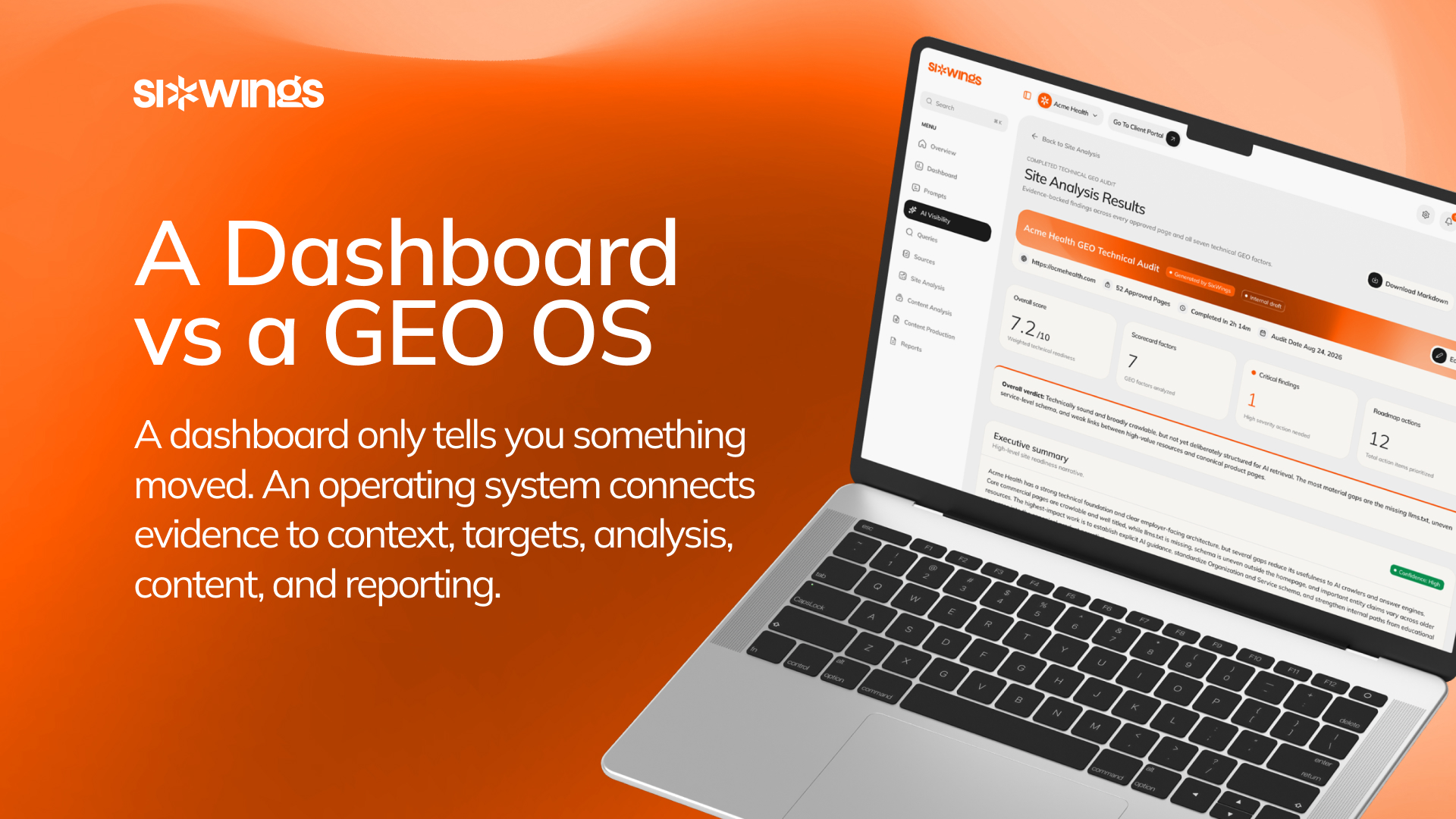
SixWings pioneered the Answer Experience Design model and built the platform that runs it. In plain terms, it is a fully white-labelled GEO operating system.
It measures how a brand shows up in AI answers, turns that raw data into prioritized recommendations and simple implementation briefs, and hands those to whoever executes, an in-house team or an external one, so the work is easy to act on. Think of it as an SEO toolkit, but for the AI-answer layer instead of Google rankings.
Mapped to the three beats, it supplies the raw material for each:
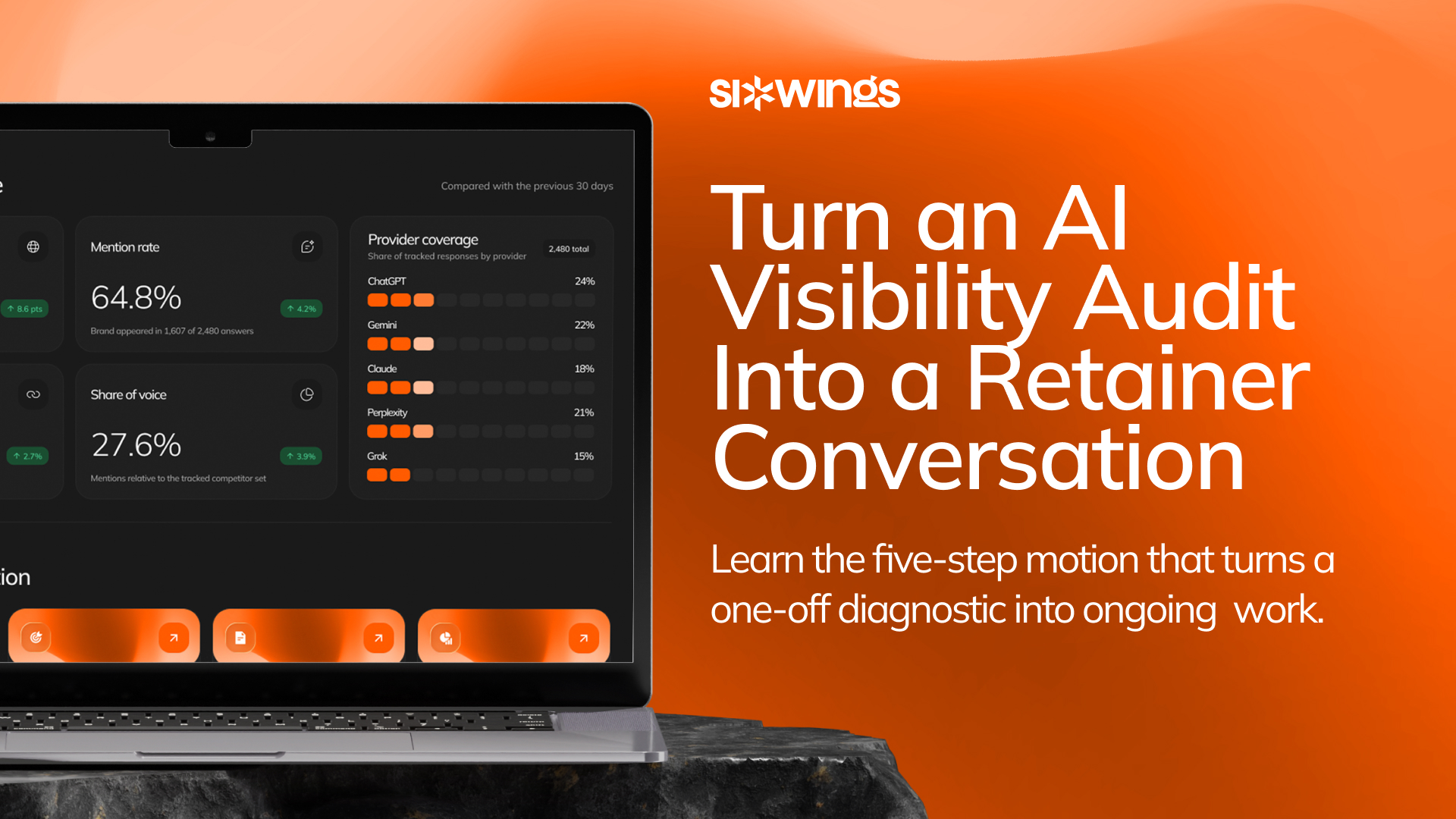
- The answer. SixWings runs real buyer questions across supported providers (currently OpenAI, Anthropic, Gemini, Perplexity, and Grok) and keeps the exact answers, so the evidence you show is current and real rather than a mock-up.
- The competitor gap. It captures competitor mentions and citations on the same questions, so the side-by-side gap is measured, not asserted.
- The ranked plan. Rather than leaving you to interpret the data, SixWings does the prioritizing, distilling the evidence into a short list of the prompts, pages, and sources that matter most. That removes the decision fatigue and the hours normally lost to figuring it out, and it is what lets the plan be ready in time for the meeting.
For the two-mode requirement, the same reporting can be shared through a custom-branded portal, so the leave-behind looks like your own service and carries the same evidence the live pitch used. The point is not that a tool delivers the pitch for you. It is that a pitch this direct needs real evidence and a ready plan behind it, and SixWings exists to produce both.
Frequently asked questions
Why lead with the answer instead of explaining GEO first? Because attention is front-loaded and the answer is the most persuasive thing you have. A category explainer saves the relevant part for last, by which point attention has faded. Showing a real AI answer about the person's own brand makes the category self-explanatory and earns attention while it is still there.
Isn't showing a competitor gap just fear-mongering? Not if it is accurate. The goal is clarity, not alarm: a real, specific gap between where the brand is and where a named competitor already is, on questions their buyers actually ask. Real urgency comes from the true situation, and an accurate picture is persuasive without any inflation.
Why must the plan be ranked rather than complete? Because a long list produces paralysis, and paralysis defaults to no decision. A short, ranked plan lets the person choose whether to proceed instead of drowning in everything that could be done. Leading with the highest-leverage move also signals judgment rather than a template.
How does this pitch work if I am not in the room? Build it to work as a leave-behind as well as live. The same storyline, answer, gap, ranked plan, becomes a short self-contained document that circulates inside the buyer's organization. Because it carries the same real evidence as the live version, it holds up when forwarded to stakeholders you never meet.
Which AI engines should the pitch pull from? The major generative answer surfaces buyers use today, including ChatGPT, Google's AI Overviews and Gemini, Perplexity, and Claude. Because each behaves differently and can cite different sources, showing evidence across providers is more credible than relying on a single one.