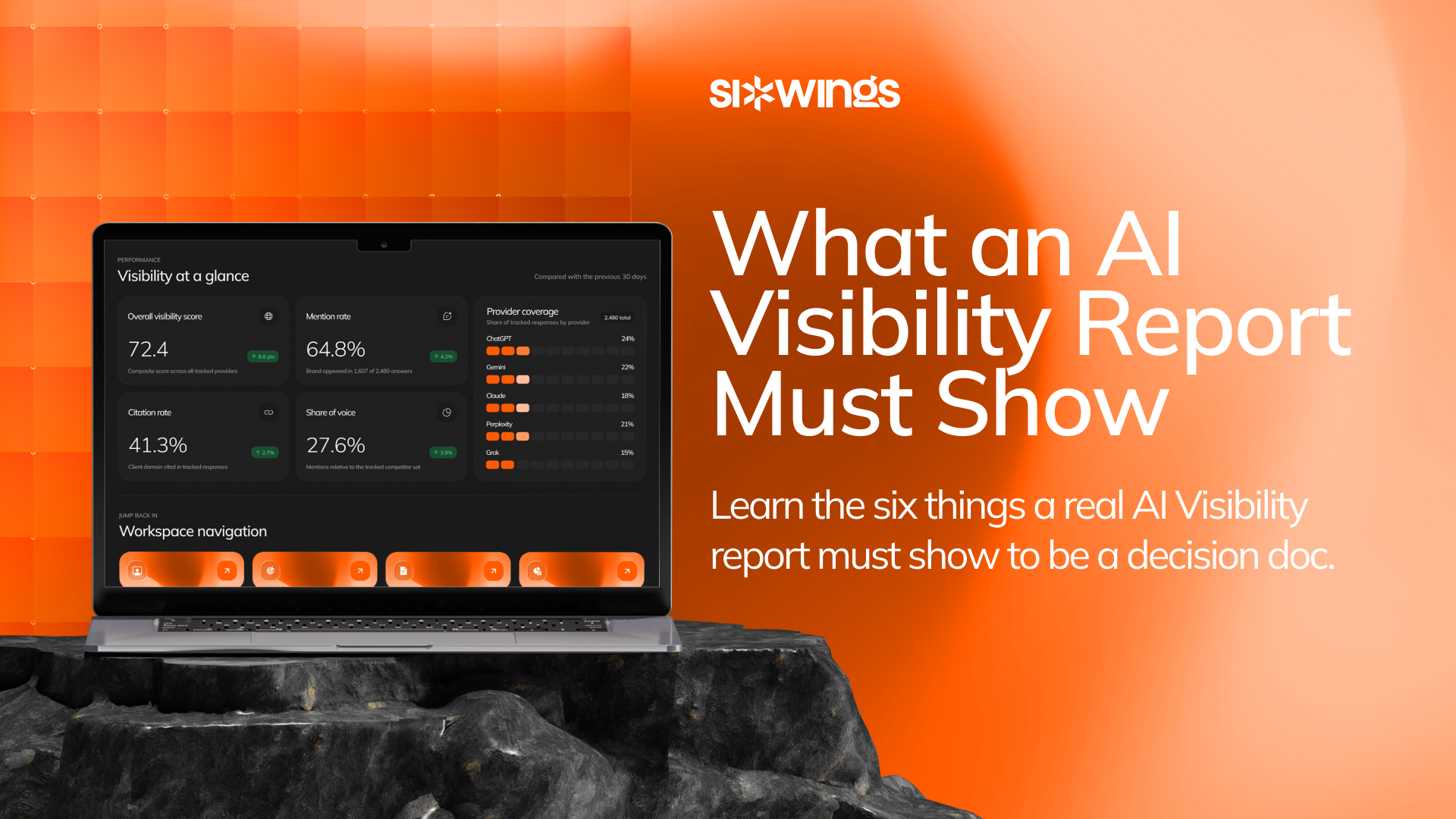
Most AI visibility reports show a number. Your brand appears in some percentage of AI answers, the number went up or down, end of report. It looks clean, it fits on a slide, and it tells you almost nothing about what to do next.
That is the gap this article is about. A good AI visibility report is not a scoreboard. It is a decision document: it should tell you where a brand stands inside AI answers, why it stands there, and what to change. The difference between a report that flatters you and a report that helps you is not length or polish. It is whether the report carries the evidence and the priorities underneath the headline figure.
Here is a sign of how unsettled this still is. In one 2026 study, 45% of marketing leaders said they cannot accurately measure their brand's visibility in AI-generated answers, and only 9% said they had tools that track all the metrics that matter. So "what should a report actually show" is not a solved question. This is a working answer: the six things a report needs to contain to be worth reading.
Contents
- Why "a score" is not a report
- The six things a real AI visibility report shows
- The test to apply to any report
- Where SixWings fits
- Frequently asked questions
Why "a score" is not a report
A single visibility score has one job: to tell you, at a glance, roughly how present a brand is. That is useful as a headline. It is a problem when it is the whole report.
The reason is that a blended number hides more than it shows. A brand can look strong on one AI provider and weak on another for the very same questions. It can lead on early "what is X" questions and trail badly on "best X for Y" comparison questions, which is a completely different commercial position than the reverse. Roll all of that into one figure and the insight disappears into the average.
There is also a quieter issue: a score with nothing beneath it cannot be acted on or defended. If a client or a leadership team asks "why did this move, and what are we doing about it," a number on its own has no answer. That is why practitioners have started calling the standalone visibility score a vanity metric in a new costume: a figure that goes up and to the right and tells leadership nothing actionable.
None of this means the score is useless. It means the score is the cover, not the book. A real report has five more things behind it.
The six things a real AI visibility report shows
Use these as the checklist. If a report is missing several of them, it is a dashboard, not a decision document.
1. Presence, broken down (not one blended number)
Start with the headline: how often is the brand mentioned in relevant AI answers? But the value is in the breakdown, not the single figure.
A useful report segments presence at least three ways: by provider (a brand can hold a strong position on one engine and a weak one on another), by topic or product line, and by funnel stage (awareness questions versus comparison and purchase questions).
Segmentation is where the actionable insight lives, because it turns "we're at 30%" into "we're strong on awareness prompts and losing the comparison ones, especially on two providers." One tells you nothing. The other tells you where to work.
2. Competitive standing, on the same questions
Presence in isolation is hard to read. A 30% mention rate looks very different when the category leader sits at 60% than when they sit at 15%.
A real report includes share of voice: how the brand's presence compares to a named set of competitors across the same set of questions. This is what tells you whether you are gaining or losing ground against the brands a buyer would actually choose between. It also reveals where a competitor dominates a specific provider or topic, which is often the clearest signal of where the opportunity is.
3. Mentions and citations, kept separate
This is the distinction most weak reports blur, and it matters. A mention is when the answer names the brand. A citation is when the answer draws on a specific page as a source. They are not the same thing, and a report should show both.
Why it matters: an answer can mention a brand while citing a competitor's comparison page, a directory, or a review site as the source behind it. It can also cite a brand's own article without naming the brand in the visible text.
Only by separating the two can you see whether you are winning the recommendation, the sourcing, both, or neither. Collapsing them into one count hides the exact thing you would act on.
4. The sources behind the answers
A report should show which pages and domains the AI actually drew from when it answered. This is the layer that explains everything above it.
It matters because the sources are rarely just the brand's own site. Across supported providers, a large share of citations come from third-party domains rather than the brand's own pages.
If you do not know which directory, review site, publisher, or competitor page is feeding an answer, you cannot correct a wrong impression or reinforce a right one. Sources are what turn "we appear this way" into "here is the specific page shaping it."
5. Consistency and method, stated plainly
AI answers are not fixed. Ask the same question twice and the wording, and sometimes the brands named, can change. A report that ignores this is measuring noise and presenting it as precision.
A trustworthy report is explicit about its method: the same prompt set, run the same way, over a large enough sample to be meaningful, so that a change between periods reflects a real shift rather than a different question set. It should also treat each result as point-in-time, not a live number that quietly rewrites last month's. Without a stated, consistent method, month-to-month comparisons are not comparable, and the trend line is fiction.
6. A prioritized "what to do next"
Finally, the report has to end somewhere other than a chart. The point of measuring is to decide, so a real report distills everything above into a short, ranked list of what to act on: the questions, pages, and sources that matter most right now.
This is the difference between a report you read and a report you use. A pile of data raises the question "so what do we do?" A finished report answers it, and it answers it in priority order, so the next move is obvious rather than a debate.
The test to apply to any report
If you want a single test, it is this: can the report answer four questions without you doing extra work?
- Where does the brand stand inside AI answers, broken down by provider, topic, and funnel stage?
- How does that compare to the competitors a buyer would consider?
- Why does it stand there, meaning which sources are shaping the answers?
- What should we do next, in priority order?
A report that answers all four is a decision document. A report that answers only the first, as a single blended score, is a vanity dashboard. The integrated approach is also the one that pays off: in one 2026 study, organizations that combined SEO and AI visibility into a single workflow were far more likely to report real gains from AI platforms than those managing them separately.
Where SixWings fits
SixWings pioneered a model for this kind of work, Answer Experience Design, and built the platform that runs it.
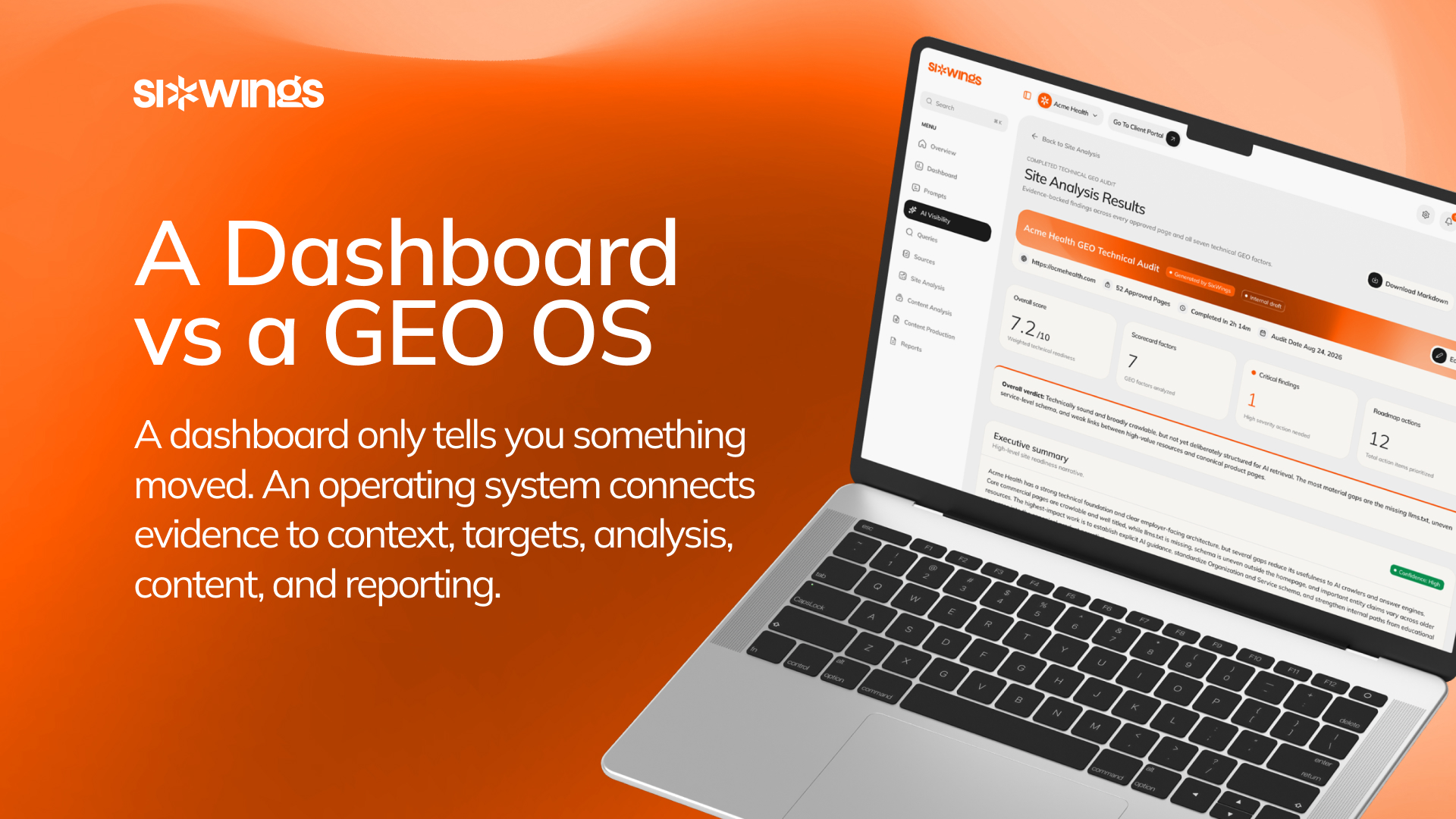
In plain terms, SixWings is a fully white-labelled GEO operating system. It measures how a brand shows up in AI answers, turns that raw data into prioritized recommendations and simple implementation briefs, and hands those to whoever executes, an in-house team or an external one, so the work is easy to act on. Think of it as an SEO toolkit, but for the AI-answer layer instead of Google rankings.
Mapped to the six components above, a SixWings report is built to show:
- Presence, broken down. It measures how often a brand is mentioned across supported providers (currently OpenAI, Anthropic, Gemini, Perplexity, and Grok), so presence can be read per provider rather than as one blended figure.
- Competitive standing. It captures competitor mentions and citations on the same questions, so a brand's position is always relative, not just absolute.
- Mentions and citations, separated. It records both whether the brand was named and whether it was cited, as distinct signals.
- The sources behind the answers. It keeps the evidence behind each answer, including the searches providers ran and the pages they drew from, so you can see what is shaping the result.
- Consistency and method. It runs a saved prompt set and freezes a reporting period into a fixed, point-in-time snapshot, so comparisons hold from one period to the next.
- A prioritized next step. Instead of leaving you to interpret the data, SixWings does the prioritizing for you, surfacing the short list of prompts, questions, and pages that matter most. That removes the decision fatigue and the hours normally lost to figuring it out.
Those results can then be shared through a custom-branded portal, so approved findings reach a client without exposing the entire working setup. The point is not the score. It is everything the score is supposed to stand for, kept intact and made actionable.
Frequently asked questions
Isn't a visibility score enough to show progress? It is a fine headline and a poor report. A single blended number hides differences between providers, topics, and funnel stages, and it cannot explain why it moved or what to do next. It should sit on top of the evidence, not replace it.
What's the difference between a mention and a citation? A mention is when an AI answer names the brand. A citation is when the answer uses a specific page as a source. An answer can do one without the other, so a good report tracks them separately rather than merging them into a single count.
Why does a report need to show sources? Because the sources explain the result and are where corrections happen. Much of what shapes an AI answer comes from third-party pages, not the brand's own site, so without the source layer you cannot fix a wrong impression or reinforce a right one.
Why does consistency of method matter so much? Because AI answers vary between runs. If a report changes its prompt set or sample between periods, the trend line reflects the change in method, not a real shift in visibility. A stable, stated method run over a meaningful sample is what makes period-to-period comparison trustworthy.
Which AI providers should a report cover? The major generative answer surfaces buyers use today, including ChatGPT, Google's AI Overviews and Gemini, Perplexity, and Claude. Because each behaves differently and pulls from different sources, results should be reported per provider rather than blended into one universal number.