Answer Experience Design (AXD) is the practice of deliberately shaping how a brand is represented, understood, and cited inside AI-generated answers - the responses people now get from ChatGPT, Perplexity, Gemini, Google's AI Overviews, and Claude instead of a page of blue links.
It treats the AI answer itself as a designed surface: not something you rank on, but something your brand appears inside, described in words the model chose, supported by sources the model retrieved.
For an agency or a CMO, the shift matters because the answer is now where decisions start. Google now shows an AI Overview on close to nine of every ten commercial queries, roughly 60% of searches end without a click to any website, and ChatGPT alone reached around 900 million weekly users in early 2026.
When a buyer asks an assistant "who's the best provider for X," the brands named in that response enter the consideration set before a single site loads.
Answer Experience Design is the discipline of making sure your client, or your brand, is one of them - and of being able to explain, in evidence, why.
This article defines what Answer Experience Design is, what it is not, the six things a real AXD practice has to do, and how to tell a genuine practice apart from a dashboard with a score on it.
Contents
- Answer Experience Design in one paragraph
- What Answer Experience Design is not
- Why the answer became a surface worth designing
- The six components of an Answer Experience Design practice
- How AXD replaces the "opaque score" way of working
- How to evaluate an Answer Experience Design capability
- Where SixWings fits
- Frequently asked questions
Answer Experience Design in one paragraph
Answer Experience Design is the end-to-end work of understanding how AI answer engines currently represent a brand, deciding which questions and sources matter most, improving the website and content that models draw from, and reporting the result in a form a client can act on.
It spans four practical questions for any brand:
- How do AI providers represent and cite us today?
- Which audience questions and sources create the biggest gaps?
- What should we improve next?
- How do we show what changed?
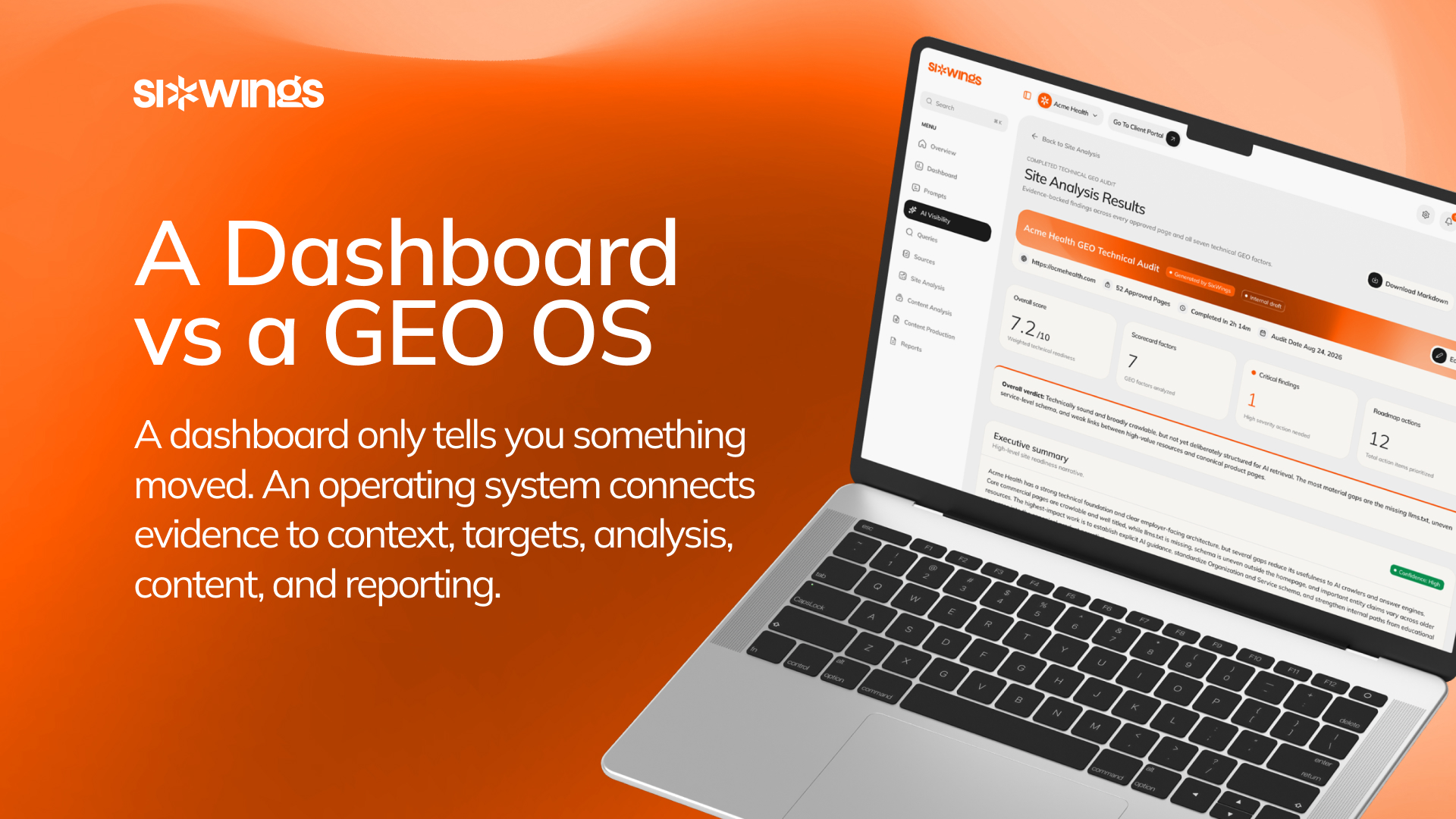
AXD is distinguished from adjacent disciplines by one commitment - it keeps the evidence behind every answer, so a change in visibility can be explained rather than just observed.
What Answer Experience Design is not
The fastest way to understand a new discipline is to separate it from the things it is often confused with.
It is not SEO. Traditional search engine optimization structures a page to rank in a list of results and earn a click.
AXD is concerned with whether a brand is named, described accurately, and cited inside a generated answer - an outcome that can happen with no click at all.
The two are related: strong SEO foundations still feed AI citation, and much of the underlying content work overlaps. But the target output is different.
SEO optimizes for position; AXD optimizes for representation.
It is not generic GEO. Generative Engine Optimization is the broader umbrella term for making content citable by AI engines, and AXD lives inside it.
The distinction is scope and discipline. A lot of "GEO" in practice stops at tactics - add statistics, add schema, add FAQ blocks - proven to lift AI visibility by up to 40% in the original Princeton-led research, but applied without a governed record of why a specific brand moved.
Answer Experience Design is GEO operated as a repeatable practice: measurement tied to a client's own facts, a deliberate way to choose what to work on, and a client-ready output at the end.
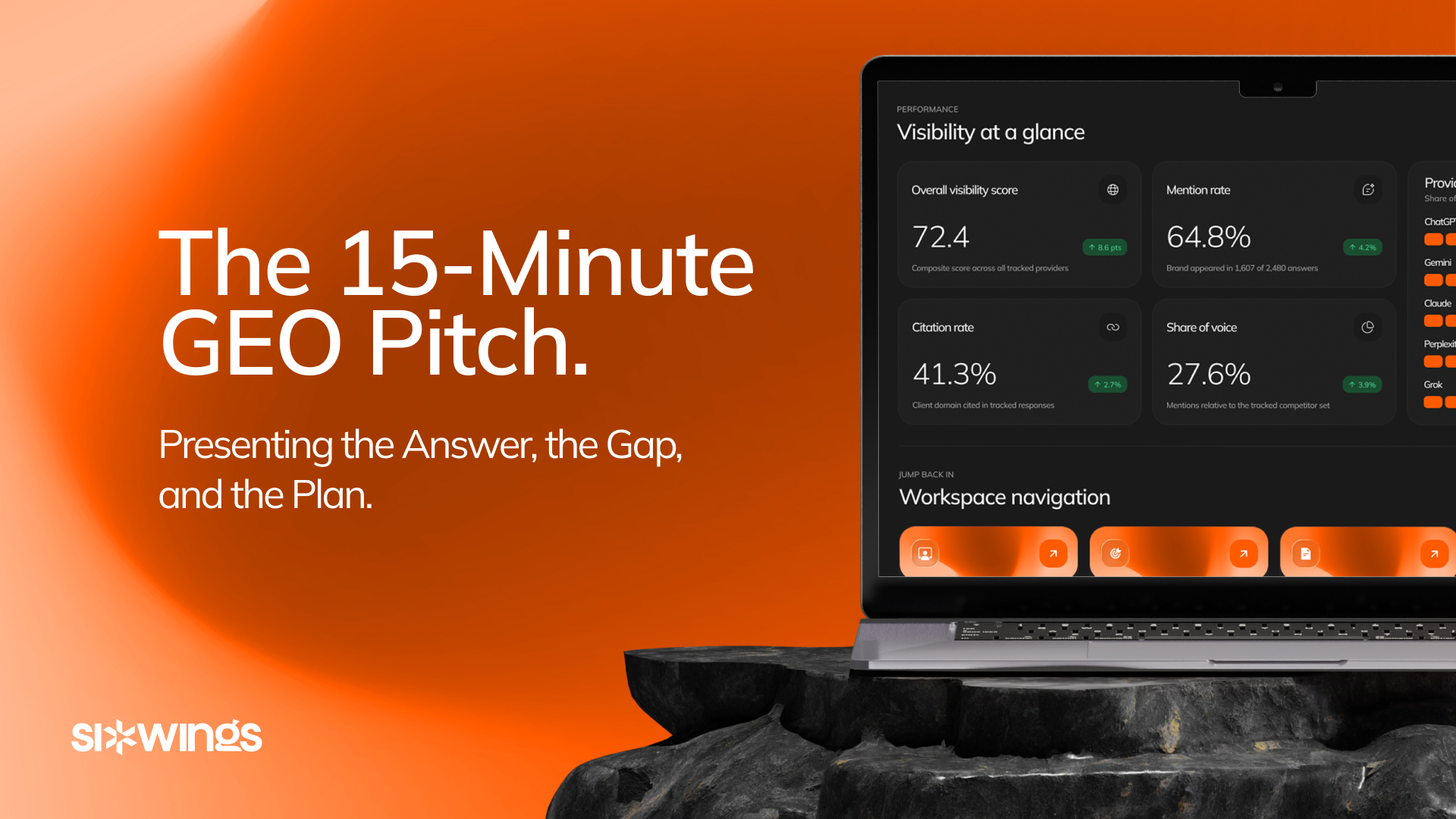
It is not AI-rank tracking. A rank tracker tells you a number - a "visibility score," a share of voice, a position. That number is real but volatile: because generative engines rebuild answers from scratch each time and rebalance for freshness and diversity, a brand visible in Monday's answer can be absent from Tuesday's.
A score alone cannot tell you what to change. AXD keeps the layer underneath the number - the exact question asked, the provider's answer, the mentions, the citations, the searches the model ran, and the sources it pulled - so the score becomes explainable and actionable rather than just something to watch move.
In short: SEO earns the click, GEO earns the citation, rank tracking counts the citation - and Answer Experience Design designs the entire experience of how the brand shows up in the answer, evidence included.
Why the answer became a surface worth designing
Three things happened at once, and together they turned "how we appear in AI answers" from a curiosity into a line item.
Discovery moved into the answer. AI Overviews appear on a large share of Google searches, and a majority of searches now end with no click.
Analysts at Gartner projected that a quarter of organic search traffic would shift toward AI chatbots and virtual agents by 2026.
When the answer replaces the list, being in the answer is the new being-on-page-one.
The answer became measurable - and unstable. A year ago, whether a brand appeared in a ChatGPT or Perplexity answer was essentially unknowable without manual spot-checking.
That changed fast: an entire category of AI-visibility platforms now exists to measure it, with multiple established players mapped across the market by mid-2026. But measurement revealed volatility.
When Google switched AI Overviews to a new model in early 2026, roughly 42% of previously cited domains were reportedly replaced. Citation shares can move overnight.
That instability is exactly why the work has to be continuous and evidence-based rather than a one-time audit.
It became a business opportunity for agencies. Client demand is visible in the search data - one industry tracker reported "GEO agency" searches up roughly 2,300% year over year - while most brands have not yet started.
Agencies packaging AI-answer visibility as a named service are reportedly closing larger retainers and reducing churn, with published agency pricing commonly landing between roughly $500 and $10,000+ per client per month depending on scope.
The gap between rising client demand and low client adoption is the commercial reason Answer Experience Design exists as a service, not just a concept.
The six components of an Answer Experience Design practice
A practice - as opposed to a tactic - has to do six things. Use these as the anchor criteria when you build or buy an AXD capability. They run in order: each one depends on the one before it.
1. Evidence capture, not just a score
The foundation of AXD is preserving the why behind every measurement. For each tracked question, that means capturing the exact prompt, the provider and its answer, where the brand and competitors were mentioned, the citations and cited domains, the searches the provider ran while answering, and the sources it retrieved.
A practice that keeps this evidence trail can explain a movement. A practice that keeps only a number cannot.
This is the single most important dividing line in the model - everything downstream depends on having the evidence rather than an opaque roll-up score.
2. One governed source of brand context
Models describe brands using whatever they can find, which is how inaccurate or thin descriptions creep into answers.
AXD counters this with a single authoritative record of the client's context: company facts, products, audiences, positioning, competitors, approved claims, the claims you must never make, tone, and guardrails.
Every downstream step - the questions you test, the content you analyze, the articles you produce - is grounded in that record.
Without it, an AI can accelerate work but will happily invent specifics; with it, the work stays aligned to what the client has actually approved.
3. A way to turn measurement into priorities
A large visibility dataset does not tell you what to do. The defining operational move in AXD is distilling that evidence into a deliberate, progressive shortlist:
- Target prompts - the audience questions that matter most.
- Target queries - the searches providers actually run beneath those prompts.
- Target sources - the specific pages and domains shaping those answers.
This prompt → query → source funnel is what separates acting on evidence from browsing a dashboard. It converts "our score is 34" into "these ten questions, these searches, and these five pages are where the opportunity is."
4. Diagnosis of the website and content behind the answer
Answers are only as good as what the models can read. AXD includes technical and content diagnosis: whether AI crawlers can access the site, whether machine-readable signals exist, whether structured data and metadata are clean, whether entities and claims are consistent, and whether individual pages and the wider content corpus are extractable and citable by answer engines.
This is the bridge from "here's how we appear" to "here's the specific reason, on our own site, that we appear that way."
5. Governed content production
Diagnosis is only useful once it turns into something you actually publish. In other words, a finding has to become a finished piece of content - a new or improved page on the brand's website.
AXD handles this through a controlled workflow: research, a structured brief, drafting, review, and a final human sign-off before anything goes live. The reason to insist on that governance is simple.
AI-written content lifts visibility only when it's accurate and grounded. A made-up statistic or an off-limits claim does more damage than the gap it was meant to fill. Requiring a person to approve the exact version that ships is the safeguard.
6. Client-ready reporting and controlled access
Finally, an agency-grade practice produces something a client can see without exposing the agency's full working environment.
That means fixed, point-in-time report snapshots (so a reporting period doesn't shift as new data arrives), and controlled client access to approved results only.
Clients now expect the same accountability from AI-answer work that they expect from SEO - trends, comparisons, and clear month-over-month movement - and the reporting layer is how the discipline earns its retainer.
Notice the sequence: capture evidence, ground it in client context, prioritize it, diagnose the cause, produce the fix, report the result.
Skip any step and you have a tactic, not a practice.
How AXD replaces the "opaque score" way of working
The old way of approaching AI visibility - where a practice existed at all - was a scattered one: a monitoring tool spat out a score, technical audits lived in one place, content work in another, and reporting was assembled by hand with weak provenance. The score told you that something moved; nothing connected it to why, or to what to do next.
Answer Experience Design collapses that chain into one connected flow. The evidence behind the score, the priorities drawn from it, the diagnosis of the site, the content produced in response, and the report delivered to the client all reference the same client context and the same underlying evidence.
The practical payoff is explainability: when a client asks "why did our visibility change and what are you doing about it," the answer is a specific chain of evidence and work, not a shrug at a moving dashboard.
For agencies, there's a second payoff. Because the work is repeatable and governed, it can be operated across many clients with deliberate roles and access - which is what turns AXD from a bespoke project into a service line you can actually scale.
How to evaluate an Answer Experience Design capability
Whether you're building the practice in-house or evaluating a platform to deliver it, the six components above double as an evaluation checklist. Ask:
- Evidence: Does it keep the actual provider answers, citations, provider searches, and retrieved sources - or only a score? If you can't see the evidence, you can't explain the number.
- Context governance: Is there one authoritative, client-approved record of facts, claims, and guardrails that grounds every downstream step? Or does each task start from scratch?
- Prioritization: Is there a deliberate method for turning a large dataset into a short, defensible list of what to work on next?
- Diagnosis: Can it tie a visibility gap to specific, evidence-backed reasons on the client's own website and content?
- Governed production: Does content move through research, review, and mandatory human approval - or does it auto-publish AI output?
- Client delivery: Can you show clients fixed, approved results through a controlled surface, without handing over your entire working environment?
Two cautions worth holding onto while you evaluate. First, be skeptical of any claim of guaranteed rankings, guaranteed citations, or guaranteed inclusion in AI answers - the engines are volatile by design, and outcomes depend on real implementation work.
Second, watch for scope inflation: "we scan every model, every day, automatically" often means less than it sounds, since providers expose different data and much of the work is deliberately run and reviewed rather than fully automated. A practice that concedes its limits is usually the one that understands the discipline.
Where SixWings fits
SixWings created Answer Experience Design and built a platform to run it. In plain terms, it's a place where an agency can deliver this AI-answer work as a service for its clients - one workspace to see how each client's brand shows up in AI answers, decide what to fix, do the work, and show the client the result. Think of it as the equivalent of an SEO toolkit, but for the AI-answer layer instead of Google rankings.
It gives each client its own workspace, starting from a governed knowledge base of that client's facts, positioning, competitors, approved claims, and guardrails, and uses that context to generate buyer-relevant prompts, run them across supported AI providers, and preserve the full evidence chain behind every answer: the question, the provider response, brand and competitor mentions, citations, the searches providers issued, and the sources they retrieved.
From that evidence, SixWings supports the same progression described above - the target prompt → target query → target source funnel - plus bounded GEO technical site audits, knowledge-grounded page and corpus content analysis, governed website-article production with mandatory human approval, fixed monthly report snapshots, and a client portal for sharing only approved results.
For agencies that want to operate the work rather than hand it off, a scoped connection lets authorized team members drive selected workflows through supported AI clients, with per-user permissions and confirmation gates on paid or consequential actions.
The point is not that a tool replaces the discipline. It's that Answer Experience Design is a sequence of connected steps - evidence, context, prioritization, diagnosis, production, reporting - and SixWings is designed to keep those steps connected and governed rather than scattered across disconnected tools.
For an agency adding AI-answer visibility as a service, that connected, client-scoped structure is what makes the practice repeatable.
Frequently asked questions
Is Answer Experience Design the same as GEO or AEO? It sits inside them. GEO (Generative Engine Optimization) and AEO (Answer Engine Optimization) are the broad terms for making content citable by AI answer engines. Answer Experience Design is that work operated as a governed, end-to-end practice - measurement tied to client context, a method for choosing what to act on, diagnosis and production, and client-ready reporting - rather than a set of standalone tactics.
Does Answer Experience Design replace SEO? No. It builds on SEO and runs alongside it. Strong search foundations still feed AI citation, and much of the content work overlaps. AXD adds the specific requirements - evidence capture, entity and claim consistency, extractability for answer engines - that ranking alone does not address.
Which AI answer engines does this apply to? The major generative answer surfaces people use today, including ChatGPT, Google's AI Overviews and Gemini, Perplexity, and Claude. Each exposes different data and behaves differently, which is why a practice keeps the underlying evidence per provider rather than assuming one universal number.
Can you guarantee my client will appear in AI answers? No credible practice can. Generative engines rebuild answers dynamically and rebalance constantly, so citation and mention behavior shifts over time. Answer Experience Design is about making a brand more understandable, trustworthy, and citable to answer engines - and being able to measure and explain the result - not about guaranteeing a placement.
Why does this matter for agencies specifically? Because client demand for AI-answer visibility is rising while most brands haven't started, and because the work is repeatable across clients when it's governed and client-scoped. That combination lets an agency offer a genuinely new, in-demand service and position itself ahead of competitors still selling search visibility alone.