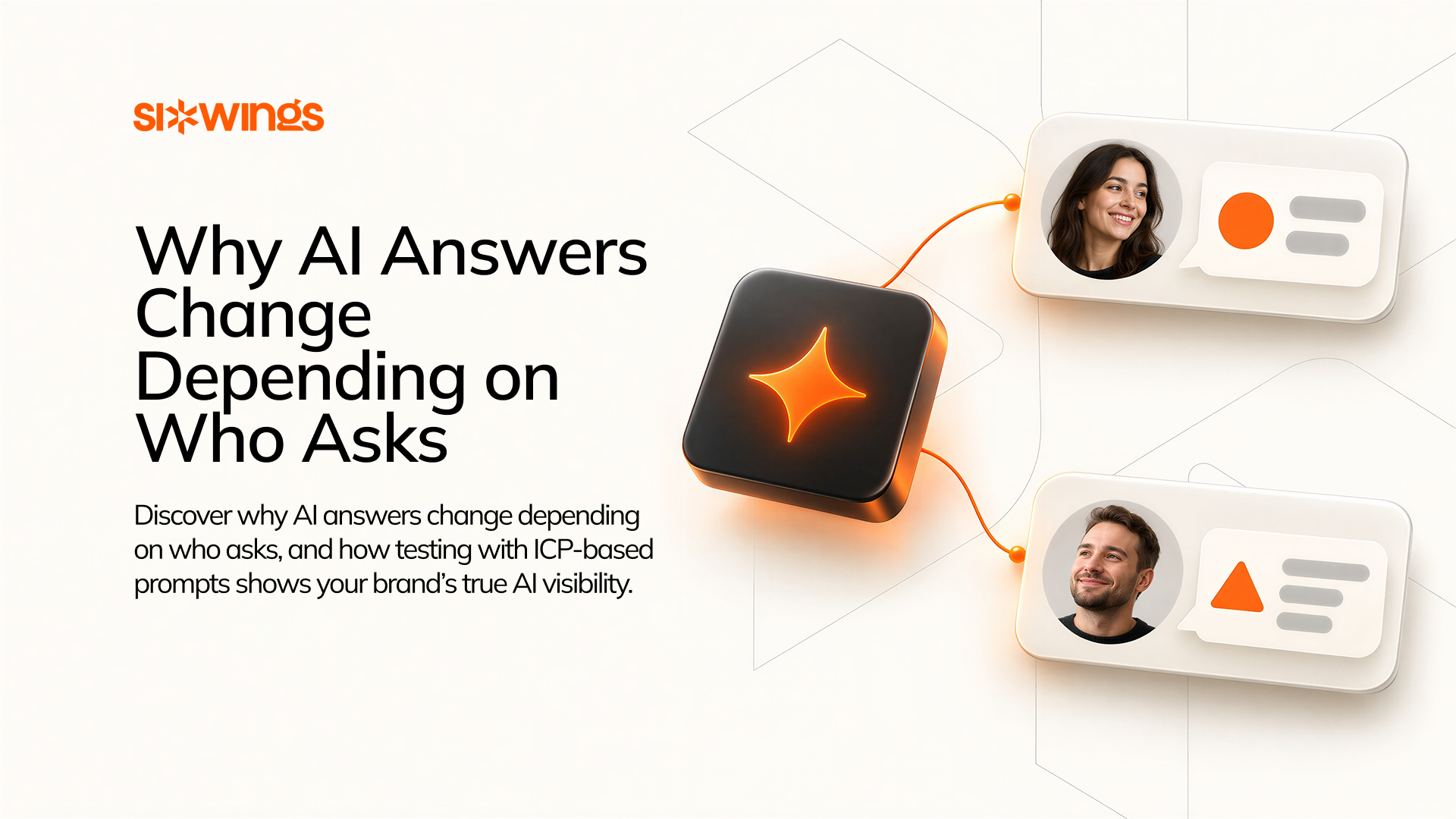
Ask ChatGPT, Perplexity, Gemini, Google's AI Overviews, or Claude the same question about a category, and the answer you get is not fixed. Change who is asking, or how they ask, and the brands named can change with it. The engine is not giving one universal truth. It is giving an answer shaped for the person in front of it.
This is easy to miss, and it quietly breaks a lot of AI visibility checks. A brand runs one generic prompt, sees itself named, and concludes it is visible. But its actual buyers do not ask generic questions. They ask from a point of view, with a role, a company size, and a problem, and the answer they get can look nothing like the one the generic test returned.
This article explains why AI answers change depending on who asks, why that makes generic prompts misleading, and why testing visibility the way real buyers ask, through ideal customer profiles, is the only way to get a true picture. It closes with how SixWings builds those profiles into the prompts it runs.
Contents
- Two reasons the answer changes
- How personal context changes an AI answer
- How the framing of the question changes an AI answer
- Why generic prompts mislead
- A worked example
- What an ideal customer profile is, and why it matters here
- What a good ICP prompt looks like, and why doing it by hand breaks down
- How SixWings builds ICPs into prompts
- Where SixWings fits
- Frequently asked questions
Two reasons the answer changes
There are two different reasons the same category question can produce different AI answers, and it helps to separate them.
The first is personal context. When a real person asks an engine something, the engine may know things about them: where they are, what they have asked before, what their account suggests about them. It can quietly use that to tailor the AI answer.
The second is the framing of the question itself. A question asked from the point of view of a finance leader at a large company is a different question from the same topic asked by a hands-on practitioner at a small one, even when the core subject is identical. The engine reads the framing and answers to fit it.
Both matter, but the second is the one a brand can actually test and act on, because it does not depend on any single person's private context. It depends on the perspective the question is asked from, and that perspective can be modeled. That is where ideal customer profiles come in, later in this article.
How personal context changes an AI answer
Start with personal context, because it is the part people find surprising.
When someone is signed in and asking an engine a question, the engine often has signals about who they are. Their location can shape AI answers that have a local dimension. Their past conversations can hint at what they care about. Account or device signals can suggest their language, their region, or the kind of work they do. The engine can fold any of this into the answer without being asked to.
The result is that two people typing the exact same words can get different answers, because the engine is quietly personalizing. One person asking "best accounting software" might see options tuned to their country and their earlier questions about freelancing. Another might see enterprise tools, because everything the engine knows about them points that way.
This is worth understanding, but it has a limit for a brand. You cannot see or control the private context of every individual buyer, and you cannot test against it directly, because it belongs to each person's own session. Personal context explains why answers vary, but it is not something a brand can measure head-on.
What a brand can do is recognize that this variation exists, and stop treating any single answer as the answer. If one check can differ from the next simply because of who is asking, then one check is never the full story.
It also means a brand should not panic over a single bad answer or celebrate a single good one. Any one result is one slice of a shifting picture, shaped partly by context a brand cannot see. What matters is the pattern across the questions real buyers ask, measured consistently, not any individual snapshot.
How the framing of the question changes an AI answer
The second reason is the one a brand can work with, because it is about the question, not the person.
The same topic, asked from different points of view, is really several different questions. "What is the best project management tool" is broad. "What is the best project management tool for a small marketing agency" is narrower. "What is the most secure project management tool for a regulated enterprise" is narrower still, and pointed in a completely different direction. Each framing tells the engine what matters, and the engine answers to fit it.
This happens because the engine is trying to be useful to the specific need in the question. When the question signals a small agency, the engine leans toward tools that suit small agencies. When it signals a regulated enterprise, it leans toward security and compliance. The brands that fit each framing are often not the same brands, so the AI answer changes with the framing.
The important consequence is that a brand can be highly visible for one framing and invisible for another, on what looks like the same topic. A tool might be named every time the question sounds like a small business and never when it sounds like an enterprise, or the reverse. The topic did not change. The point of view did.
This is good news, because unlike personal context, framing is testable. A brand can ask the question from each of its buyers' points of view and see how the answer changes. That is exactly what checking visibility properly requires.
Why generic prompts mislead
Now the practical problem. If answers change with framing, then a single generic prompt gives a brand a false reading, in either direction.
A generic prompt can flatter. "Best tools for X" might name the brand, and the brand concludes it is visible. But its real buyers ask from a specific angle the generic prompt never captured, and in that angle the brand may be absent. The brand looks visible in the test and is invisible to the people who matter.
A generic prompt can also understate. A brand might be missing from the broad question but strong on the specific, high-intent framings its buyers actually use. A generic check would report a problem that is not really there, or miss a strength worth building on.
Either way, the generic prompt is measuring the wrong thing. It is measuring how the brand appears to nobody in particular, when what matters is how it appears to its actual buyers, asking in their actual words, from their actual point of view.
This is the core mistake in a lot of AI visibility work: testing with broad, generic questions and treating the result as the truth. The questions that decide real buying, the specific, framed, high-intent ones, are the questions a brand needs to see itself in, and those are the ones a generic prompt skips.
There is a reporting risk in this too. An agency that checks a client with a generic prompt, sees the client named, and reports "you are visible in AI" has made a claim it cannot stand behind, because the client's buyers ask differently. When the client's own leads do not reflect that reported visibility, the gap undermines trust. Testing the way buyers actually ask protects the agency as much as it helps the client.
A worked example
Picture one product, a scheduling tool, and two of its real buyers.
The first is an operations manager at a 300-person clinic group. When a buyer like this asks an engine for options, the question sounds like "scheduling software that integrates with our electronic health records and handles multiple locations." The engine leans toward tools with strong integrations and enterprise features.
The second is a solo therapist running their own small practice. Their version of the question sounds like "simple, affordable scheduling tool for a one-person practice." The engine leans toward lightweight, low-cost tools, and the enterprise options the first buyer saw may not appear at all.
Same product category, same engine, two completely different answers, because the point of view changed. A brand that only tested the generic "best scheduling software" would see one of these realities at best, and more likely neither, because the generic question matches no real buyer exactly. The only way to know how the brand appears to each of these buyers is to ask the way each of them actually asks.
What an ideal customer profile is, and why it matters here
An ideal customer profile, or ICP, is a clear description of the kind of buyer a brand is actually trying to reach: their role, the size and type of company they work at, the problems they are trying to solve, and the language they use to describe them.
Most brands already have some sense of their ICPs, even informally. A tool might sell to operations leaders at mid-sized logistics firms, and separately to founders at early-stage startups. Those are two different ICPs, and they ask about the same product in very different ways.
ICPs matter for AI visibility because they are how the framing problem becomes testable. Each ICP implies a point of view, and each point of view implies a set of questions asked a particular way. Instead of one generic prompt, the test uses prompts that sound like each real buyer: their role, their company, their problem, their words.
Testing visibility through ICP-shaped prompts is what gives a brand a true picture. It shows where the brand is strong and weak for each kind of buyer it cares about, rather than an average that describes none of them. A brand might discover it is well recommended to startups and invisible to enterprises, which is a far more useful finding than a single blended "you are somewhat visible."
This is also why two brands with similar overall visibility can have very different real positions. One might be visible to exactly the buyers it wants and the other visible only to buyers it cannot serve. The ICP-level view is what tells them apart, and the generic view hides it completely.
ICPs also keep the testing focused. A brand could, in theory, ask an engine every conceivable version of a question, but most of those versions describe buyers it does not want. Anchoring the prompts to real ICPs means the brand spends its attention measuring the answers that actually affect its pipeline, not an endless spread of questions no target buyer would ask.
How SixWings builds ICPs into prompts
This is where the idea becomes a workflow that actually scales. SixWings is built so that the prompts it tests are shaped by a brand's ICPs from the start, rather than being generic category questions, and so that the generating, running, and comparing happen systematically instead of by hand.
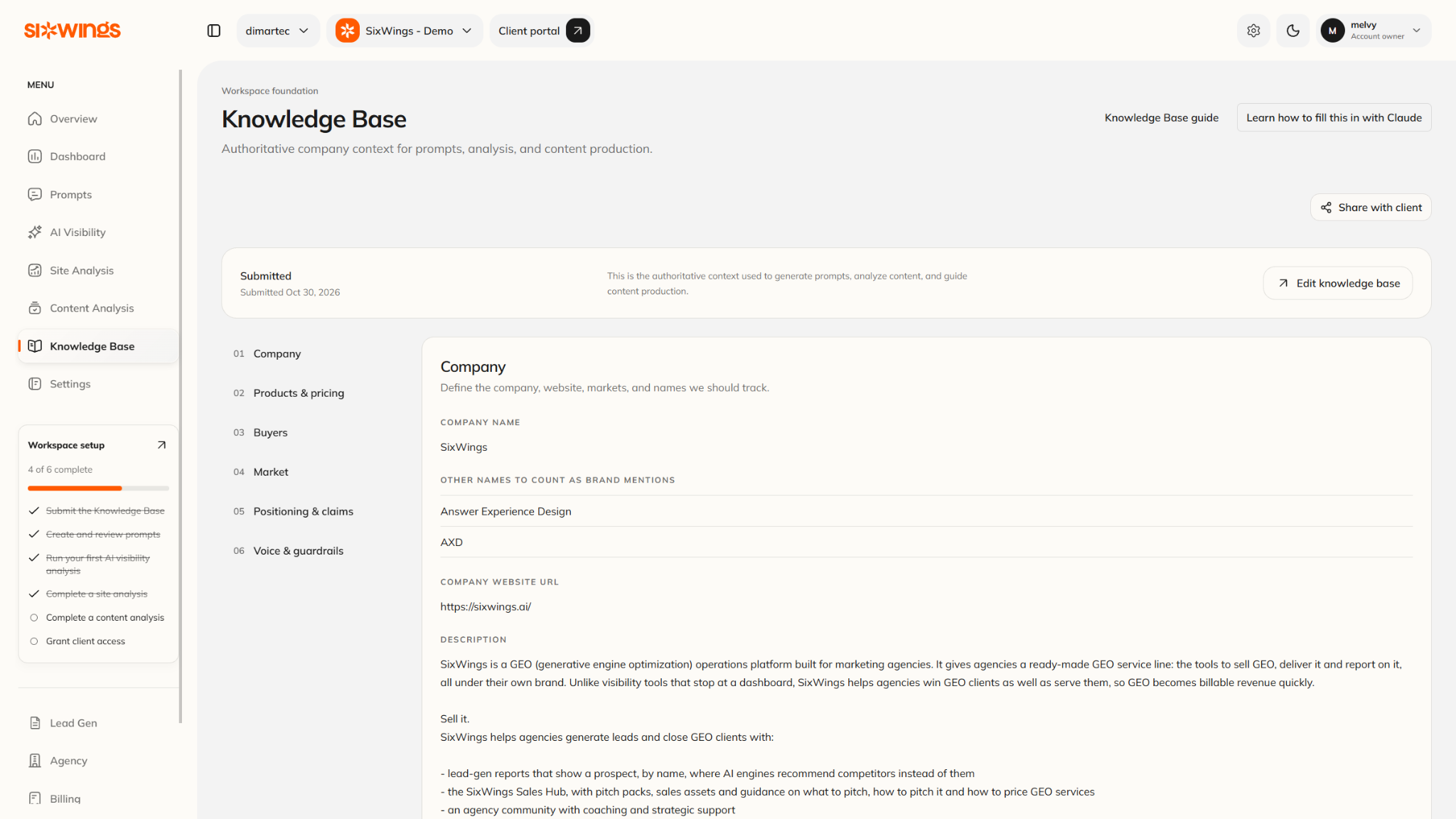
It begins with the knowledge base, the record of a brand's context. That record includes the brand's ICPs: who its buyers are, the problems they have, and the language their market uses. Capturing the ICPs is the foundation, because everything downstream is built on them.
This is a deliberate difference in how SixWings works, and it is one of its defining choices. A lot of GEO tools scrape a client's website and let AI guess the rest. That is quicker to set up, but the AI does not know the client's customers, their competitors, or what actually makes them different, so the strategy built on it is thin from day one.
SixWings made the opposite call: capture the detail properly up front, and put quality of delivery ahead of a fast start. The payoff is cumulative. The more a brand puts into its knowledge base, the sharper everything SixWings produces for it, and the longer that work stays valuable.
From that knowledge base, SixWings generates prompts grounded in the brand's own context, so the questions reflect how that brand's real buyers ask, not a generic template. You can then refine them, rename lists, add, remove, reorder, or rewrite questions, and classify each by commercial intent, from top of funnel through to bottom of funnel, so the high-intent, decision-stage questions each ICP asks are represented.
The effect is that the visibility run measures the brand against the questions its buyers actually ask, framed from their points of view, rather than against a broad question no real buyer uses. The result reflects the brand's true position with the buyers it cares about.
Because the ICPs live in the knowledge base, this also stays consistent over time. Every run uses the same buyer-grounded questions, so comparisons from one period to the next reflect real movement rather than a different set of questions each time. The ICP foundation is what makes the measurement both accurate and repeatable.
What a good ICP prompt looks like, and why doing it by hand breaks down
It helps to know what a good ICP-shaped prompt looks like. For each ICP, the question should carry that buyer's role, company type and size, and must-have requirement, in their own words. "Best scheduling tool" becomes "best scheduling tool for a multi-location clinic" for one buyer and "cheapest simple scheduling tool for a solo practice" for another. The high-intent, decision-stage versions matter most, because that is where buying happens.
Understanding that is the easy part. Doing it properly, at the scale that gives a true picture, is where a manual approach falls apart.
A real test is not two or three prompts. It is a meaningful set of questions for each ICP, run across several engines, repeated over time so you can see movement, with the brand and competitor results captured from every answer.
Done by hand, that is hours of typing, copying, and note-taking per client, and the moment you change the questions between runs, your comparison breaks. It does not scale past a single client, and it is not consistent enough to report on.
This is exactly the gap a platform is built to close. The thinking stays human, knowing your ICPs and what your buyers care about, but the generating, running, capturing, and comparing has to be systematic. That is what turns the right idea into a measurement you can actually trust and repeat.
Where SixWings fits
The thread through this article is that AI answers change depending on who asks, so a brand has to test the way its buyers actually ask. Doing that by hand, across every ICP, every framing, and every engine, is not realistic. This is what SixWings is built to handle.
SixWings pioneered the Answer Experience Design model and built the platform that runs it. In plain terms, it is a fully white-labelled GEO operating system.
It measures how a brand shows up in AI answers, turns that raw data into prioritized recommendations and simple implementation briefs, and hands those to whoever executes, so the work is easy to act on. Think of it as an SEO toolkit, but for the AI-answer layer instead of Google rankings.
For the who-is-asking problem specifically, it grounds everything in the brand's ICPs. It generates ICP-shaped prompts from the knowledge base, runs them across supported providers (currently OpenAI, Anthropic, Gemini, Perplexity, Grok, and AI Overviews), and keeps the evidence behind every answer, so you can see how the brand appears to each kind of buyer rather than to nobody in particular.
Rather than leaving you to interpret all of that, SixWings does the prioritizing, distilling the evidence into the questions, pages, and sources that matter most for the buyers a brand actually wants, and turning them into a prioritized roadmap, delivered under your own brand through a custom-branded portal.
The point is not that a tool changes how engines personalize. It is that a true picture of visibility comes from testing the way real buyers ask, and SixWings builds that into the prompts from the start.
Frequently asked questions
Why do I get a different answer than my colleague for the same AI question? Because engines can personalize to the person asking, using signals like location and past conversations, and because small differences in how each of you phrases the question change what the engine thinks you need. The same topic, asked from a different point of view, is effectively a different question.
Does this mean AI visibility cannot be measured reliably? It can, but not with a single generic prompt. Because answers change with framing, a true picture comes from testing the specific questions real buyers ask, shaped by the brand's ideal customer profiles, and reading the results per engine rather than as one universal number.
What is an ideal customer profile in this context? It is a clear description of a buyer the brand is trying to reach: their role, their company type and size, their problems, and the words they use. Each ICP implies a point of view, which implies a set of questions asked a particular way, which is what makes visibility testable for real buyers rather than generic ones.
Why are generic prompts a problem? Because they measure how a brand appears to nobody in particular. A brand can look visible on a broad question and be absent from the specific, high-intent questions its buyers actually ask, or the reverse. Either way, the generic result does not reflect the brand's real position with the people who matter.
Which AI engines does this apply to? The major generative answer surfaces buyers use today, including ChatGPT, Google's AI Overviews and Gemini, Perplexity, and Claude. Because each personalizes and interprets framing a little differently, visibility is best tested per provider and per ideal customer profile rather than as one blended number.