OpenAI has started letting businesses into ChatGPT directly. Through a new Business Hub, a company can claim and verify its business, keep its information and product feed up to date, and see insights on how people engage with it inside ChatGPT.
Eligible US ecommerce and online-service businesses can also build a Business Agent that answers customer questions. OpenAI says it reaches the 1.2 billion people who use ChatGPT each week, and frames this as an early step toward bringing businesses more deeply into the platform over time.
If you run marketing for clients, this is a moment to act on, not just read about. There is a simple, concrete new thing you can do for every client this week: get them properly set up in ChatGPT. It is an easy win, it is easy to explain, and it opens the door to the work that actually matters.
Here is the key thing to keep straight. Claiming a ChatGPT profile is the easy opener. The real service, the one worth building your agency around, is helping clients get recommended in AI answers across every platform, and being able to pitch, sell, and deliver that, not just track mentions on one tool.
This article gives you both halves, in order. First, a ChatGPT Business Readiness checklist you can run with any client this week, the quick win that gets you in the door. Then the part that matters more: how to turn that opener into an ongoing AI visibility service, across ChatGPT, Perplexity, Gemini, Google's AI Overviews, and Claude. The checklist is step one. The service is the point.
Contents
- What "Businesses in ChatGPT" actually is
- Why this matters for you and your clients
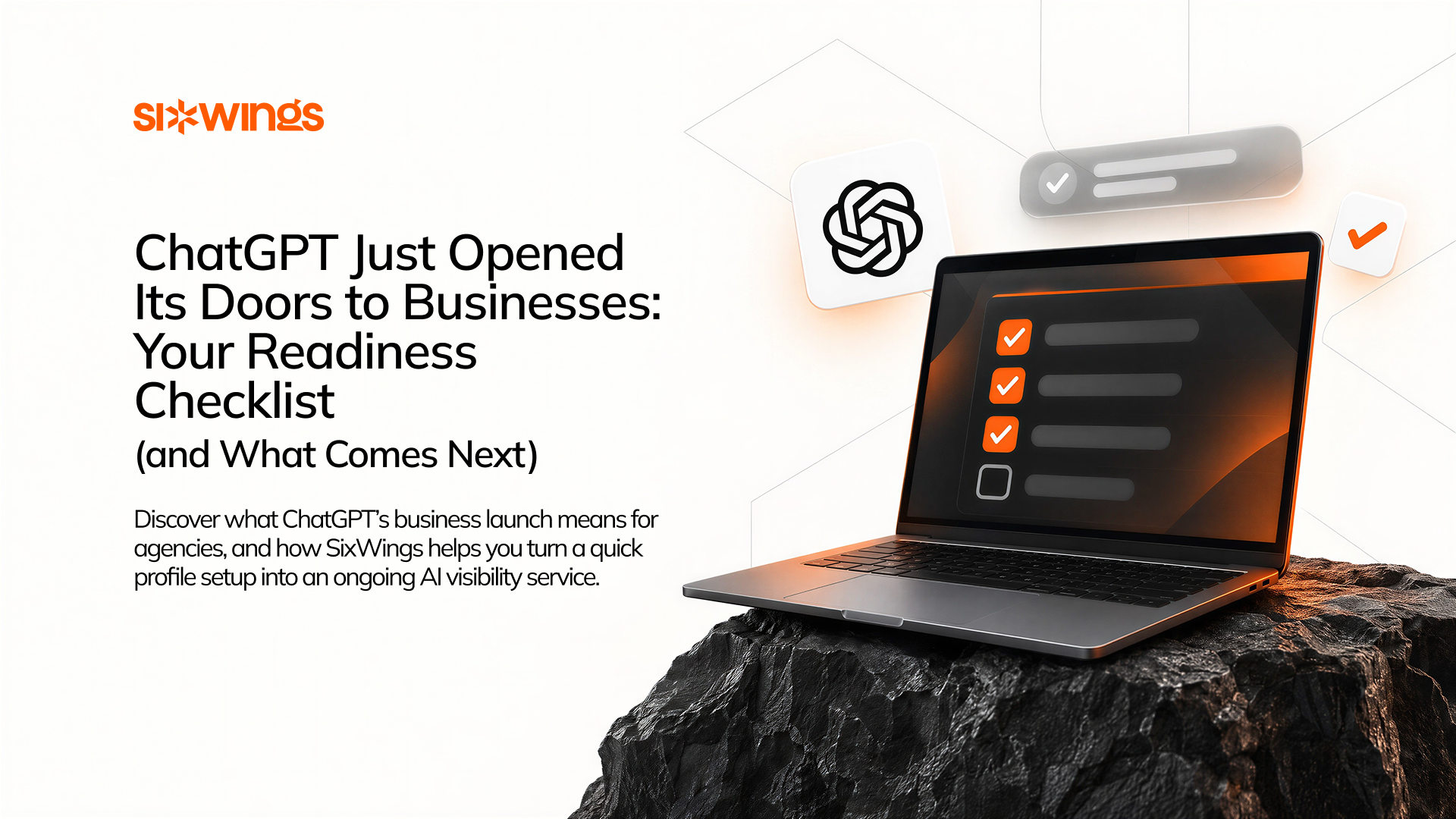
- The ChatGPT Business Readiness checklist
- How to pitch this to a client
- What the checklist does not do
- The real work: getting recommended across AI
- What this looks like in practice
- Where SixWings fits
- Frequently asked questions
What "Businesses in ChatGPT" actually is
In plain terms, OpenAI has given businesses three new things. Knowing what each one is tells you exactly what to offer a client.
A Business Hub to claim and manage the profile. A company can claim its business in ChatGPT and, once verified, update its key details and add a product feed with pricing and availability. Any eligible business where ChatGPT is available can claim its profile. Shopify merchants can connect their store to make verification easier.
Insights into engagement. The Hub shows aggregated data on how people engage with the business in ChatGPT: mentions, website clicks, and profile views, plus discovery topics, the common themes in conversations where the business is cited. The data is aggregated and privacy-protected, and only appears once there is enough activity to meet a threshold.
Business Agents. Eligible US ecommerce and online-service businesses can build an agent that answers customer questions and helps people explore their offerings. OpenAI is clear that this agent is clearly labelled and separate from ChatGPT's own independent answers. Businesses can also sponsor their agent as a paid placement.
Hold onto that last point. OpenAI draws a firm line between what a business controls, its profile and agent, and what it does not, ChatGPT's independent answers. That line is the key to everything below.
Why this matters for you and your clients
This launch is good news for agencies, for two reasons, and it comes with one important limit that is also an opportunity.
The first reason it is good news: it gives you an easy, concrete service to offer. "Let's make sure you show up properly in ChatGPT" is a sentence any client understands instantly. There is a profile to claim, information to get right, and a feed to populate. It produces a quick, visible result, which is the perfect way to start or deepen a client relationship.
For the client, the value is just as clear. More and more of their buyers are using ChatGPT to research and compare before they decide, so being present and accurate there is no longer optional. A claimed, well-maintained profile means the information people see about them is correct and current, rather than whatever the engine pieced together on its own.
The second reason: it gives you a reason to reach out now. This is an early beta, and most businesses have not acted on it. The agencies that get in touch while it is new, explain it, and set it up are the ones who own the relationship before anyone else does. Being early to a credible new service is its own advantage.
Now the limit, which is really the opportunity. Because ChatGPT now shows a business its own mentions and clicks for free, any tool that mostly reports those same numbers just became less useful. Reporting alone is no longer a differentiator.
What a client actually needs is someone who can act on the data and work across every AI platform, not just hand them a number ChatGPT already gives them. That is the service worth selling, and the checklist below is how you start the conversation.
So the strategic read is simple. This launch quietly retires one weak offering, the dashboard that only reports mentions, and it strengthens the real one, the service that interprets the data and acts on it everywhere buyers ask. For an agency positioned around the second, this is a tailwind.
The ChatGPT Business Readiness checklist
Here is the checklist to run with any client. It is the quick win: claim the ground in ChatGPT, get the information right, and set up the pieces that help a business show up accurately. Work through it in order.
1. Claim and verify the business. Claim the business in the Business Hub and complete verification. Shopify merchants can connect their store to streamline it, and enterprise customers or advertisers can claim through their OpenAI representative. Confirm the business is eligible and located where ChatGPT is available.
2. Get the core business information right. Fill in the key details accurately and completely: what the business is, what it does, who it serves, and how to reach it. Make sure this matches what the business says about itself everywhere else, because consistency across sources is what builds an engine's confidence.
3. Build an accurate product or service feed. Where the business sells products, add the self-service feed with correct pricing and availability, and keep it current. Outdated prices or discontinued items are worse than no feed, because they put wrong information into the experience.
4. Decide on a Business Agent. If the client is an eligible US ecommerce or online-service business, decide whether to build a Business Agent. If yes, set it up with accurate context, test it thoroughly, and make sure it answers real customer questions well before launching.
5. Set a maintenance rhythm. A profile is not set-and-forget. Agree who keeps the information, feed, and agent up to date, and how often. As the business changes its pricing, products, or positioning, the profile has to change with it.
6. Baseline the insights. Once claimed, record the starting point: mentions, website clicks, profile views, and the discovery topics where the business is cited. This baseline is what you measure progress against.
7. Read the insights as a starting point, not an answer. The native insights tell you what is happening, not why, and only for ChatGPT. Treat them as the first signal and the prompt for deeper work, not the full picture.
A final note on running it: do it with the client, not just for them. Walking a client through the claim and the insights, even briefly, turns a back-office task into a visible piece of value they remember you for. It also surfaces the questions that lead naturally into the deeper work, because the client starts asking them in the room.
Run this well and you have delivered a clean, concrete result for the client, and earned the right to the bigger conversation.
How to pitch this to a client
Because this is new, the pitch is easy, and it works for existing clients and cold leads alike.
Lead with the client's own curiosity. Most businesses have already wondered what ChatGPT says about them. "OpenAI just made it possible to claim your business in ChatGPT and see how people engage with you there, we can set that up for you" is a message that gets opened and answered, because it speaks to a question the client already has.
Keep the first offer small and concrete. The readiness checklist is a defined, finishable piece of work with a visible result at the end: a claimed, verified, well-populated profile. That makes it easy to say yes to, and easy for you to deliver quickly and look good doing it.
Then let the result do the selling. Once the profile is live and the insights start coming in, the obvious next question, why the client is or is not being recommended, is already on the table. You do not have to force the upsell. The setup earns it.
What the checklist does not do
This is the part that turns a one-off setup into an ongoing service, so it is worth being direct about it.
Claiming a profile lets a business provide accurate information and see its own ChatGPT data. It does not make ChatGPT recommend the business. When ChatGPT answers "what is the best option for X" and names some brands and not others, that answer is the engine's own judgment, built from across the web. A verified profile with a tidy feed does not put a brand into that answer.
Sponsoring a Business Agent does not change that either. That is paid placement, clearly labelled and separate from ChatGPT's responses, the way an ad is separate from an organic search result. It can put a business in front of people, but it is not the same as earning the organic recommendation, and buyers can tell the two apart.
And the profile covers one platform. Buyers also ask Perplexity, Gemini, Google's AI Overviews, and Claude, and each builds its own answers from its own sources. A perfect ChatGPT profile does nothing for how a brand appears in any of them.
So the checklist is necessary but not sufficient. It makes a client present and accurate in one place. It does not make the client get recommended, and it does not cover the other platforms where buyers are deciding.
The real work: getting recommended across AI
Here is the question every client will ask once their profile is live: "Great, we are set up. So why does ChatGPT still recommend our competitor, and what do we do about it?"
That question is the real service, and it is the same whether the platform is ChatGPT, Perplexity, Gemini, Google's AI Overviews, or Claude. Getting recommended in an AI answer comes down to a few things a profile cannot touch: whether the brand is described consistently across the web, backed by specific evidence rather than vague claims, structured so an engine can lift it cleanly, and present in the sources the engine actually draws on.
This is the work of GEO, generative engine optimization, and it is where lasting AI visibility is won. It is also exactly the work this ChatGPT launch does not do, which is why the launch is an opening for agencies rather than a threat. The profile setup gets you in the door; making the client actually recommended, across every platform, is the retainer.
The trap to avoid is treating ChatGPT profile setup as the whole job. It is the first, easy step. The ongoing work, diagnosing why a client is or is not recommended, fixing it, and doing it across all the AI platforms, is the part worth building a service around.
This is the core of it, so it is worth stating plainly. The service that wins is the one that lets an agency pitch, sell, and deliver GEO across every AI platform, not the one that tracks mentions on one. Tracking is now partly free, courtesy of ChatGPT itself.
Pitching a clear offer, selling it as a retainer, and delivering real movement in how a brand is recommended, everywhere buyers ask, is the work that is not free, not commoditized, and not going away. The ChatGPT checklist is simply the easiest way to begin that conversation.
It is worth being honest with clients about this, because it builds trust. Telling a client "we will claim and polish your ChatGPT profile, and that is a real and useful step, but it will not by itself make ChatGPT recommend you" is more credible than overselling the setup. It also sets up the next piece of work naturally, because the client now understands there is a next piece, and why it matters.
What this looks like in practice
Picture a client that sells accounting software to small businesses.
You run the readiness checklist with them. You claim and verify their profile, get their description and product feed accurate, and baseline the insights. Within a week they have a clean, verified presence in ChatGPT and their first engagement data. That is the quick win, delivered, and the client is pleased.
Then the insights raise the real question. The discovery topics show people are finding them for "simple accounting software," but when you check how ChatGPT actually answers "best accounting software for freelancers," a competitor is named and your client is not. The profile is perfect, and the client is still being left out of the recommendation.
That gap is where the ongoing work begins, and it is the same gap on every other platform too. Why is the competitor cited and not your client? Which pages is the engine pulling from? What on the client's own site is vague, inconsistent, or hard to lift? Answering those, across ChatGPT and Perplexity and Gemini and the rest, is the service that keeps the client paying, long after the profile setup is done.
Where SixWings fits
The checklist gets a client set up in ChatGPT. SixWings is how you deliver the part that comes after: getting them recommended across every AI platform, and pitching, selling, and delivering that as a service.
SixWings pioneered the Answer Experience Design model and built the platform that runs it. In plain terms, it is a fully white-labelled GEO operating system.
It measures how a brand shows up in AI answers, turns that raw data into prioritized recommendations and simple implementation briefs, and hands those to whoever executes, so the work is easy to act on. Think of it as an SEO toolkit, but for the AI-answer layer instead of Google rankings.
Where ChatGPT's own insights show one platform's mentions, SixWings runs real buyer questions across supported providers (currently OpenAI, Anthropic, Gemini, Perplexity, Grok and AI Overviews) and keeps the evidence behind every answer: whether the brand was mentioned, whether it was cited, which competitors appeared instead, and which pages the engine drew on. That is the multi-platform, why-behind-the-number view the native insights cannot give.
It does not stop at measurement. It checks the brand's own content and site for the reasons it is hard to recommend, and turns the evidence into a ranked plan of what to fix, which is the work that actually moves organic recommendations.
And because it is built for agencies, it supports all three parts of the core job. Pitching: the commercial side, how to position and price GEO, is supported, so you can sell it with confidence. Selling: results reach the client through a custom-branded portal, so the service looks like yours. Delivering: the ranked plans and briefs turn findings into work your team can actually ship.
That is the difference worth holding onto. The ChatGPT checklist opens the relationship. SixWings is how you pitch, sell, and deliver GEO across every client and every AI platform, and keep delivering it, which is the service this whole shift is pointing toward.
Frequently asked questions
What is Businesses in ChatGPT? It is a set of tools from OpenAI, in beta, that lets a company claim and verify its business through a Business Hub, keep its information and product feed up to date, and see aggregated insights on mentions, clicks, and profile views. Eligible US ecommerce and online-service businesses can also build a Business Agent that answers customer questions.
Does claiming my business in ChatGPT make ChatGPT recommend me? No. Claiming a profile lets you provide accurate information and see insights. OpenAI is explicit that a business's profile and agent are distinct from ChatGPT's own independent answers. Getting recommended in those organic answers is a separate job, and it is what GEO addresses.
If ChatGPT now shows my mentions for free, do I still need anything else? For the basic ChatGPT mention count, the native insights cover a lot. What they do not give you is the why behind the numbers, a view across other AI platforms like Perplexity, Gemini, and Claude, or a plan for what to fix. Those are the things that actually move recommendations.
Does this cover AI platforms other than ChatGPT? No. It is a ChatGPT feature. Buyers also ask Perplexity, Gemini, Google's AI Overviews, and Claude, and each builds its own answers from its own sources. A ChatGPT profile does nothing for how a brand appears on any other platform.
What should an agency do about this launch? Treat the ChatGPT profile setup as a quick-win service and a foot in the door: run the readiness checklist to claim, verify, populate, and maintain the client's profile. Then use that delivered result to open the bigger conversation about getting the client recommended across every AI platform, which is the ongoing GEO work.