Your clients are starting to ask a new question. Not "how are we doing on Google," but "what is ChatGPT saying about us, and do we show up in Perplexity." Most agencies do not have a confident answer yet.
The instinct is to treat GEO as a whole new discipline that needs new hires, which it is not. The team you already have, your SEO people, carry most of what GEO needs. The gap is not a skills gap. It is a mindset gap, and a few new habits.
This article is for the agency owner deciding whether to retrain rather than rehire. It covers the skills that transfer straight over, the mindset shifts your team needs to make, the new habits to build, and how to explain the change to existing SEO clients and offer GEO without undercutting the SEO work they already pay for.
There is a real decision underneath this. You can hire GEO specialists, which means recruiting for a role that barely existed a year ago, learning the discipline well enough to judge whether a new hire is any good, and waiting months before the first client sees anything.
Or you can retrain the team you already trust, who already know your clients, and point their existing skills at a new surface. For most agencies, the second path is faster, cheaper, and less risky, and it is the one this article lays out.
Contents
- The skills that carry straight over
- The mindset shifts, side by side
- The new habits to build
- The mistakes to avoid while making the shift
- How to explain the shift to existing SEO clients
- How the Sales Hub helps you sell it
- Where SixWings fits
- Frequently asked questions
The skills that carry straight over
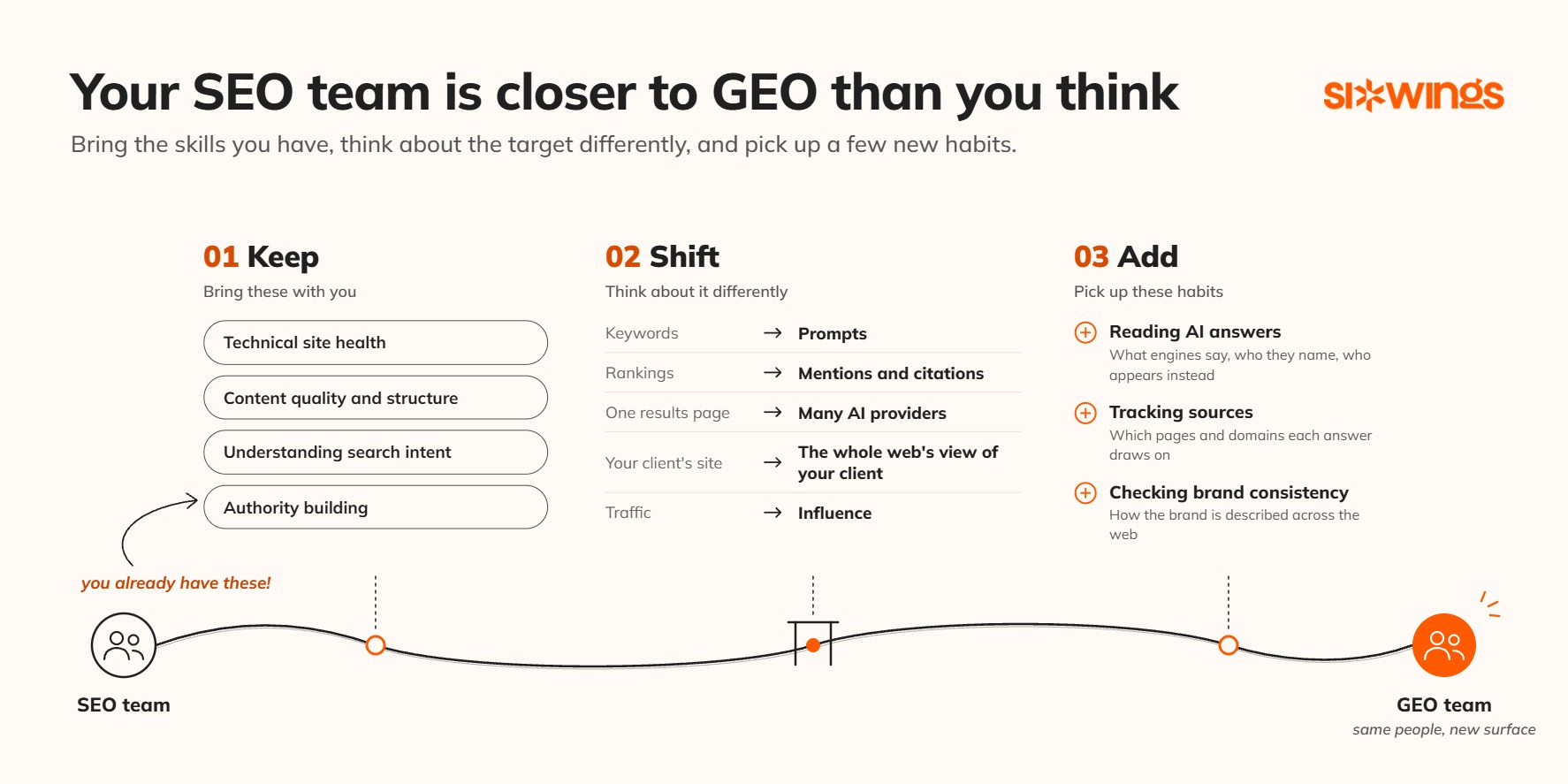
Start with the reassuring part, because it is also the strategic part: most of what makes a strong SEO practitioner makes a strong GEO practitioner. GEO builds on SEO rather than replacing it, which is exactly why your existing team is the right team.
Technical site health. The technical instincts an SEO team already has map almost directly onto GEO. Clean site structure, crawlability, structured data, fast and consistent pages, sensible metadata: these matter for AI answer engines for the same underlying reason they matter for search.
An engine has to be able to access, read, and understand a page before it can use it. An SEO who can diagnose a crawl problem can diagnose why an AI engine cannot read a page.
Content quality and structure. SEO teams already know how to write content that is clear, well-organized, and genuinely answers a question. That skill becomes more important in GEO, not less. Answer engines favor content that states things clearly, can be extracted in a clean passage, and backs claims up. A team that knows how to structure a page for a featured snippet already understands most of what makes a page citable by an AI engine.
Understanding search intent. The discipline of asking "what does this person actually want" is at the heart of SEO, and it is at the heart of GEO too. The difference is the shape of the question, which we will come to. But the underlying skill, reading intent and matching content to it, transfers completely.
Authority building. SEO teams understand that visibility is earned through authority: credible content, references from trusted places, a brand that is known for something. AI engines lean on the same signals when deciding which sources to trust and cite. The work of building a brand's authority across the web is work an SEO team already knows how to do.
The point of listing these is not just reassurance. It is that the foundation is already built. Retraining an SEO team for GEO is not starting from zero. It is redirecting skills they already have toward a new surface.
This is also why GEO is a defensible service for an agency rather than a commodity. An agency that already does SEO well has most of what GEO requires, so the move is natural. An agency that treats GEO as a separate bolt-on, disconnected from the search foundations it rests on, tends to deliver a weaker version of both.
One clarification before going further, because it changes what retraining actually means. The skills above are the judgment your team brings. They are not the method, the measurement, or the reporting, and your team should not have to build those from scratch.
In practice, a GEO operating system supplies the method and the data, and the team applies its transferred skills on top. Retraining is about pointing good judgment at a new surface, not about hand-building a GEO practice from nothing.
The mindset shifts, side by side
If the skills transfer, what actually changes? The shift is in how the team thinks about the target. Here are the five mindset shifts, set side by side.
Each one is worth understanding on its own.
Keywords become prompts. SEO tracks search terms, the short phrases people type into a search box. GEO tracks prompts, the full, natural questions people ask an AI engine. A prompt is longer, more conversational, and often more specific about the decision being made. The shift is from optimizing for a keyword to understanding the real questions a buyer asks, and the comparison and decision questions matter most, because that is where a choice gets made.
Rankings become mentions and citations. SEO measures position: where you sit on the results page. GEO measures something different: whether the brand is named in the answer at all, and whether it is cited as a source behind it.
You are no longer trying to be listed on a page. You are trying to be chosen inside an answer. That is a harder and more binary target, because an answer either includes you or it does not.
One results page becomes many AI providers. In SEO, there is essentially one Google results page to win. In GEO, there are several engines, and they do not answer the same way. A brand can be strong in one and invisible in another for the very same question, because each engine searches and cites differently. The team has to stop thinking about one surface and start thinking about several, each measured on its own.
Your client's site becomes the whole web's view of your client. SEO work centers on the client's own site, the thing you control. GEO is wider. An AI answer is built from sources across the web, most of which are not the client's site: directories, review sites, publishers, competitor pages.
The team has to shift from optimizing one property to shaping how the whole web represents the client, because that is what the engine draws on.
Traffic becomes influence. SEO's goal is the click: traffic to the site. GEO's value often happens with no click at all. An AI answer can shape a buyer's shortlist, their impression, their decision, entirely inside the answer, before any site is visited.
The team has to stop measuring success only in sessions and start thinking in terms of influence: whether the brand is shaping the decision, even when nobody lands on the page. This is the hardest shift for an SEO team, because sessions are concrete and influence is not, but it is the one that matters most as more buying research moves into the answer itself.
None of these shifts throws away the SEO mindset. Each one extends it to a new surface where the rules are related but different.
The new habits to build
Mindset shifts become real through daily habits. Three new habits turn an SEO team into a GEO team in practice. The important thing is that these are habits of attention and judgment, not manual data collection. A GEO operating system captures the raw material; the team's job is to read it well and decide what to do.
Reading AI answers. The single most important new habit is simply looking at what the engines say. An SEO team is used to reading a rankings report. A GEO team reads the actual answers: what the engines say when asked a client's buying questions, who they name, how they describe the client, which competitors appear instead.
The platform runs the questions and captures the answers; the habit is making a point of reading them, the way checking rankings became routine in SEO.
Tracking sources. The second habit is paying attention to the sources behind answers, not just the answers themselves. Which pages and domains is the engine drawing on? Which ones is it citing?
This is new territory for an SEO team, because the sources shaping an answer are usually not the client's own site. Learning to trace a weak answer back to the specific page or directory feeding it is the habit that turns observation into a fixable problem.
Checking brand consistency across the web. The third habit is auditing how a brand is represented everywhere, not just on its own site. Because engines build answers from across the web, an outdated fact on a third-party listing or an inconsistent description on a review site can shape an answer. A GEO team learns to watch the brand's wider footprint, because that footprint is what the engine reads.
These habits are not exotic. They are the GEO versions of things an SEO team already does, pointed at a new surface. Build them in, and the team is operating as a GEO team.
How to explain the shift to existing SEO clients
Retraining the team is half the job. The other half is the client conversation, and the goal there is to add GEO without undercutting the SEO the client already values.
The honest framing is that GEO does not replace SEO. It sits alongside it. Strong search foundations still feed AI citation, and much of the work overlaps, so the SEO investment the client has made is not wasted. It is part of what makes them visible in AI answers too. Say this plainly, because a client who hears "SEO is dead" will distrust the whole pitch.
Then name the new surface. The client is already asking about ChatGPT and AI answers, or they soon will be. Position GEO as the answer to a question they already have, not a problem you invented. "You asked what AI is saying about you. Here is the service that measures and improves it" is a far better opening than a cold upsell.
The cleanest way to make it concrete is to show them. An AI visibility check on their own brand, with their name in it and competitors named instead, turns an abstract pitch into a specific gap they can see. Showing beats telling, because the client is looking at real answers about their own company rather than taking your word that this matters.
Frame GEO as the natural next layer of a service they already buy. They pay you to manage how they are found on Google. GEO is how they are found in AI answers. It is the same job, extended to where discovery is moving, which makes it an expansion of the relationship rather than a replacement of it. That framing protects the SEO retainer and adds the GEO one on top.
How SixWings Sales Hub helps you sell it
Retraining the team to deliver GEO still leaves one gap: knowing how to pitch it, price it, and sell it. A capable delivery team is not automatically a capable sales team for a brand-new service, and this is where many agencies stall.
SixWings includes a Sales Hub for exactly this. It is a sales playbook and mini course on how to pitch GEO, what to charge for it, and how to win GEO clients, including the ones you already have. The point is that you are not left to work out the commercial side alone while also learning to deliver.
On the higher plan, the sell-side support goes further, with a sales toolkit of ready materials like an offer document, a proposal, and a pitch board, plus a GEO agency community with coaching. The idea is that the selling is supported the same way the delivery is, so adding GEO is a complete service line rather than just a tool.
This matters for the SEO-to-GEO transition specifically. The team can deliver, because their skills transfer. The Sales Hub covers the part that does not transfer automatically: how to package and sell a service the agency has not sold before.
The mistakes to avoid while making the shift
A few predictable mistakes slow this transition down, and naming them up front saves time.
The first is treating GEO as a rebranding of SEO. If the team simply renames its existing audit and calls it GEO, nothing real changes and clients eventually notice. The mindset shifts above are the actual work, not the label.
The second is measuring GEO with SEO metrics. A team that reports only rankings and traffic will miss what GEO is for, because the value often happens with no click. The team has to get comfortable reporting mentions, citations, and share of the answer, not just sessions.
The third is overpromising. AI answers are volatile and rebuild constantly, so promising guaranteed placement in them is both untrue and unnecessary. What a GEO team can honestly offer is a disciplined program: measure how the brand appears, prioritize what to fix, do the work, and measure again. That honesty is a trust signal, especially with clients who have been burned by inflated claims before.
The fourth is trying to build the tooling and the method from scratch while also learning the discipline. That is the slow route, and it is the one the right platform removes.
Where SixWings fits
Turning an SEO team into a GEO team needs two things the team does not have on day one: a way to see the AI-answer layer, and a method for acting on it. The skills transfer, but the method and the tooling do not appear on their own, and building them from scratch is the slow, expensive route.
This is the gap SixWings closes, and it is why SixWings is an operating system rather than a tracker: it carries the method, not just the measurement.
SixWings pioneered the Answer Experience Design model and built the platform that runs it. In plain terms, it is a fully white-labelled GEO operating system.
It measures how a brand shows up in AI answers, turns that raw data into prioritized recommendations and simple implementation briefs, and hands those to whoever executes, so the work is easy to act on.
For a retraining team, it supplies the new habits as built-in workflow. It runs real buyer questions across supported providers (currently OpenAI, Anthropic, Gemini, Perplexity, and Grok, with Google's AI Overviews covered through the Gemini provider that powers them) and keeps the evidence behind every answer, so reading AI answers and tracking sources becomes something the platform structures rather than grunt work the team does by hand.
Crucially, it does not stop at measurement. It turns the evidence into prioritized recommendations and implementation briefs, so the method itself, the part that would otherwise take months to invent, is inside the software. That is what lets the existing team deliver GEO without a new specialist hire: the team brings the judgment, and the platform brings the method.
It also carries the commercial side. The Sales Hub supplies the pitch and the pricing, results are shared under the agency's own brand, and the cost is one flat fee per client, so the margin holds as the agency adds clients. The result is a path from an SEO team to a GEO service line that uses the people you already have, the skills they already have, and a platform that supplies the rest.
Frequently asked questions
Do I need to hire GEO specialists, or can my SEO team do it? Your existing SEO team is the right team. Most of what GEO needs, technical site health, content structure, intent, and authority building, transfers directly from SEO. The gap is a mindset shift and a few new habits, not a skills gap, which is why retraining is usually faster and cheaper than hiring.
Does moving into GEO mean dropping SEO? No. GEO builds on SEO and runs alongside it. Strong search foundations still feed AI citation, and much of the work overlaps, so the SEO service and its retainer stay valuable. GEO is an additional layer for the AI-answer surface, not a replacement.
What is the biggest change for an SEO practitioner? Learning to think in prompts, mentions, and citations instead of keywords and rankings, and learning that the sources shaping an answer are usually not the client's own site. The daily habit shift is reading actual AI answers and tracing their sources, rather than only reading a rankings report.
How do I sell GEO to clients without undercutting their SEO? Frame it as the natural next layer of a service they already buy. They pay you for how they are found on Google; GEO is how they are found in AI answers. Showing them a real AI visibility check on their own brand makes the gap concrete without implying their SEO was a waste.
Which AI engines should a new GEO team track? The major generative answer surfaces buyers use today, including ChatGPT, Google's AI Overviews and Gemini, Perplexity, and Claude. Because each answers and cites differently, the team should read and measure them per provider rather than treating AI visibility as a single number.