When someone asks ChatGPT, Perplexity, Gemini, Google's AI Overviews, or Claude about your category, the answer that comes back feels instant and whole. It reads like the engine simply knew the answer and typed it out.
It did not. That answer was assembled, in stages, from several moving parts: the question as the engine interpreted it, what the model already knew, what it searched for in the moment, and which of those sources it decided to trust enough to use.
Understanding those stages matters, because a brand can quietly drop out at any one of them. A brand can be absent because the engine never searched for it, or because it searched and did not retrieve it, or because it retrieved the page and chose not to cite it. Each of those is a different problem with a different fix.
This article walks through how an AI answer gets built, from the prompt to the final citation. At each stage, it shows where a brand can fall out, so that "we are not showing up" stops being one vague problem and becomes a specific, locatable one.
Contents
- The four stages of an AI answer
- Stage 1: The prompt, and how phrasing changes everything
- Stage 2: Training knowledge and live retrieval
- Stage 3: Sources searched versus sources cited
- Stage 4: The final answer
- Where a brand drops out, stage by stage
- Why this changes how you fix visibility
- Where SixWings fits
- Frequently asked questions
The four stages of an AI answer
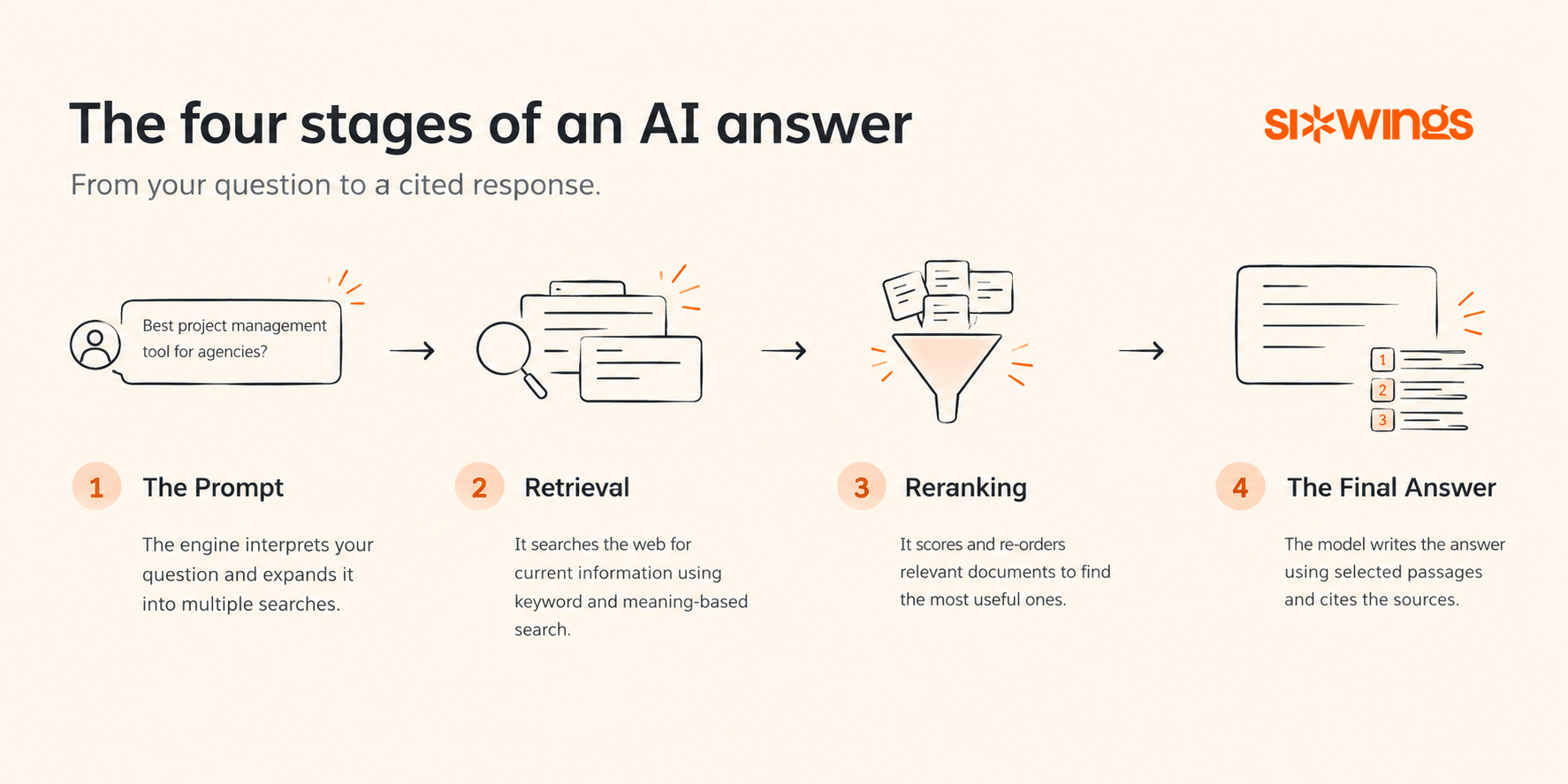
Most AI answer engines build a response in roughly four stages, and it helps to name them before going deeper.
First, the engine plans. It takes the user's question and works out what to search for, often rewriting and splitting it into several searches. Second, it retrieves, pulling in candidate documents through search. Third, it reranks, re-scoring those candidates to decide which passages are actually worth using. Fourth, it generates, writing the answer from the passages that survived and citing some of them.
Each stage narrows the field. The planning stage decides what gets looked for at all. Retrieval casts a wide net. Reranking is a fine filter. Generation is the final cut, where even a retrieved, relevant source may or may not get named.
The key idea to carry through the rest of this article is simple. A source can be dropped at any of these four stages, and each drop has a different cause. Knowing which stage failed is what makes a fix possible.
Stage 1: The prompt, and how phrasing changes everything
Everything starts with the prompt, the question the user actually types. But the engine rarely searches for that question word for word.
Instead, it interprets and expands it. A modern answer engine usually rewrites the prompt and fans it out into several distinct searches, each aimed at a different facet of the question. A single question like "best project management tool for agencies" might become several underlying searches: one about features, one about pricing, one comparing named competitors.
This is why phrasing changes the answer so much. The exact words in the prompt shape which searches the engine runs, and those searches decide which sources are pulled in at all. Ask the same underlying question two different ways and you can get two different sets of sources, and therefore two different answers.
For a brand, this has a direct consequence. You are not competing to appear for one question. You are competing across the whole spread of searches that a question fans out into. A brand can be well-matched to the headline question and still miss the specific searches the engine actually runs beneath it.
It also means the questions that matter are not always the obvious ones. The high-value moment is often a comparison or decision-stage phrasing, because that is where a buyer is choosing. Two brands can target the same broad topic while the engine, underneath, is running comparison searches that only one of them is prepared for.
The practical takeaway from stage one is that the prompt is not a single target. It is a doorway into a set of searches, and the brand's presence is decided across all of them.
Stage 2: Training knowledge and live retrieval
Once the engine knows what to search for, it draws on two very different kinds of knowledge to answer. Understanding the difference is central to understanding where brands win and lose.
The first kind is the model's training knowledge. This is what the model absorbed when it was built: a vast, compressed sense of the world up to a certain cutoff date. It is fast and always available, but it is frozen, general, and has no live awareness of what changed yesterday.
When a model answers purely from training knowledge, it is working from memory, and that memory can be out of date or vague about any specific brand.
The second kind is live retrieval. This is where the engine runs the searches from stage one, pulls in current documents from the web, and uses them to inform the answer. The technique behind this is usually called retrieval-augmented generation, or RAG: rather than relying on memory alone, the engine retrieves fresh, external sources and grounds its answer in them.
Grounding is the important word. A grounded answer is one built on retrieved sources the engine can point to, rather than on the model's unsupported memory. Grounding is what makes an answer current and checkable, and it is also what produces citations, because a citation is the engine showing which retrieved source a statement rests on.
The retrieval step itself typically combines two methods. One is keyword search, matching the literal terms. The other is vector search, which matches on meaning rather than exact words, so a page can be retrieved because it is about the right concept even if it does not use the exact phrase. The engine merges these result lists, and pages that score well on both tend to get a boost.
For a brand, stage two sets up two distinct ways to matter. You can be well-enough established that the model knows you from training, which helps you appear even in answers with little live retrieval. And you can be well-enough structured and current that you get retrieved live, which is what gets you into grounded, cited answers. The strongest position is both.
Stage 3: Sources searched versus sources cited
This is the stage most people miss, and it is the most important one for understanding brand visibility. The sources an engine searches and the sources it cites are not the same set, and the gap between them is where a lot of brands quietly lose.
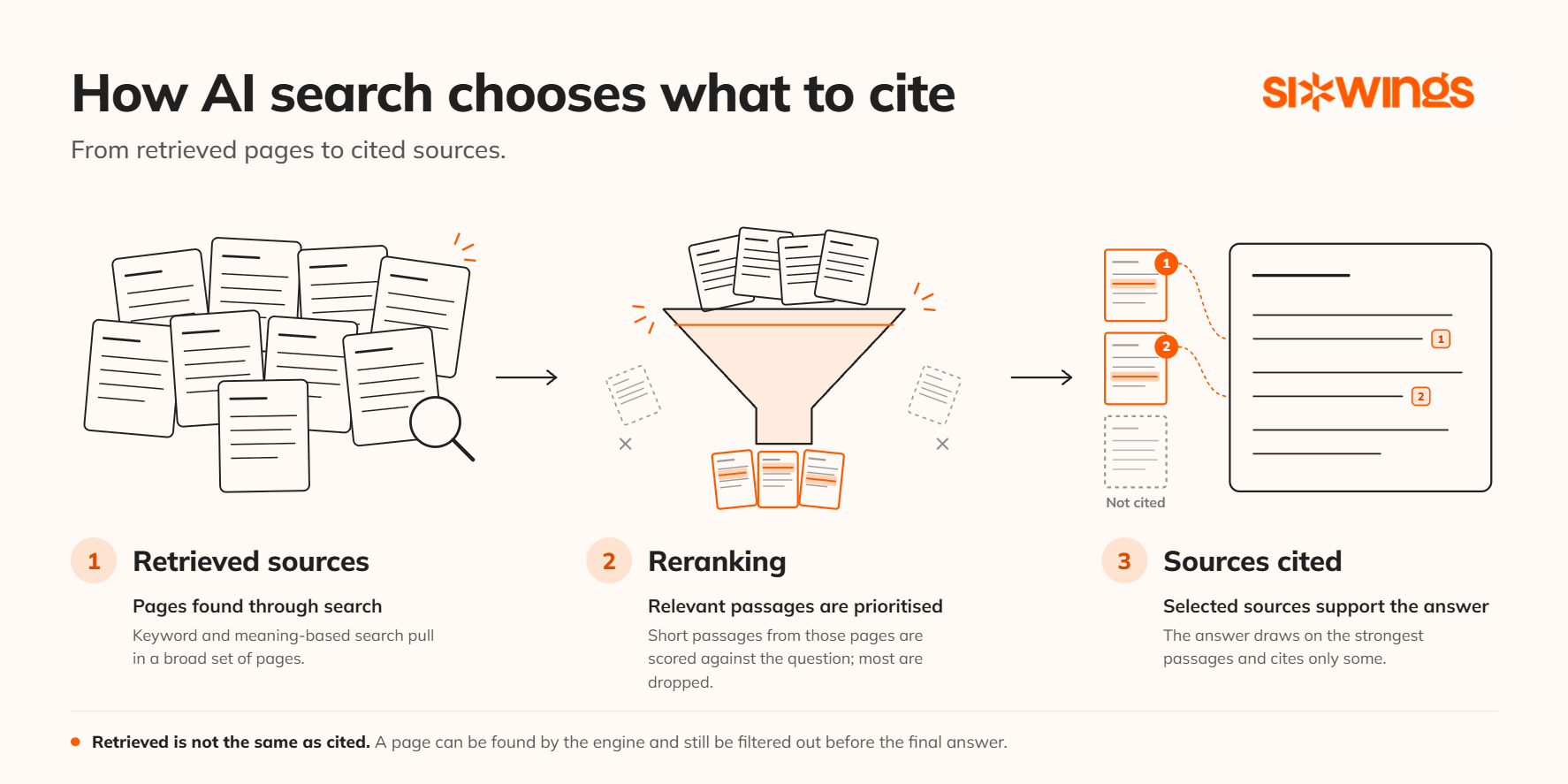
Retrieval, from stage two, casts a wide net. It pulls in many candidate documents (the pages the engine has found that might be relevant, before it has decided which ones to actually use), far more than will ever appear in the final answer. Then the engine narrows that long list down, and it does this through a step called reranking.
Reranking is a filtering step where a model reads each candidate passage (a specific chunk of text pulled from one of those pages, such as a paragraph, rather than the whole page) alongside the question and re-scores it for how well it actually answers that question. It is a fine filter applied to the broad list that retrieval produced. Most of the retrieved sources do not survive it.
One detail matters here. The reranker scores passages, not whole pages. A strong, authoritative page can still contain a weak passage that gets scored low for a specific question, which means a good site can be retrieved and then still lose at this stage because the relevant passage was not clear or direct enough.
After reranking, the engine generates the answer from the surviving passages, and even then not every surviving source gets named. The generation step applies its own logic: source quality, a preference for diversity so the answer does not lean on one domain, and the simple fact that the answer only has room to cite a few things.
So a source can be searched but not retrieved, retrieved but not reranked highly, or reranked but not cited. Each of those is a different outcome with a different cause. This is why "we were in the sources but not in the answer" is a real and common situation, not a contradiction.
The distinction between searched and cited is, in a sense, the whole game. Being searched means the engine looked in your direction. Being cited means it chose you as a source worth standing behind. The work of GEO is largely about closing the distance between the two.
Stage 4: The final answer
The last stage is generation: the engine writes the answer from the passages that made it through, and attaches citations to some of them.
A few things are worth understanding about this stage. The answer is written fresh, not copied. The engine takes the pieces of text that made it through, plus what it already knows from training, and writes them up into new sentences. This is why a brand can be described in words that appear on no single page: the description is pieced together, not lifted.
It is also why the answer can get a brand wrong. If the pages that survived are thin, out of date, or disagree with each other, the engine can still blend them into one smooth, confident sentence that happens to be inaccurate.
The citations attached at this stage are the engine showing its work, but it only shows some of it. A cited source is one the engine is willing to point to for a specific claim.
A missing citation does not always mean a source went unused, and a citation does not mean it was the only thing that shaped the answer. Citations show you part of what an answer is built on, not the full list.
Finally, this stage is not fixed. Because the engine builds the answer fresh each time, and because the sources and the model keep changing, the same question can produce a different answer, with different brands and different citations, from one run to the next. An AI answer is a snapshot of a moving process, not a stable fact.
Where a brand drops out, stage by stage
Now the payoff. If a brand is not showing up well in AI answers, the cause sits at one of the four stages, and naming the stage is what points to the fix.
Dropped at the prompt stage. The engine's searches, fanned out from the question, never pointed toward the brand's territory. The brand may be strong on the headline topic but absent from the specific comparison or decision searches running underneath. The issue is a mismatch between the brand's content and the actual searches buyers' questions generate.
Dropped at retrieval. The engine searched in the right direction but did not pull in the brand's pages. This is usually a coverage, structure, or findability problem: the content is not indexed well, not machine-readable, or not clearly about the thing being searched. The brand exists but was not found.
Dropped at reranking. The brand's page was retrieved but scored too low to survive the filter, often because the relevant passage was not clear, direct, or extractable enough for the specific question. The page was found but judged not the best answer to that exact query.
Dropped at generation. The brand's source survived reranking but was not cited, whether because of source-quality judgments, diversity rules, or simply limited room in the answer. The brand was close, and the gap is about authority, clarity, or distinctiveness relative to what did get cited.
Each of these is a genuinely different problem. A brand dropped at retrieval needs to become findable. A brand dropped at reranking needs clearer, more extractable passages. A brand dropped at generation needs stronger authority or a sharper, more citable claim. Treating all four as one problem, "we are not visible," is how teams waste effort fixing the wrong stage.
Why this changes how you fix visibility
The most common mistake in AI visibility work is to see a weak answer and immediately rewrite a page. Sometimes that is right. Often it changes nothing, because the page was never the problem.
Rewriting a paragraph does nothing for a page that was never retrieved. Adding more content does nothing if the issue was that the engine never searched in that direction. Improving authority does nothing if the passage simply was not clear enough to survive reranking. The fix only works if it matches the stage where the drop actually happened.
This is why the useful question is never just "are we visible?" It is "at which stage are we losing?" The prompt stage, the retrieval stage, the reranking stage, or the generation stage. Diagnosing the stage first, and changing content second, is the difference between work that moves the answer and work that just feels productive.
It also reframes what "winning" looks like. You are not trying to rank for a question. You are trying to survive four sequential filters: get searched for, get retrieved, get reranked highly, and get cited. A brand that understands this stops asking why it is invisible in general and starts asking, specifically, where in the pipeline it is being filtered out.
Where SixWings fits
Everything above describes a process that is, by default, invisible. You see the final answer, but not the stages that produced it, which is exactly why diagnosing the real problem is so hard. SixWings exists to make that process visible and fixable.
SixWings pioneered the Answer Experience Design model and built the platform that runs it. In plain terms, it is a fully white-labelled GEO operating system.
It measures how a brand shows up in AI answers, turns that raw data into prioritized recommendations and simple implementation briefs, and hands those to whoever executes, an in-house team or an external one, so the work is easy to act on.
Mapped to the four stages, it surfaces what each one normally hides. It runs real buyer questions across supported providers (currently OpenAI, Anthropic, Gemini, Perplexity, and Grok, with Google's AI Overviews covered through the Gemini provider that powers them).
For every answer, it preserves the full evidence: the question, the response, where the brand and competitors were mentioned, the citations, and, where the provider exposes them, the web-search queries the engine ran and the sources it retrieved.
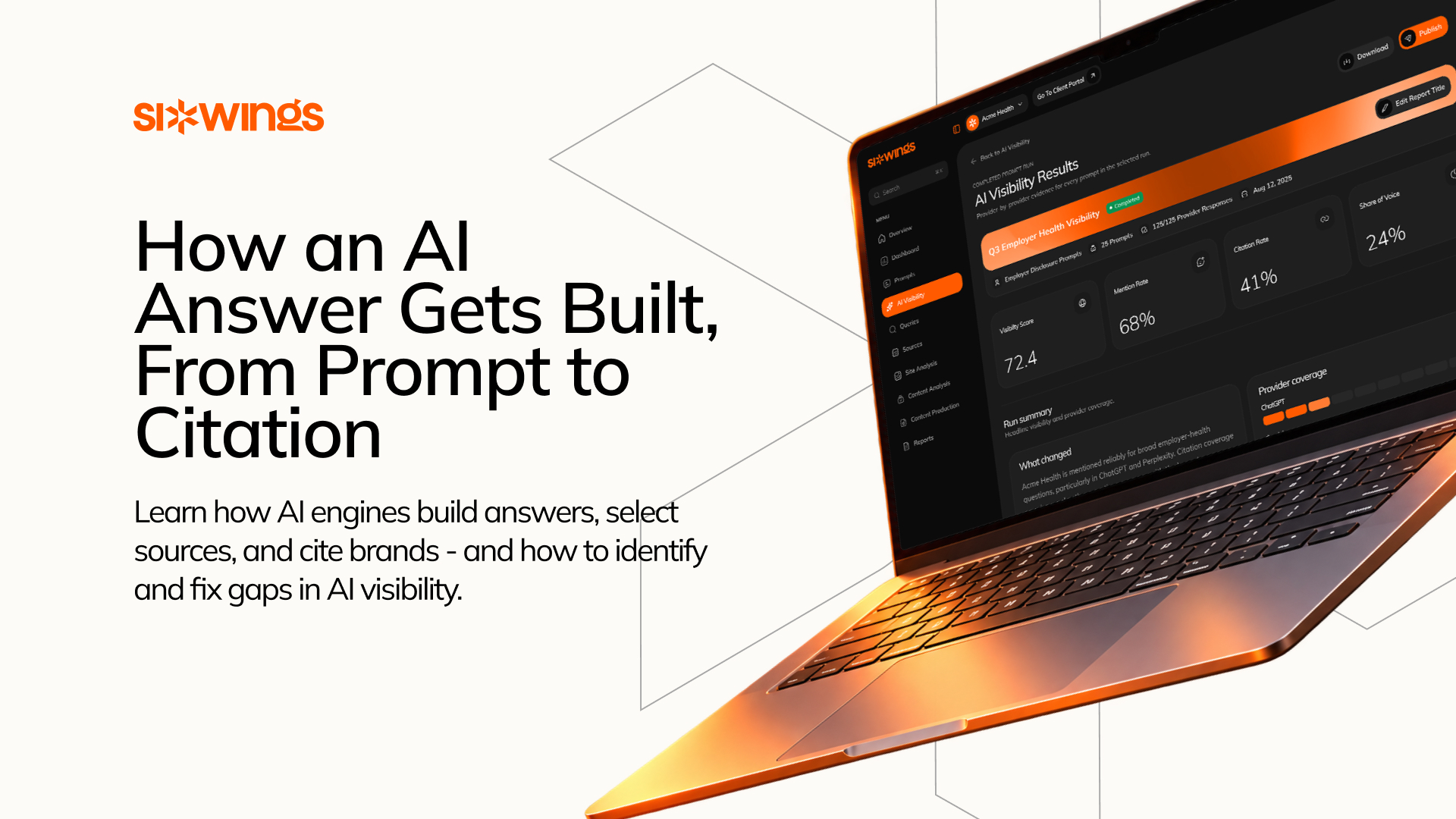
That evidence is what lets you separate the stages. The captured searches show what the engine looked for. The searched sources show what it retrieved. The citations show what it actually used. Seeing those side by side is how "we are not visible" becomes "we are retrieved but not cited on these questions," which is a problem you can act on.
Rather than leaving you to interpret all of that, SixWings does the prioritizing, distilling the evidence into the prompts, pages, and sources that matter most and turning them into a ranked plan. The point is not that a tool changes how AI answers get built. It is that the process is invisible until something captures it, and acting on the right stage is only possible once you can see which stage is failing.
Frequently asked questions
Why does AI give a different answer to the same question each time? Because the engine rebuilds the answer from scratch on each run, and the sources it retrieves and the model itself keep changing. An AI answer is a snapshot of a moving process, not a fixed fact, which is why AI visibility has to be measured repeatedly rather than checked once.
What is the difference between a source being searched and a source being cited? Searched means the engine retrieved the page as a candidate while building the answer. Cited means it chose that page as a source worth pointing to in the final answer. Many pages are searched and then filtered out before citation, so being in the sources is not the same as being in the answer.
Why does changing the wording of a question change the answer? Because the engine expands the prompt into several underlying searches, and the exact words shape which searches run. Different phrasings pull in different sources, which produce different answers. This is also why the specific, high-intent phrasings a buyer uses matter more than the broad topic.
What is retrieval-augmented generation? It is the technique where an engine retrieves live, external sources and grounds its answer in them, rather than relying only on the model's training memory. Grounding in retrieved sources is what makes an answer current and checkable, and it is what produces citations.
Which AI engines does this apply to? The major generative answer surfaces buyers use today, including ChatGPT, Google's AI Overviews and Gemini, Perplexity, and Claude. Each behaves a little differently and exposes different data, which is why the evidence behind an answer is best kept per provider rather than assumed from one universal number.