The difference between SEO and GEO is no longer academic - it's a line on a budget.
SEO (Search Engine Optimization) works to rank a page in a list of results and earn a click.
GEO (Generative Engine Optimization) works to get a brand named, described, and cited inside the answer an AI engine generates - ChatGPT, Perplexity, Gemini, Google's AI Overviews, Claude.
The cost of not knowing the difference is specific: your rankings can look perfectly healthy on the SEO dashboard while the clicks, the buyers, and the category conversation quietly move somewhere you aren't measuring.
This article is about that gap - the commercial cost of running SEO alone while treating AI answers as someone else's problem.
It's written for agency owners and marketing leaders who already sell search visibility and are deciding whether AI-answer visibility is a real budget line or a hype cycle.
The short version: the traffic decline is measurable, the blind spot is structural, and the brands moving first are compounding an advantage the laggards will pay to recover in years to come.
Here's the uncomfortable part.
Most teams don't discover the cost until a client asks why leads are down while the rankings report is still green.
By then the money has already moved.
Contents
- GEO vs SEO in one table
- The blind spot: why your SEO dashboard looks fine while traffic falls
- The eight places the cost of not knowing actually shows up
- Why GEO doesn't replace SEO - and why that's the point
- What "knowing" looks like in practice
- Where SixWings fits
- Frequently asked questions
GEO vs SEO in one table
Builds on SEO; adds citation, entity, and extractability work
The two are not rivals. They're layers. The problem is that most measurement stacks only see the bottom layer - and the buyer has moved to the top one.
The blind spot: why your SEO dashboard looks fine while traffic falls
This is the core of "the cost of not knowing," so it's worth being precise.
When Google shows an AI Overview, your ranking doesn't necessarily drop. The blue link is still there, still in position. What changes is the click.
Multiple independent studies converge on the same direction: when AI Overviews appear, organic click-through rate drops sharply - Seer Interactive's analysis of millions of queries put the fall at roughly 61%, while a randomized field experiment by researchers at the Indian School of Business and Carnegie Mellon measured a 38% reduction in organic clicks on queries where AI Overviews triggered.
The mechanism is what makes it dangerous: rankings haven't moved, the content is solid - but clicks per impression are collapsing.
That's the trap. A dashboard built for SEO reports position, and position looks fine.
The damage is happening one layer up, in a surface the SEO stack was never designed to watch. You can't fix what you can't measure - and by default, you can't measure what an AI answer says about you at all.
The blind spot compounds because the shift underneath it is structural, not seasonal.
Similarweb measured zero-click searches rising from 56% to 69% between May 2024 and May 2025, and in Google's fully conversational AI Mode the picture is starker still: AI Mode replaces organic results entirely, so unless your brand earns a citation inside the AI response, organic SEO has no reach there at all.
Ranking is becoming a weaker predictor of being seen: the overlap between page-one organic results and AI Overview citations had fallen to somewhere between 17% and 38% by early 2026, depending on the dataset.
Not knowing, then, isn't a passive state. It's an active accumulation of invisible losses on a report that says everything is fine.
The eight places the cost of not knowing actually shows up
The "cost" isn't one number. It surfaces in eight distinct ways, and each one is a place an agency can either get caught flat-footed or get ahead. Use these as the dimensions to audit against.
1. Lost clicks on queries you already "win"
You rank first and still lose the click. Organic CTR drops around 61% when an AI Overview appears, so the keywords your SEO work already earned are the exact ones being quietly devalued. The cost is highest where you feel safest.
2. Being absent from the answer entirely
AI citation is closer to binary than SEO ranking. In traditional search, a brand ranking fifteenth still gets some traffic and can improve incrementally; in AI-mediated research, a brand not cited in the summary receives nothing - there is no page two of an AI answer.
And absence is common even for strong sites: one H1 2026 B2B benchmark found the median brand was cited in just 3% of AI Overviews for its relevant keywords, despite ranking in the results those overviews summarize.
3. Being described wrong
Absence is one failure mode; misrepresentation is the quieter one. When your own content is thin or inconsistent, models fill the gap from elsewhere.
When you allow "data silence" on your own domain, AI models define your category using a competitor's attributes or an outdated archive.
The impression forms off-site, in an answer you never see, which makes it harder to detect - because the first impression happens in an answer you don't control.
4. Handing the category to competitors
Every gap you leave is a slot a rival fills. In categories where AI answers are already pervasive, the cost of being invisible is immediate - buyers are forming impressions inside AI summaries right now. The flip side is the opportunity: brands that learn to earn citations before competitors can shape how an entire category is framed, much as early SEO adopters captured outsized shares of organic visibility.
5. Forfeiting the highest-converting traffic on the web
This is the cost that hits pipeline, not just traffic. Buyers who arrive via an AI citation have usually already researched and compared, so they land in decision mode.
Being cited by AI drives measurably higher conversion, with early data suggesting AI-referred traffic converts several times better than organic search.
One benchmark framed the commercial gap bluntly: in a study of 312 B2B technology firms, AI accounted for just 4% of sessions but 19% of qualified inbound pipeline. Low volume, disproportionate value - and it flows to whoever is cited.
6. Misreading your own analytics
Because the losses hide behind stable rankings, teams draw the wrong conclusion.
Declining organic CTR often masks deeper pipeline losses as searchers prioritize AI answers over links.
An agency reporting only sessions and rankings will tell a client everything is fine right up until the client's revenue says otherwise - which is the worst possible moment to discover the gap.
7. Losing the B2B buyer before the first click
For B2B especially, the research itself has moved into the answer.
According to Forrester, 89% of B2B buyers use generative AI to evaluate providers before reaching out.
If a brand isn't present and accurate in that pre-click research, it isn't in the shortlist - and it never knows it was excluded.
8. Paying more to recover later than to move now
The advantage compounds, so the cost of waiting does too.
Once a brand becomes established as an authoritative source it gets cited more frequently, which reinforces its position as an authoritative source.
Early movers build durable ground; late movers face rising recovery costs to unseat incumbents who got there first. "We'll deal with it next year" is itself the expensive option.
Why GEO doesn't replace SEO - and why that's the point
It would be easy to read the numbers above as "SEO is dead." It isn't, and selling it that way is a mistake.
GEO builds on SEO. Strong search foundations - authority, clean technical structure, comprehensive content - still feed AI citation, and much of the underlying work overlaps.
The distinction is what you optimize for and what you measure: SEO optimizes for position and clicks; GEO optimizes for representation and citation.
A brand with weak search foundations rarely gets cited well, and a brand with strong foundations but no citation strategy leaves the AI layer to chance.
That's why "GEO vs SEO" is a slightly misleading frame, and why the real cost is in treating them as either/or. The teams paying the highest price are the ones running SEO competently and assuming it covers the AI surface. It doesn't.
The correct posture is additive: keep the SEO foundation, add the measurement and citation layer on top, and - critically - instrument the second layer so it's no longer a blind spot. The cost of not knowing is, at its root, a measurement cost. Fix the measurement and the strategy follows.
What "knowing" looks like in practice
If the cost is not knowing, the fix is a way to actually see the AI layer - and act on it. In practice that means being able to answer four questions for any brand:
- How do AI providers represent and cite this brand today? Not a single score, but the actual answers, mentions, and citations across supported providers.
- Where are the gaps and who's filling them? Which questions, searches, and sources are shaping the answers - and where competitors are being cited instead of you.
- What should we improve next? A defensible shortlist of priorities drawn from evidence, rather than a dashboard to stare at.
- How do we show a client what changed? Fixed, reviewable results a client can act on, not a moving number.
The reason this has to be a deliberate practice - rather than occasional manual spot-checks - is the volatility established earlier.
Answers rebuild constantly, so a one-time audit ages out fast; and providers expose different data, so "knowing" means keeping the underlying evidence per provider rather than trusting one universal figure.
Manual checking doesn't scale past a client or two, which is exactly why the measurement layer has to be operational, not occasional.
Where SixWings fits
SixWings pioneered a model for exactly this work - Answer Experience Design - and built the platform that runs it.
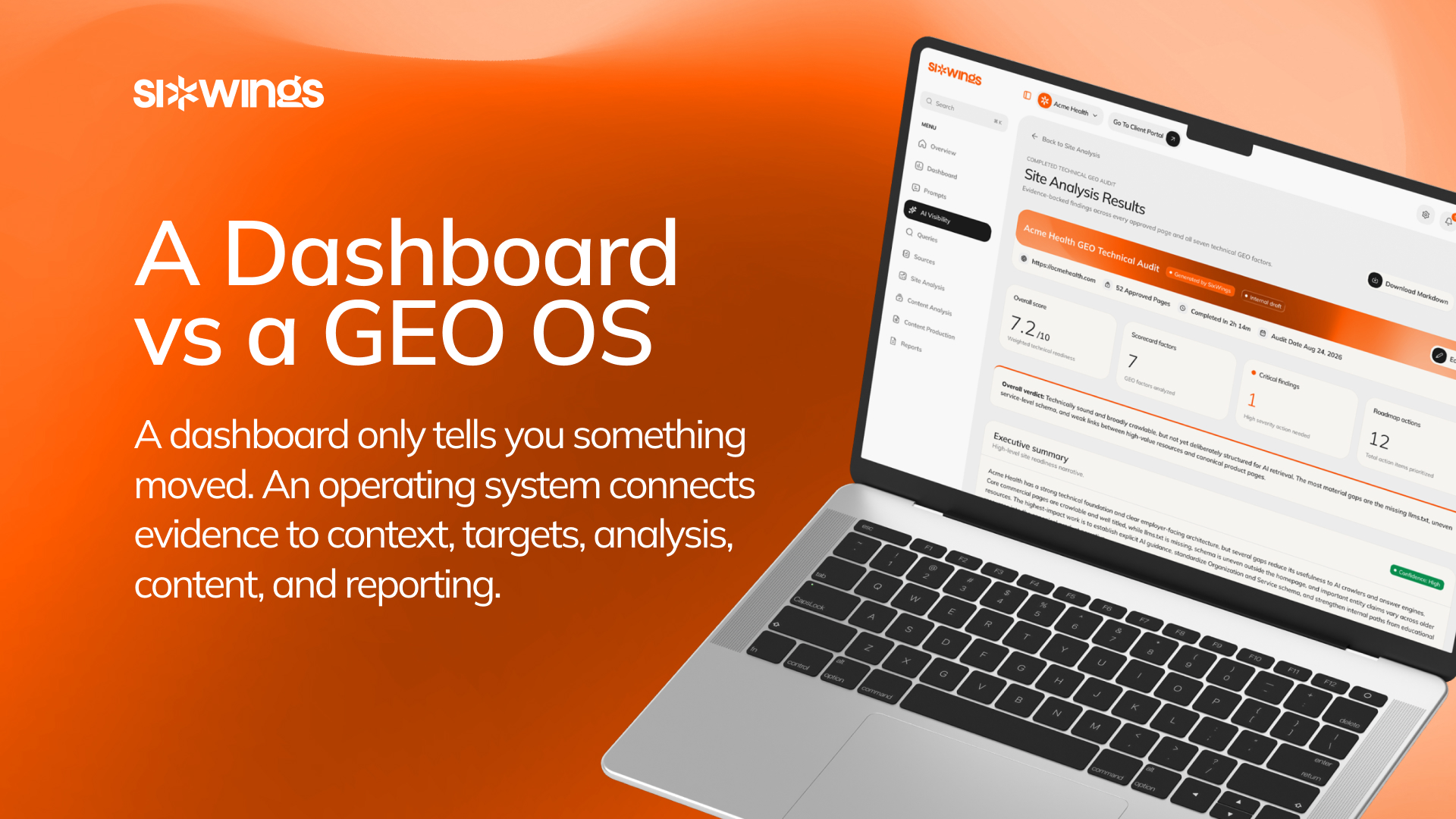
In plain terms, SixWings is a fully white-labelled GEO operating system. It measures how a brand shows up in AI answers, turns that raw data into prioritized recommendations and simple implementation briefs, and hands those to whoever executes - an in-house team or an external one - so the work is easy to act on.
Think of it as the equivalent of an SEO toolkit, but for the AI-answer layer instead of Google rankings.
Here's how it works, step by step:
- One workspace per brand. Each brand gets its own separate space, so one team can manage many without mixing data. Each space starts with a simple record of that brand's facts - what it sells, who it competes with, what it's allowed to claim - so everything the platform does stays true to that specific brand.
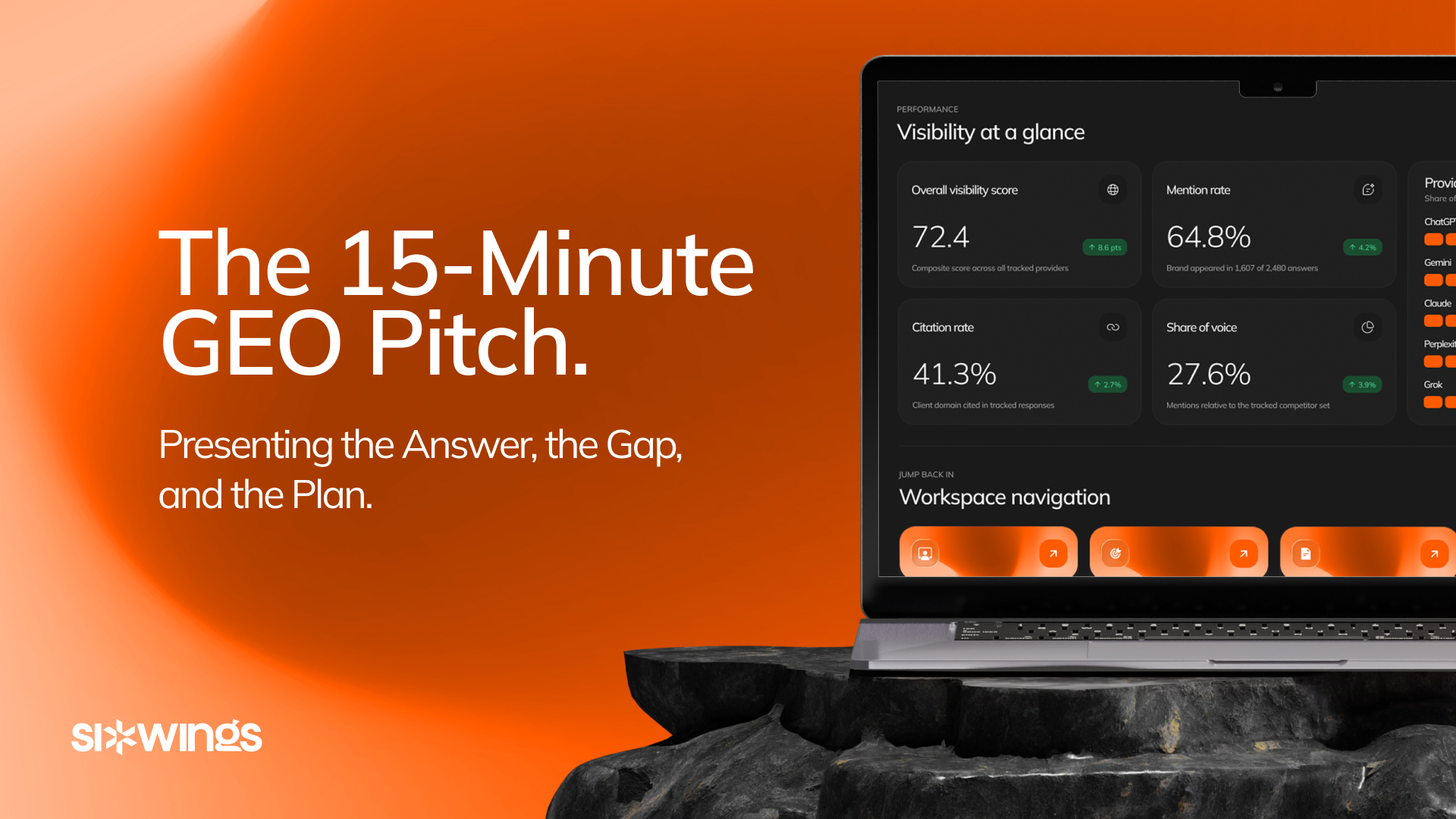
- See what AI says. SixWings asks the AI engines the kinds of questions a real buyer would ask, across supported providers (currently OpenAI, Anthropic, Gemini, Perplexity, and Grok), and records exactly what came back: whether the brand was mentioned, whether it was cited, which competitors showed up instead, and which web pages the AI leaned on. This is the part that closes the blind spot.
- Get told what to fix. Instead of leaving you to interpret a giant pile of data, SixWings does the prioritizing for you - it surfaces the short list of buyer questions, searches, and pages that matter most. That removes the decision fatigue and the hours normally lost to "figuring it out."
- Do the work. It checks a brand's website for the technical reasons AI finds it hard to read and cite, reviews existing content, and helps produce new website articles - with a person always approving the final version before anything goes live.
- Report the result. At the end, SixWings turns a reporting period into a clean, fixed summary, viewable through a custom-branded portal - so approved results can be shared without handing over the entire working setup.
The point isn't that a tool makes the problem disappear. It's that "the cost of not knowing" is, at its root, a knowing problem - and SixWings pioneered the model, and built the platform, to see the AI-answer layer, act on it, and report it, while SEO keeps doing its job underneath.
Frequently asked questions
Is GEO replacing SEO? No. GEO builds on SEO and runs alongside it. Search foundations still feed AI citation, and much of the content and technical work overlaps. GEO adds the citation, entity-consistency, and extractability work that ranking alone doesn't address - and, just as importantly, the measurement of a surface SEO tools don't watch.
If my rankings are stable, am I safe? Not necessarily - that's the blind spot. Rankings can hold steady while click-through rate on those same queries falls sharply once AI Overviews appear. Stable rankings on an SEO dashboard can coexist with real losses in clicks, pipeline, and category presence that the dashboard doesn't show.
What does "the cost of not knowing" actually mean? It's the accumulation of losses that don't appear on standard SEO reporting: clicks lost on queries you rank for, absence from or misrepresentation inside AI answers, high-intent AI-referred traffic going to competitors, and the compounding advantage rivals build while you wait. The losses are real before they're visible, which is what makes measurement the first fix.
Which AI engines does GEO cover? The major generative answer surfaces buyers use today - including ChatGPT, Google's AI Overviews and Gemini, Perplexity, and Claude. Each behaves differently and exposes different data, so a serious practice keeps the evidence per provider rather than assuming one universal metric.
Why does this matter more for agencies than for individual brands? Because agencies carry the reporting relationship. When a client's leads soften while the rankings report stays green, the agency owns that conversation. Being able to measure and explain the AI layer - across many clients, repeatably - turns a looming awkward conversation into a new, in-demand service line and a reason clients stay.