Sometime in the last two years, nearly every marketing and SEO agency added a line to its website: "We do GEO too." A new tab appeared in the navigation. A slide got added to the pitch deck. The conference talks pivoted from "how to rank on Google" to "how to show up in ChatGPT." Overnight, a whole category of agency work seemed to exist.
Most of it does not. Adding "we do GEO too" to a service menu is a claim, not an offer. A claim is a sentence on a page. An offer is a defined thing a client can buy, understand, and judge: a method, a set of deliverables, a way of reporting, and a reason to trust that it works. The gap between the two is exactly where agencies lose deals, lose pricing power, and lose the clients they thought the line would win.
This article is about that gap. It lays out, side by side, what "we do GEO too" looks like as a bolt-on versus what a real Generative Engine Optimization offer actually requires. The distinction matters more than it did a year ago, because clients have started asking a second question that most agencies still cannot answer.
Contents
- The second question clients now ask
- Bolt-on vs real offer: the core difference
- 1. A method, not a rename
- 2. Evidence, not adjectives
- 3. Defined deliverables, not "activity"
- 4. Reporting that stands up, not a screenshot
- 5. Repeatability, not a one-off heroics project
- 6. A trust boundary, not a black box
- Why the bolt-on is a commercial risk, not just a weak pitch
- Where SixWings fits
- Frequently asked questions
The second question clients now ask
Twelve months ago, an agency client asked one question about discovery: "How are we doing on Google?" Agencies had a mature answer for that, backed by years of tooling and reporting.
Today the client asks a second question too. "What about ChatGPT? Do we show up in Perplexity when someone searches for what we do? What is the AI saying about us?" The demand behind that question is real and growing. Surveys through 2026 put the share of B2B buyers using AI to research and evaluate vendors high enough that no agency can treat it as a fringe behavior.
Here is the uncomfortable part. Most agencies still do not have a systematic answer to the second question.
Not because they do not want one, but because they do not have the data or the workflow to produce it. So the "we do GEO too" line papers over a gap: it promises an answer the agency cannot actually deliver on demand.
That is survivable while the client is only curious. It stops being survivable the moment the client expects a deliverable, a number, and a plan. A claim that cannot become an offer under pressure is worse than no claim at all, because it sets an expectation the agency then fails to meet.
Bolt-on vs real offer: the core difference
The simplest way to see the difference is to notice what each one is made of.
A bolt-on is a repositioning. It takes work the agency already does, mostly traditional SEO, and relabels it for the AI era. The tactics do not change. The reporting does not change.
What changes is the word on the tab. Industry observers have been blunt about this: when the category emerged, some agencies genuinely rebuilt their methodology around how AI models retrieve and cite information, while others simply renamed their existing SEO services and hoped nobody would notice.
A real offer is a different thing entirely. It is a defined service with its own method, its own evidence, its own deliverables, its own reporting, and its own trust boundaries. It survives a skeptical client asking "how does this actually work, and how will I know it worked."
The rest of this article is the six-part test that separates the two. If an offer fails several of these, it is a bolt-on wearing an offer's clothes.
1. A method, not a rename
The first test is whether there is an actual method underneath the label, distinct from SEO.
GEO is additive to SEO, and the two share foundations. But a real GEO method understands things SEO never had to: how AI models retrieve and select sources, why a brand being corroborated across many places matters more than keyword density on one page, and how to influence something that does not show up in a traditional rankings report at all.
That is a genuine discipline, and it is learnable. What it is not is the same audit with a new cover.
The bolt-on version skips this. It runs the familiar SEO checklist, adds a mention of "AI," and calls it GEO. You can spot it fast: ask what specifically the method does differently for an AI answer than it would for a Google ranking. If the answer is "we add some FAQs and schema," that is a tactic borrowed from SEO, not a method built for AI answers.
A real method has a shape a client can follow. It starts from the brand's own facts and positioning, measures how AI engines currently represent the brand, decides what to change based on that evidence, does the work, and reports the result. Each step connects to the next. The label is the least important part.
2. Evidence, not adjectives
The second test is whether the offer rests on evidence or on adjectives.
The GEO market is full of language like "proprietary playbooks" and "advanced AI optimization." Analysts covering the space have pointed out the obvious problem: that kind of phrasing is marketing positioning, not technical differentiation. It describes nothing a client can verify. Every agency can write "proprietary." None of the words prove anything.
A real offer replaces adjectives with evidence. It can show a client the actual AI answers about their brand: where the brand was mentioned, where it was cited, which competitors appeared instead, and which pages the models drew from. It can point to the specific source feeding a wrong impression.
It can distinguish a brand being named in an answer from a brand's page being used as a source, which are different outcomes that a vague "visibility" claim blurs together.
The reason evidence matters commercially, not just intellectually, is that it is what makes the work sellable to a skeptical client. Empirically grounded interventions are far easier to sell than vague best practices, because the client can see the before, the change, and the after rather than taking the agency's word for it. An offer built on evidence answers the client's real question. An offer built on adjectives just restates the claim more loudly.
3. Defined deliverables, not "activity"
The third test is whether the client is buying a defined outcome or a vague promise of effort.
A bolt-on tends to sell activity: "we will optimize your presence in AI search." That sentence commits to nothing specific. There is no artifact the client receives, no scope they can point to, no line between what is included and what is not. Scope creep and disappointment are the predictable results, because the agency and the client were never looking at the same thing.
A real offer is specific about what the client gets. Consultants who productize their services describe the discipline plainly: write out exactly what the client receives, how it is delivered, and what is explicitly not included, before pitching anything.
For GEO, that means naming the deliverables: an evidence-backed picture of current AI visibility, a prioritized list of what to fix, the actual content or technical changes produced, and a report on what moved.
The clarity is not just operational tidiness. It changes how the client talks about you. When someone refers a vague agency, they say "they do good marketing." When someone refers a productized offer, they can describe exactly what it is and what it produces. A GEO offer that cannot be described in a sentence by a happy client is not yet an offer.
4. Reporting that stands up, not a screenshot
The fourth test is whether the offer produces reporting a client can act on and a stakeholder can defend.
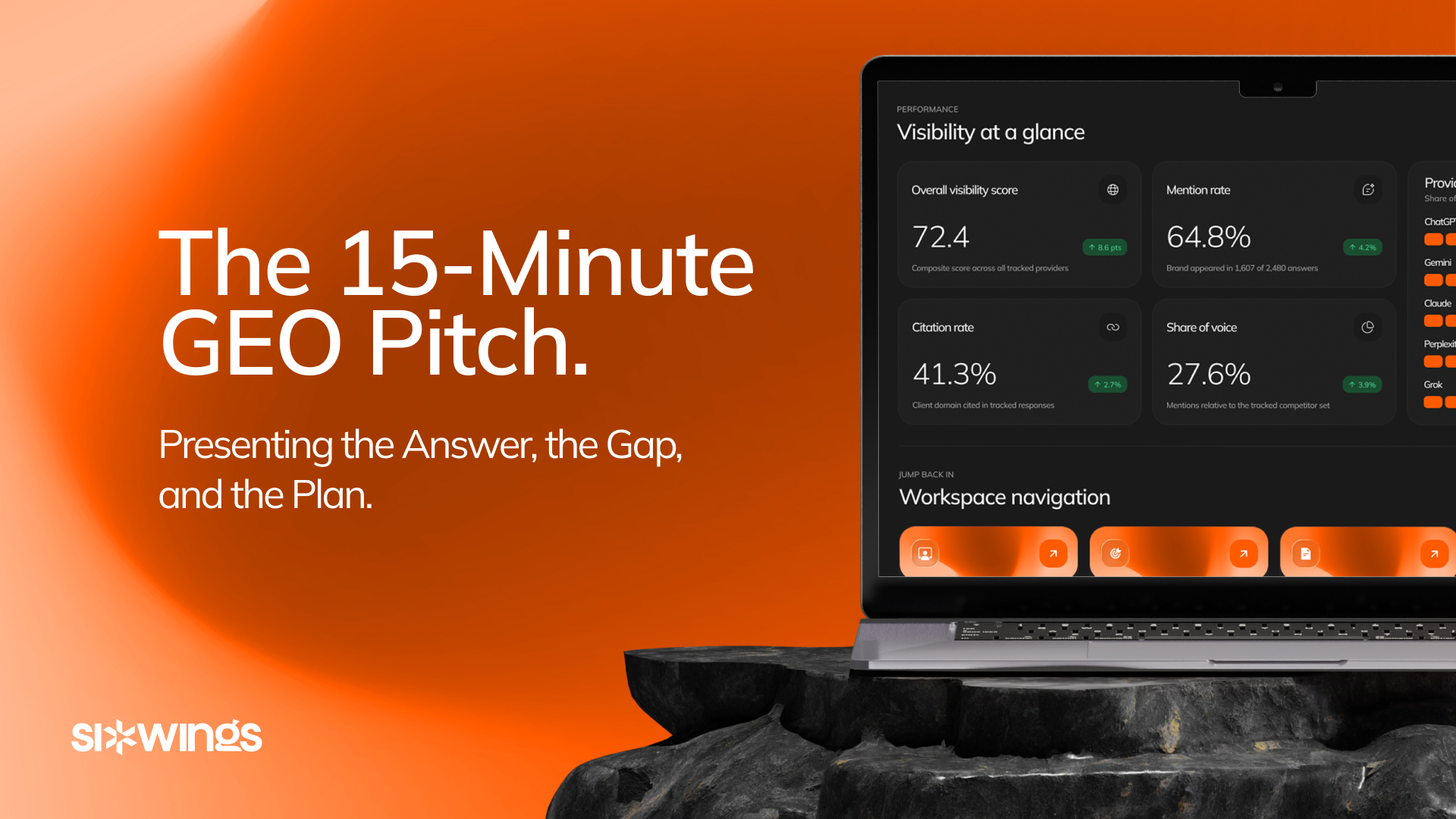
The bolt-on's idea of a GEO report is often a single screenshot: a visibility score, maybe a share-of-voice percentage, dropped into the monthly deck. It looks like measurement. It survives exactly one hard question. When a client's leadership asks "why did this move, and what are we doing about it," a lone number has no answer.
A real offer reports the layer underneath the number. It breaks presence down by provider and by the type of question a buyer asks, because a brand can be strong on one engine and weak on another, and strong on early-stage questions while losing the comparison ones.
It shows competitive standing against a named set of rivals. It shows the sources shaping the answers. And it ends in a prioritized recommendation rather than a chart.
There is also a discipline of method that a defensible report requires: the same questions, run the same way, over a meaningful sample, frozen as a point-in-time snapshot so that period-to-period comparisons are real rather than an artifact of a changed question set. A report without a stated, consistent method is measuring noise. A report with one is a decision document, and a decision document is what justifies a retainer.
5. Repeatability, not a one-off heroics project
The fifth test is whether the offer can be delivered again, reliably, across many clients, without being rebuilt from scratch each time.
This is where a lot of well-meaning GEO work quietly fails as a business. An agency runs an impressive one-off analysis for a flagship client, largely by hand, powered by a senior person's effort. It works once. Then it cannot be repeated at the same quality for the next ten clients, because the process lived in one person's head and one heroic week. That is a project, not a service line.
A real offer has a repeatable structure. The productized-service literature is consistent on the threshold: if nothing repeats across several engagements, the offer is still too custom to scale, and the delivery has to be documented so the same outcome ships on a predictable cadence for every client who buys it. Repeatability is what lets an agency add the fifth, tenth, and twentieth client without costs and quality swinging wildly with each one.
Repeatability also protects the client relationship in a way custom work does not. A defined, recurring deliverable gives the client a clear roadmap and a predictable rhythm, which reduces the friction and the "are we getting our money's worth" anxiety that quietly ends engagements. The agency that can only deliver GEO as a bespoke miracle cannot scale it, and cannot rely on it for retention.
6. A trust boundary, not a black box
The sixth test is whether the offer has clear, honest boundaries, or whether it hides behind vagueness and overclaiming.
AI work invites two failure modes.
The first is overclaiming: promising guaranteed rankings, guaranteed citations, or guaranteed inclusion in AI answers. Because the engines rebuild answers dynamically and rebalance constantly, those guarantees cannot be honored, and a client who was promised them will eventually notice.
The second is the black box: "trust us, the AI does it," with no visibility into what was changed or why.
A real offer sets honest boundaries. It is explicit that outcomes depend on real implementation work and that the engines are volatile. It keeps a human in the loop on consequential changes rather than auto-publishing whatever a model generates, because content lifts visibility only when it is accurate and on-brand.
And it grounds the work in the client's approved facts, claims, and the things the brand must never say, so the agency is not quietly creating compliance exposure in the client's name.
Honesty about limits is not a weakness in the pitch. It is a trust signal. Clients have been burned by tools that overclaim, and an offer that concedes what it cannot promise tends to be the one that understands the discipline well enough to be worth buying.
Why the bolt-on is a commercial risk, not just a weak pitch
It would be easy to treat all this as a matter of pitch quality. It is more than that. The bolt-on is a commercial risk with real downside.
Start with pricing power. GEO, done properly, is one of the few marketing services still commanding real margin, precisely because few agencies can deliver it well and clients do not yet have a fixed anchor for what it should cost. A bolt-on throws that advantage away. If your GEO is visibly just relabeled SEO, you get compared to relabeled SEO, and you lose the premium the real discipline earns.
Then there is retention, which is where the money actually is. Keeping a client is estimated to be many times cheaper than winning a new one, and retained clients become the case studies and referrals that lower everyone else's acquisition cost.
A bolt-on erodes retention from both ends: it fails to answer the client's second question, and it invites the comparison shopping that a defensible, well-reported offer avoids. Client churn is quiet. It shows up as a delayed reply and a skipped meeting long before a formal non-renewal, and a hollow GEO line gives a wavering client one more reason to drift.
Finally there is trust, the asset underneath all of it. The moment a client discovers that "we do GEO too" meant "we renamed a slide," the credibility of the rest of the relationship takes a hit. The claim that was supposed to make the agency look current instead makes it look like it was hoping nobody would check.
The through-line is simple. In a category this new, the agencies that win are not the ones that added the line fastest. They are the ones that can show a client where AI visibility is happening, where it is missing, what is shaping it, and what to do next. That is a better conversation than a traffic chart, and it is a far more defensible service.
Where SixWings fits
Turning "we do GEO too" into a real offer requires the method, evidence, deliverables, reporting, repeatability, and trust boundaries described above. Building all of that from scratch is a heavy lift. This is the gap SixWings was built to close.
SixWings pioneered a model for this kind of work, Answer Experience Design, and built the platform that runs it.
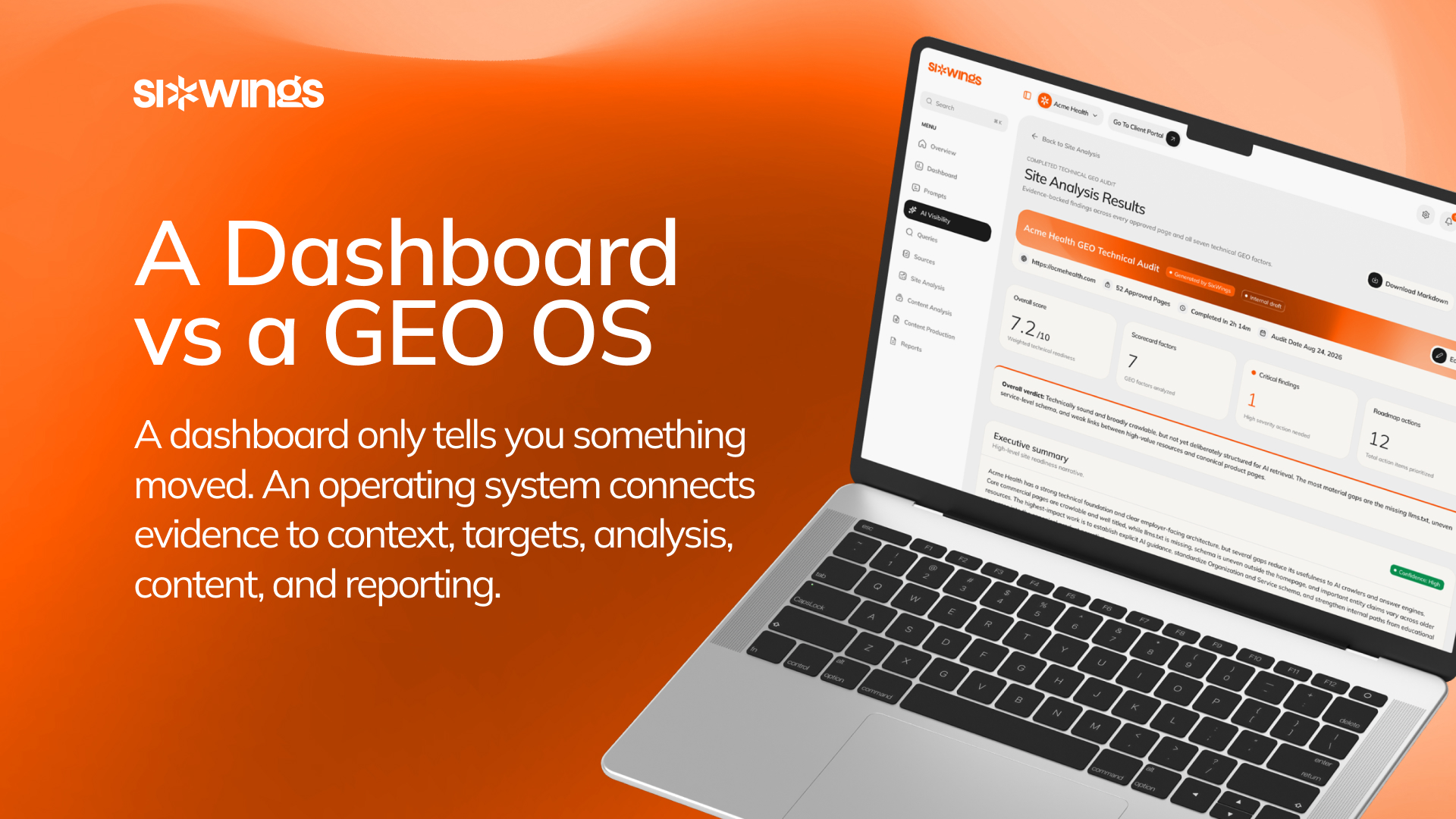
In plain terms, SixWings is a fully white-labelled GEO operating system. It measures how a brand shows up in AI answers, turns that raw data into prioritized recommendations and simple implementation briefs, and hands those to whoever executes, an in-house team or an external one, so the work is easy to act on. Think of it as an SEO toolkit, but for the AI-answer layer instead of Google rankings.
Mapped to the six tests in this article, that means:
- A method, not a rename. SixWings runs a defined sequence: start from the brand's facts, measure how AI engines represent it, prioritize what to change, do the work, and report the result. The steps connect, so there is an actual method to sell.
- Evidence, not adjectives. It keeps the evidence behind every answer across supported providers (currently OpenAI, Anthropic, Gemini, Perplexity, and Grok): whether the brand was mentioned, whether it was cited, which competitors appeared, and which pages the answer drew from.
- Defined deliverables. The picture of current visibility, the prioritized fixes, the content and technical changes, and the report are concrete artifacts, not "activity."
- Reporting that stands up. A reporting period freezes into a fixed, point-in-time snapshot, broken down by provider and question, with competitors and sources included.
- Repeatability. Each client gets its own workspace with defined roles, so the same service ships across many clients without being rebuilt each time.
- A trust boundary. Work is grounded in the client's approved facts and guardrails, and a person approves the final content before anything goes live.
Two more things make it an offer rather than a tool. SixWings does the prioritizing for you, surfacing the short list of questions, pages, and sources that matter most, which removes the decision fatigue and the hours normally lost to figuring it out. And results are shared through a custom-branded portal, so what reaches the client looks like the agency's own service, not a third party's dashboard.
The point is not that a platform makes an agency credible. It is that "we do GEO too" only becomes an offer when there is a method, evidence, and reporting behind it, and SixWings pioneered the model, and built the platform, to supply exactly that.
Frequently asked questions
Is adding a GEO page to our site really a problem? The page is fine. The problem is when the page is the whole thing. If "we do GEO too" is not backed by a distinct method, real evidence, defined deliverables, and defensible reporting, it sets a client expectation the agency cannot meet, which does more damage than not making the claim at all.
Isn't GEO just SEO with extra steps? No, though they are closely related and share foundations. GEO adds requirements SEO never had: understanding how AI models retrieve and select sources, why cross-platform corroboration matters, and how to measure a surface that does not appear in a rankings report. An offer that only relabels SEO is the bolt-on this article is about.
How can a client tell a real GEO offer from a relabeled one? Ask two questions. "How does your method work differently for an AI answer than for a Google ranking?" and "How will I know it worked?" A real offer answers the first with a specific method and the second with evidence and reporting. A bolt-on answers both with adjectives.
Do we need to build all of this ourselves to offer GEO? No. The method, evidence, and reporting can come from a platform built for it, delivered under your own brand. That is the difference between offering GEO and building GEO tooling, which are separate and very different investments.
Which AI engines should a real GEO offer cover? The major generative answer surfaces buyers use today, including ChatGPT, Google's AI Overviews and Gemini, Perplexity, and Claude. Because each behaves differently and pulls from different sources, a credible offer reports per provider rather than collapsing everything into one universal number.